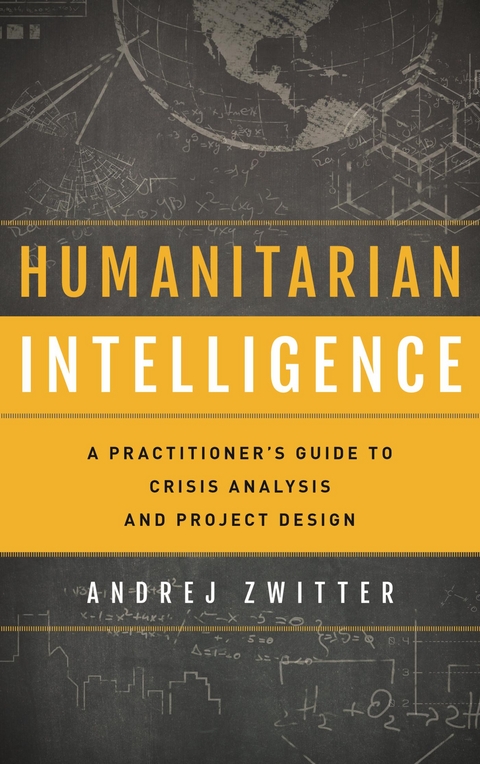
Humanitarian Intelligence (eBook)
248 Seiten
Rowman & Littlefield Publishers (Verlag)
9781442249493 (ISBN)
Humanitarian aid workers are faced with many challenges, from possible terrorist attacks to dealing with difficult stakeholders and securing operational space free from violence. To do their work properly and safely, they need effective intelligence. Humanitarian intelligence refers to the use of investigative and analytical techniques in service of rapid and continuous assessment, project and program development, impact evaluation, and learning. It focuses just as much on how to use early warning indicators to assess risks, evaluate trends, and write early warning analyses as it does provide guidance on the operational design of humanitarian relief efforts. Further, operational security depends on the intelligence analysis. Unlike governments, NGOs' resources are very limited. Humanitarian intelligence officers hardly have any literature detailing useful current standards and important tools for their analysis needs. Humanitarian Intelligence is the first to provide an overview and a practical guide to the tools and methods of data gathering and assessment, standards of measurement in humanitarian action, interpretation strategies, and operational planning tools. Short hypothetical cases and practical examples illustrate and explain the tools detailed in each chapter.Additional resources including case studies and teaching tools are available online at http://humanitarianintelligence.net .
Andrej Zwitter is professor of international relations and program coordinator of the Humanitarian Action Master’s Program specialization on Humanitarian Analysis and Intervention Design at the University of Groningen, the Netherlands.
AcknowledgmentsList of FiguresList of TablesList of Tools and Step-by-Step Guides IntroductionChapter 1. What is Humanitarian Intelligence?Chapter 2. Humanitarian Intelligence in the Project Cycle Management Chapter 3. Information Collection, Reliability and Probability Chapter 4. Understanding Complex Contexts Chapter 5. Humanitarian Analysis and Intervention Design Framework (H-AID): Comprehensive Chapter 6. Understanding Actors and their Impact Chapter 7. Social Network Analysis and Interpretation (SNA) Chapter 8. Humanitarian Analysis and Intervention Design Framework (H-AID): Trend Factors Analysis Chapter 9. Operational Planning and Forecasting Conclusion: Recapitulating the Humanitarian Intelligence CycleAppendices1. Sample LogFrame for a Rice Production Project 2. Context Dimensions Measurements and Indicators3. Context Dimensions and Human Rights Correspondence 4. H-AID Trend Calculation 5. Agency Needs Form for Office Opening 6. Planning Check-List for Office Closure Bibliography
| Erscheint lt. Verlag | 12.10.2016 |
|---|---|
| Reihe/Serie | Security and Professional Intelligence Education Series |
| Zusatzinfo | 95 Illustrations including: - 45 Black & White Illustrations; - 26 Tables; - 24 Text Boxes. |
| Sprache | englisch |
| Themenwelt | Sozialwissenschaften ► Pädagogik ► Sozialpädagogik |
| Sozialwissenschaften ► Politik / Verwaltung ► Europäische / Internationale Politik | |
| Sozialwissenschaften ► Politik / Verwaltung ► Staat / Verwaltung | |
| Sozialwissenschaften ► Soziologie | |
| Schlagworte | Human Rights • Intelligence & Espionage • Political Science |
| ISBN-13 | 9781442249493 / 9781442249493 |
| Informationen gemäß Produktsicherheitsverordnung (GPSR) | |
| Haben Sie eine Frage zum Produkt? |
 EPUB (Adobe DRM)
Kopierschutz: Adobe-DRM
Adobe-DRM ist ein Kopierschutz, der das eBook vor Mißbrauch schützen soll. Dabei wird das eBook bereits beim Download auf Ihre persönliche Adobe-ID autorisiert. Lesen können Sie das eBook dann nur auf den Geräten, welche ebenfalls auf Ihre Adobe-ID registriert sind.
Details zum Adobe-DRM
Dateiformat: EPUB (Electronic Publication)
EPUB ist ein offener Standard für eBooks und eignet sich besonders zur Darstellung von Belletristik und Sachbüchern. Der Fließtext wird dynamisch an die Display- und Schriftgröße angepasst. Auch für mobile Lesegeräte ist EPUB daher gut geeignet.
Systemvoraussetzungen:
PC/Mac: Mit einem PC oder Mac können Sie dieses eBook lesen. Sie benötigen eine
eReader: Dieses eBook kann mit (fast) allen eBook-Readern gelesen werden. Mit dem amazon-Kindle ist es aber nicht kompatibel.
Smartphone/Tablet: Egal ob Apple oder Android, dieses eBook können Sie lesen. Sie benötigen eine
Geräteliste und zusätzliche Hinweise
Buying eBooks from abroad
For tax law reasons we can sell eBooks just within Germany and Switzerland. Regrettably we cannot fulfill eBook-orders from other countries.
aus dem Bereich