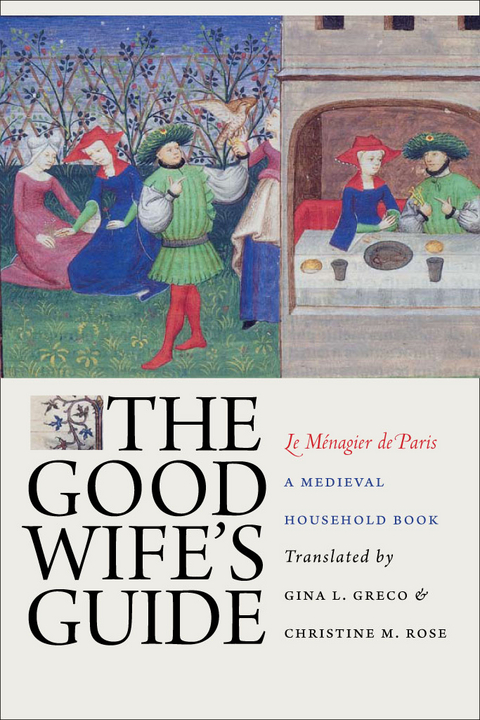
The Good Wife's Guide (Le Ménagier de Paris) (eBook)
384 Seiten
Cornell University Press (Verlag)
978-0-8014-6211-5 (ISBN)
"You said that you would not fail to improve yourself according to my teaching and correction, and you would do everything in your power to behave according to my wishes." [Prologue] "I urge you to bewitch and bewitch again your future husband, and...
In the closing years of the fourteenth century, an anonymous French writer compiled a book addressed to a fifteen-year-old bride, narrated in the voice of her husband, a wealthy, aging Parisian. The book was designed to teach this young wife the moral attributes, duties, and conduct befitting a woman of her station in society, in the almost certain event of her widowhood and subsequent remarriage. The work also provides a rich assembly of practical materials for the wife's use and for her household, including treatises on gardening and shopping, tips on choosing servants, directions on the medical care of horses and the training of hawks, plus menus for elaborate feasts, and more than 380 recipes.
The Good Wife's Guide is the first complete modern English translation of this important medieval text also known as Le Ménagier de Paris (the Parisian household book), a work long recognized for its unique insights into the domestic life of the bourgeoisie during the later Middle Ages. The Good Wife's Guide, expertly rendered into modern English by Gina L. Greco and Christine M. Rose, is accompanied by an informative critical introduction setting the work in its proper medieval context as a conduct manual. This edition presents the book in its entirety, as it must have existed for its earliest readers.
The Guide is now a treasure for the classroom, appealing to anyone studying medieval literature or history or considering the complex lives of medieval women. It illuminates the milieu and composition process of medieval authors and will in turn fascinate cooking or horticulture enthusiasts. The work illustrates how a (perhaps fictional) Parisian householder of the late fourteenth century might well have trained his wife so that her behavior could reflect honorably on him and enhance his reputation.
In the closing years of the fourteenth century, an anonymous French writer compiled a book addressed to a fifteen-year-old bride, narrated in the voice of her husband, a wealthy, aging Parisian. The book was designed to teach this young wife the moral attributes, duties, and conduct befitting a woman of her station in society, in the almost certain event of her widowhood and subsequent remarriage. The work also provides a rich assembly of practical materials for the wife's use and for her household, including treatises on gardening and shopping, tips on choosing servants, directions on the medical care of horses and the training of hawks, plus menus for elaborate feasts, and more than 380 recipes.
The Good Wife's Guide is the first complete modern English translation of this important medieval text also known as Le Ménagier de Paris (the Parisian household book), a work long recognized for its unique insights into the domestic life of the bourgeoisie during the later Middle Ages. The Good Wife's Guide, expertly rendered into modern English by Gina L. Greco and Christine M. Rose, is accompanied by an informative critical introduction setting the work in its proper medieval context as a conduct manual. This edition presents the book in its entirety, as it must have existed for its earliest readers.
The Guide is now a treasure for the classroom, appealing to anyone studying medieval literature or history or considering the complex lives of medieval women. It illuminates the milieu and composition process of medieval authors and will in turn fascinate cooking or horticulture enthusiasts. The work illustrates how a (perhaps fictional) Parisian householder of the late fourteenth century might well have trained his wife so that her behavior could reflect honorably on him and enhance his reputation.
Gina L. Greco is Associate Professor of French at Portland State University. Christine M. Rose is Professor of English at Portland State University.
Introduction. Maid to Order: The Good Wife of Paris
The Book: Backgrounds, Narrator, Genre, Sources
Contexts: Conduct Books and Household Books
Glossing the Tale of Griselda: The Model Wife and Marriage in Le Ménagier de Paris
Translation ProtocolsThe Good Wife's Guide: The English Text of Le Ménagier de Paris
Prologue
Introductory Note to Articles 1.1-1.3
Prayers and Orderly Dress (1.1)
Behavior and Attire in Public (1.2)
The Mass, Confession, the Vices and Virtues (1.3)
On Chastity (1.4)
Devotion to Your Husband (1.5)
Obedience (including the Story of Griselda) (1.6)
The Care of the Husband's Person (1.7)
The Husband's Secrets (1.8)
Introductory Note to Article 1.9
Providing Your Husband with Good Counsel (including the Story of Melibee) (1.9)
Introductory Note to Article 2.1
Le Chemin de povreté et de richesse (2.1)
Horticulture (2.2) 2
Choosing and Caring for Servants and Horses (2.3)
Introductory Note to Article 3.2
Hawking Treatise (3.2)
Menus (2.4)
Recipes (2.5)Glossary of Culinary Terms
Bibliography
Index
| Erscheint lt. Verlag | 15.9.2012 |
|---|---|
| Übersetzer | Gina L. Greco, Christine M. Rose |
| Verlagsort | Ithaca |
| Sprache | englisch |
| Maße | 160 x 160 mm |
| Themenwelt | Sachbuch/Ratgeber ► Geschichte / Politik ► Mittelalter |
| Geschichte ► Allgemeine Geschichte ► Mittelalter | |
| Geisteswissenschaften ► Geschichte ► Regional- / Ländergeschichte | |
| Geschichte ► Teilgebiete der Geschichte ► Kulturgeschichte | |
| Geisteswissenschaften ► Sprach- / Literaturwissenschaft ► Anglistik / Amerikanistik | |
| Geisteswissenschaften ► Sprach- / Literaturwissenschaft ► Literaturwissenschaft | |
| Sozialwissenschaften ► Soziologie ► Gender Studies | |
| Schlagworte | Byzantine Empire • Charlemagne • chivalry • Classical literature • conduct manual • french medieval households • gender in the middle ages • Gender Studies • guide to housekeeping • guide to managing a house • household manuals • house manager guide • Hundred Years' War • Joan of Arc • keeping house • medieval anthropology • medieval cultural history • Medieval culture • medieval customs • medieval Europe • medieval france • medieval gender relation • Medieval Gender roles • Medieval Gender Studies • Medieval History • medieval households • medieval housewives • Medieval Literary Criticism • medieval literary studies • Medieval Literature • medieval literature studies • medieval living • medieval morality • Medieval Paris • medieval reference • medieval scholars • Medieval Studies • Medieval text • medieval traditions • medieval wives • Medieval Women • medieval women roles • medieval women's studies • Middle Ages • Single Working Womens Day • woman of the house |
| ISBN-10 | 0-8014-6211-8 / 0801462118 |
| ISBN-13 | 978-0-8014-6211-5 / 9780801462115 |
| Informationen gemäß Produktsicherheitsverordnung (GPSR) | |
| Haben Sie eine Frage zum Produkt? |
 EPUB (Adobe DRM)
Kopierschutz: Adobe-DRM
Adobe-DRM ist ein Kopierschutz, der das eBook vor Mißbrauch schützen soll. Dabei wird das eBook bereits beim Download auf Ihre persönliche Adobe-ID autorisiert. Lesen können Sie das eBook dann nur auf den Geräten, welche ebenfalls auf Ihre Adobe-ID registriert sind.
Details zum Adobe-DRM
Dateiformat: EPUB (Electronic Publication)
EPUB ist ein offener Standard für eBooks und eignet sich besonders zur Darstellung von Belletristik und Sachbüchern. Der Fließtext wird dynamisch an die Display- und Schriftgröße angepasst. Auch für mobile Lesegeräte ist EPUB daher gut geeignet.
Systemvoraussetzungen:
PC/Mac: Mit einem PC oder Mac können Sie dieses eBook lesen. Sie benötigen eine
eReader: Dieses eBook kann mit (fast) allen eBook-Readern gelesen werden. Mit dem amazon-Kindle ist es aber nicht kompatibel.
Smartphone/Tablet: Egal ob Apple oder Android, dieses eBook können Sie lesen. Sie benötigen eine
Geräteliste und zusätzliche Hinweise
Buying eBooks from abroad
For tax law reasons we can sell eBooks just within Germany and Switzerland. Regrettably we cannot fulfill eBook-orders from other countries.
aus dem Bereich