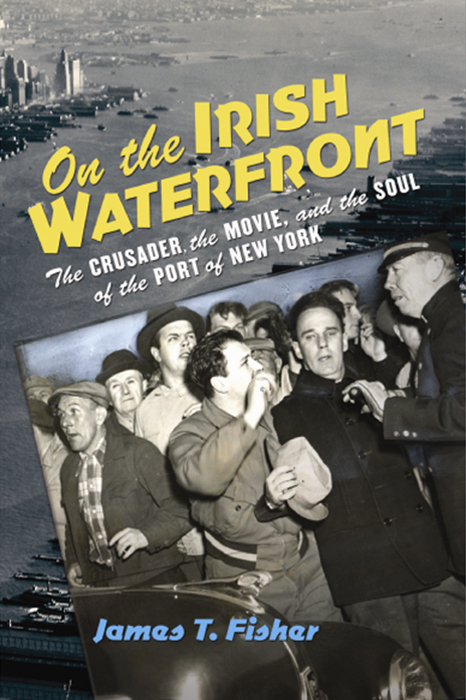
On the Irish Waterfront (eBook)
392 Seiten
Cornell University Press (Verlag)
978-0-8014-5734-0 (ISBN)
The real story of gangsters, politicians, longshoremen, union leaders, and Catholic priests that informed the classic 1954 film, On the Waterfront.
Site of the world's busiest and most lucrative harbor throughout the first half of the twentieth century, the Port of New York was also the historic preserve of Irish American gangsters, politicians, longshoremen's union leaders, and powerful Roman Catholic pastors. This is the demimonde depicted to stunning effect in Elia Kazan's On the Waterfront (1954) and into which James T. Fisher takes readers in this remarkable and engaging historical account of the classic film's backstory.
Fisher introduces readers to the real "Father Pete Barry" featured in On the Waterfront, John M. "Pete" Corridan, a crusading priest committed to winning union democracy and social justice for the port's dockworkers and their families. A Jesuit labor school instructor, not a parish priest, Corridan was on but not of Manhattan's West Side Irish waterfront. His ferocious advocacy was resisted by the very men he sought to rescue from the violence and criminality that rendered the port "a jungle, an outlaw frontier," in the words of investigative reporter Malcolm Johnson.
Driven off the waterfront, Corridan forged creative and spiritual alliances with men like Johnson and Budd Schulberg, the screenwriter who worked with Corridan for five years to turn Johnson's Pulitzer Prize-winning 1948 newspaper exposé into a movie. Fisher's detailed account of the waterfront priest's central role in the film's creation challenges standard views of the film as a post facto justification for Kazan and Schulberg's testimony as ex-communists before the House Committee on Un-American Activities.
On the Irish Waterfront is also a detailed social history of the New York/New Jersey waterfront, from the rise of Irish American entrepreneurs and political bosses during the World War I era to the mid-1950s, when the emergence of a revolutionary new mode of cargo-shipping signaled a radical reorganization of the port. This book explores the conflicts experienced and accommodations made by an insular Irish-Catholic community forced to adapt its economic, political, and religious lives to powerful forces of change both local and global in scope.
Site of the world's busiest and most lucrative harbor throughout the first half of the twentieth century, the Port of New York was also the historic preserve of Irish American gangsters, politicians, longshoremen's union leaders, and powerful Roman Catholic pastors. This is the demimonde depicted to stunning effect in Elia Kazan's On the Waterfront (1954) and into which James T. Fisher takes readers in this remarkable and engaging historical account of the classic film's backstory.
Fisher introduces readers to the real "Father Pete Barry" featured in On the Waterfront, John M. "Pete" Corridan, a crusading priest committed to winning union democracy and social justice for the port's dockworkers and their families. A Jesuit labor school instructor, not a parish priest, Corridan was on but not of Manhattan's West Side Irish waterfront. His ferocious advocacy was resisted by the very men he sought to rescue from the violence and criminality that rendered the port "a jungle, an outlaw frontier," in the words of investigative reporter Malcolm Johnson. Driven off the waterfront, Corridan forged creative and spiritual alliances with men like Johnson and Budd Schulberg, the screenwriter who worked with Corridan for five years to turn Johnson's Pulitzer Prize-winning 1948 newspaper exposé into a movie. Fisher's detailed account of the waterfront priest's central role in the film's creation challenges standard views of the film as a post facto justification for Kazan and Schulberg's testimony as ex-communists before the House Committee on Un-American Activities.
On the Irish Waterfront is also a detailed social history of the New York/New Jersey waterfront, from the rise of Irish American entrepreneurs and political bosses during the World War I era to the mid-1950s, when the emergence of a revolutionary new mode of cargo-shipping signaled a radical reorganization of the port. This book explores the conflicts experienced and accommodations made by an insular Irish-Catholic community forced to adapt its economic, political, and religious lives to powerful forces of change both local and global in scope.
James T. Fisher is Professor of Theology and American Studies, Fordham University. He is author of Communion of Immigrants: A History of Catholics in America, Dr. America: The Lives of Thomas A. Dooley, 1927–1961, and The Catholic Counterculture in America, 1933-1962. Visit James T. Fisher's blog at: irishwaterfront.wordpress.com.
Prologue: Pete Barry's Punch
Introduction: The Port’s Irish PlacesPart I. Boys of the Irish Waterfront
1. Chelsea’s King Joe
2. The Boss
3. Becoming Mr. Big
4. The Longshoreman’s GrandsonPart II. The Soul of the Port
5. A Labor Priest in the Catholic Metropolis
6. The Crusader
7. Covering the Waterfront
8. The Hollywood Prince
9. Meeting across the River
10. Priest and Worker
11. An Intimacy with ViolencePart III. Waterfront Apotheosis
12. A Season for Testimony
13. "The Hook"
14. Good Citizens
15. Saving the Picture
16. The Mile Square City’s Moment
17. The Priest in the Movie
18. "The Corruption Goes Deep"
19. The Poetry of SuccessEpilogue: Souls of the (Port) Apostolate
Acknowledgments
Notes
Index
| Erscheint lt. Verlag | 15.1.2011 |
|---|---|
| Reihe/Serie | Cushwa Center Studies of Catholicism in Twentieth-Century America | Cushwa Center Studies of Catholicism in Twentieth-Century America |
| Zusatzinfo | 12 halftones, 1 map |
| Verlagsort | Ithaca |
| Sprache | englisch |
| Maße | 160 x 160 mm |
| Themenwelt | Kunst / Musik / Theater ► Film / TV |
| Sachbuch/Ratgeber ► Geschichte / Politik ► Regional- / Landesgeschichte | |
| Sachbuch/Ratgeber ► Geschichte / Politik ► 20. Jahrhundert bis 1945 | |
| Geschichte ► Allgemeine Geschichte ► Neuzeit (bis 1918) | |
| Geisteswissenschaften ► Geschichte ► Regional- / Ländergeschichte | |
| Sozialwissenschaften ► Kommunikation / Medien ► Medienwissenschaft | |
| Wirtschaft ► Volkswirtschaftslehre ► Makroökonomie | |
| Schlagworte | 20th century Port of New York, On the Waterfront true story, John M. "Pete" Corridan real history, social justice on the Irish Waterfront, New York/New Jersey waterfront social history |
| ISBN-10 | 0-8014-5734-3 / 0801457343 |
| ISBN-13 | 978-0-8014-5734-0 / 9780801457340 |
| Informationen gemäß Produktsicherheitsverordnung (GPSR) | |
| Haben Sie eine Frage zum Produkt? |
 EPUB (Adobe DRM)
Kopierschutz: Adobe-DRM
Adobe-DRM ist ein Kopierschutz, der das eBook vor Mißbrauch schützen soll. Dabei wird das eBook bereits beim Download auf Ihre persönliche Adobe-ID autorisiert. Lesen können Sie das eBook dann nur auf den Geräten, welche ebenfalls auf Ihre Adobe-ID registriert sind.
Details zum Adobe-DRM
Dateiformat: EPUB (Electronic Publication)
EPUB ist ein offener Standard für eBooks und eignet sich besonders zur Darstellung von Belletristik und Sachbüchern. Der Fließtext wird dynamisch an die Display- und Schriftgröße angepasst. Auch für mobile Lesegeräte ist EPUB daher gut geeignet.
Systemvoraussetzungen:
PC/Mac: Mit einem PC oder Mac können Sie dieses eBook lesen. Sie benötigen eine
eReader: Dieses eBook kann mit (fast) allen eBook-Readern gelesen werden. Mit dem amazon-Kindle ist es aber nicht kompatibel.
Smartphone/Tablet: Egal ob Apple oder Android, dieses eBook können Sie lesen. Sie benötigen eine
Geräteliste und zusätzliche Hinweise
Buying eBooks from abroad
For tax law reasons we can sell eBooks just within Germany and Switzerland. Regrettably we cannot fulfill eBook-orders from other countries.
aus dem Bereich