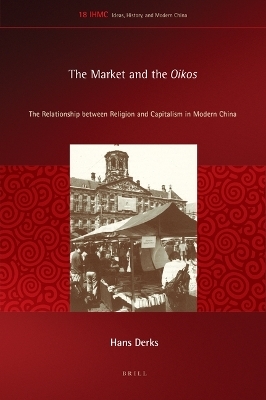
The Market and the Oikos
Brill (Verlag)
9789004383906 (ISBN)
Probably the most fundamental relationship in human history is that of the Market versus the Oikos (= the authoritarian ruled house, family, household or the State). Its main features and elements are analysed and newly defined as are its relations with town–country antagonisms or capitalism, nation, race, religion, and so on. Because it concerns a rather universal relationship, the definitions of the relevant elements are developed over time (from ancient Greeks to Nazi contexts) and place (in the West and the East, particularly China).
Max Weber is chosen as our “sparring partner,” starting with his popular analysis of the relationship of capitalism and religion in the West and of Chinese society in the East
Hans Derks (Doctor of Social Sciences since 1986) has taught at several Dutch and foreign universities as a historian and sociologist. He has published many articles in outstanding scholarly journals and about 20 books, like Jew, Nomad or Pariah … Hannah Arendt (Aksant, 2004) or the extensive History of the Opium Problem … 1600-1950 (Brill, 2012).
Preface
1 Introduction
2 A Mystery Explained
3 A Famous Debate
4 China
5 Plan of the Book
Acknowledgements
Abbreviations and Notes
Part 1: The Problem
1 Religion, Capitalism and the Rise of Double-Entry Bookkeeping
1.1Introduction
1.1.1 The C in the Relationship
1.1.1.1The Origin of Capitalism
1.1.1.2Market versus Oikos
1.1.1.3The Oikoïdal Economy
1.1.1.4“Rechenhaftigkeit”
1.1.2 Religion and the Rise of Double-Entry Bookkeeping
1.1.2.1The Revision
1.1.2.2Business Scruples and All the Rest
1.1.2.3The Catholicism Thesis
1.1.2.4Commenda and Common-law
1.1.2.5A Papal Revolution?
1.1.3 The Pasts and Future of deb
1.1.3.1The Future of the Present
1.1.3.2The Past of the Present
1.1.3.3The Theory of the Balance
1.1.3.4Political Geometry and Arithmetic
1.1.4 The Balance of a Theory
Part 2: Market and Oikos: Basics in the West
2 How to Bring Cows to Athens
2.1What is a Polis?
2.2An Astu for a Polis
2.3The Southern Greek “Cities”
2.4Astu versus Agros
3A Fascinating Oikos
3.1Introduction
3.2The Basic Concept House-Oikos
3.3An Oikos Controversy
3.4The “Whole House” of Otto Brunner
3.5TThe Devil and the Details
3.6The End of an Ideology?
4 Oikoïdal Qualities: Rasse,VolkandNation
4.1Introduction: Weber and Rasse
4.2“Jewish” Rasse Theories Now
4.3Some “Devastating” Comments in Advance
4.4The Future of the Past
4.5The Birth of German Anti-Semitism
4.6Ignaz Zollschan, 1877–1948
4.6.1 Rasse-theory
4.6.2 The Rasse Categories and Meanings
4.7Arthur Ruppin, 1876–1943
4.8Werner Sombart, 1863–1941
5 Market or Oikoïdal Religion: The Case of “Ancient Judaism”
5.1The Problem
5.2The Near Eastern Challenge
5.3The Many “Signs of Cain”
5.4Amalek, the Eternal Enemy
5.5The Pariah Complex
5.6The Crime and its “Tatort”
5.7Preliminary Conclusions
Part 3: Market and Oikos: Basics in the East
6 Settlers Between East and West
6.1Settlers’ Historical Sins
6.2Protestants
6.3Catholics
6.4The Heirs and Heiresses
6.5Profiles
7 On the Origin of Market Relations in (Asian) History
7.1Stock Farmers versus Peasants
7.2Weber’s Comparative World History
7.3Ideology
7.4Milk and Meat
7.5The Mutual Relationships
7.6The Rulers and Their Wars
7.7Imperial Oikoïdal Court Rules
7.8Market Behavior
7.9Ideological Historiography
7.10Nomads and Oikoïdal Collectivizations
7.11An Evaluation
8 Town and Country in Chinese History: An Overview
8.1Introduction
8.2The Pre-Industrial Phase
8.3The Roaring 19th Century
8.4The Start of Industrialization
8.5The Shanghai Westernization
8.6Town and Country in the Interbellum
8.7A Russian Lesson?
8.8The “New Democracy”
8.9Land Reform, 1950–1952
8.10City Reform, 1950–1955
8.11To the Present
Part 4: Toward a Market–Oikos Theory
9 Old Market-Oikos Theories
9.1An Old Debate about New Questions
9.2A “Mode of Despotism”?
9.3The European Ancestors
9.4The Wittfogel Debates
9.5From Post-War Modernization to Shock Therapy
10 A Sparring Partner for All Seasons
10.1Introduction
10.2Weber in the usa
10.3Weber in Europe
10.4Weber in China
11 Epilogue
11.1A Favorite Method
11.2The Theses
11.3The Follow-up
Bibliography
Index
| Erscheinungsdatum | 19.09.2018 |
|---|---|
| Reihe/Serie | Ideas, History, and Modern China ; 18 |
| Verlagsort | Leiden |
| Sprache | englisch |
| Maße | 155 x 235 mm |
| Gewicht | 835 g |
| Themenwelt | Geisteswissenschaften ► Geschichte |
| Geisteswissenschaften ► Religion / Theologie ► Judentum | |
| Sozialwissenschaften ► Soziologie | |
| ISBN-13 | 9789004383906 / 9789004383906 |
| Zustand | Neuware |
| Informationen gemäß Produktsicherheitsverordnung (GPSR) | |
| Haben Sie eine Frage zum Produkt? |
aus dem Bereich