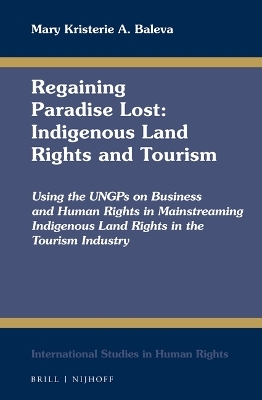
Regaining Paradise Lost: Indigenous Land Rights and Tourism
Martinus Nijhoff (Verlag)
9789004376779 (ISBN)
Mary Kristerie A. Baleva’s Regaining Paradise Lost: Indigenous Land Rights and Tourism uses the UN Guiding Principles on Business and Human Rights as its overarching legal framework to analyze the intersections of indigenous land rights and the tourism industry. Drawing from treatises, treaties, and case law, it traces the development of indigenous rights discourse from the Age of Discovery to the adoption of the UN Declaration on the Rights of Indigenous Peoples. The book highlights the Philippines, home to a rich diversity of indigenous peoples, and a country that considers tourism as an important contributor to economic development. It chronicles the Ati Community’s 15-year struggle for recognition of their ancestral domains in Boracay Island, the region’s premiere beach destination.
Mary Kristerie A. Baleva, Ph.D. (2017) is a human rights lawyer serving in the Philippines' Department of Environment and Natural Resources. She has published articles on business and human rights, and the proceedings at the Khmer Rouge Tribunal in Cambodia.
List of Illustrations
List of Cases
Acknowledgements
Terms, Abbreviations and Acronyms
Glossary of Terms
Introduction
1 Indigenous Peoples and International Law
§1 Historical Underpinnings
§2 Developments in International Law: An Overview
I Natural Law and the Law of Nations
II The Uncivilized Other
§3 The International Labour Organization
I The “Native Labour Code”
II The Integrationist Paradigm and Milestones in 1950s
III Ilo Convention Concerning the Protection and Integration of Indigenous and Other Tribal and Semi- Tribal Populations in Independent Countries
§4 The United Nations and the Human Rights Regime
§5 The Ilo’s Indigenous and Tribal Peoples Convention, 1989
I Shifts in the Paradigm
II Consultation and Participation
III Land and Indigenous Peoples
§6 The UN Declaration on the Rights of Indigenous Peoples
I Individual and Collective Rights
II Self-Determination
III Free, Prior, and Informed Consent
§7 Conclusion
2 Soft Law and Hard Realities: The UN Guiding Principles on Business and Human Rights
§1 Cautionary Tales
§2 Developments in the Business and Human Rights Discourse
§3 The United Nations “Protect, Respect and Remedy” Framework
I The Three Pillars of the UNGPs
II Principled Pragmatism
§4 Conclusion
3 Indigenous Filipinos: The Regalian Doctrine and Indigenous Rights Prior to the 1987 Constitution
§1 Pre-Colonial Philippines
§2 Introduction of the Regalian Doctrine
§3 The American Succession
I American Policies on Indigenous Filipinos
II Indigenous Peoples in Jurisprudence
§4 Land Policies During the Colonial Government and the Regalian Doctrine in the 1935 Constitution
§5 Iteration of the Regalian Doctrine in the 1973 Constitution
I The Marcos Regime’s Policy on Indigenous Peoples
II Ancestral Territories as Part of the Public Domain
§6 Conclusion
4 Indigenous Rights under the 1987 Constitution
§1 The Status of International Law in the 1987 Constitution and Philippine Jurisprudence
I The Philippines as a Dualist State
II Judicial Review
§2 Philippine Human Rights Law
I Human Rights in Jurisprudence
II The Philippine Commission on Human Rights: Bastion of Human Rights or Paper Tiger?
§3 Obligations under the International Bill of Human Rights and the Core Treaties
§4 The Current Iteration of the Regalian Doctrine
§5 Indigenous Rights Discourse under the 1987 Constitution
§6 Developments Prior to the Passage of the IPRA
I Pre-IPRA Government Agencies
II Indigenous Peoples in Autonomous Regions
III DENR Administrative Order No. 02, Series of 1993
§7 The Indigenous Peoples Rights Act of 1997
I Indigenous Peoples in the Philippines
II Legal Basis of the ipra and Its Governing Principles
§8 The IPRA’s Rights Protection Regime
I Rights to Ancestral Domains and Lands
II The Right to Social Justice and Human Rights
III Right to Self-Governance and Empowerment
IV Right to Cultural Integrity
V Right to Remedies
§9 The Right to FPIC in Tourism: the Experience of the Calamian Tagbanua of Coron Island, Palawan
§10 Conclusion
5 Tourism and Indigenous Land Rights
§1 Tourism’s Impacts on Indigenous Rights
§2 The UN World Tourism Organization
§3 The Global Code of Tourism Ethics
I The Gcet’s 10 Principles
II Analyzing the GCET
III The Framework Convention on Tourism Ethics and Its Optional Protocol
§4 Tourism in the Philippines
I The Tourism Act of 2009
II Tourism Governance
III Tourism Enterprise Zones
IV Grievance Mechanisms
V Incentives for Social Responsibility Initiatives
§5 Respecting Human Rights in the Tourism Industry
I Corporate Policy Commitment
II Human Rights Due Diligence in Tourism
III Dispute Resolution through the World Committee on Tourism Ethics
§6 Conclusion
6 The Ati Community of Boracay Island
§1 Boracay: Profile of an Island Paradise
§2 Remembering The Ati’s Boracay
I Boracay before Mass Tourism
II The First Boracaynon
III The Contemporary Ati Community
§3 Tourism on the Rise
I Boracay as a Tourist Zone
II Tourism Governance in Boracay
§4 Displacement and Resettlement
I Relocation to Bolabog
II Charity-Based Approach to Displacement
§5 The Political Alternative: an Ati Reservation via Presidential Proclamation
§6 Presidential Proclamation No. 1064
§7 The Ati as Rights-Holders: The CADT Application Process
I Consultation and Data Gathering (2001 to 2006)
II The NCIP Bureaucracy
III The “Ati Problem”
IV Delay in the Delineation of the Ati’s Ancestral Domains
§8 The Ati and Their Ancestral Domains
I Issuance of the CADT
II Occupation through “Self-Installation”
§9 Death in the Community
§10 Conclusion
I Obstacles to the Implementation of the IPRA
II Human-Rights Based Approach vis-à-vis Altruism and Charity
III Justice for Dexter
IV Basis of the NCIP En Banc’s 19 April 2012 Decision on the Case for Injunction
V Tourism and the Ati of Boracay
Conclusion
Bibliography
Index
| Erscheinungsdatum | 26.11.2018 |
|---|---|
| Reihe/Serie | International Studies in Human Rights ; 126 |
| Sprache | englisch |
| Maße | 155 x 235 mm |
| Gewicht | 674 g |
| Themenwelt | Recht / Steuern ► EU / Internationales Recht |
| Recht / Steuern ► Öffentliches Recht ► Völkerrecht | |
| Sozialwissenschaften ► Ethnologie | |
| Sozialwissenschaften ► Politik / Verwaltung | |
| Sozialwissenschaften ► Soziologie | |
| ISBN-13 | 9789004376779 / 9789004376779 |
| Zustand | Neuware |
| Informationen gemäß Produktsicherheitsverordnung (GPSR) | |
| Haben Sie eine Frage zum Produkt? |
aus dem Bereich