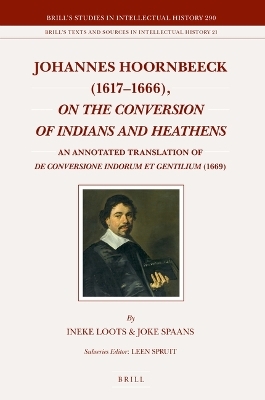
Johannes Hoornbeeck (1617-1666), On the Conversion of Indians and Heathens
Brill (Verlag)
978-90-04-25544-9 (ISBN)
Exploration, trade and conquest expanded and upset traditional worldviews of early modern Europeans. Christians saw themselves confronted with a largely heathen world. In the wake of Iberian colonization, Jesuits successfully christianized heathen populations overseas.
In his De conversione Indorum et gentilium, Johannes Hoornbeeck presents a systematic overview of every aspect of the missionary imperative from a Reformed Protestant perspective. The most attractive part of his book may be the global survey it offers of the various types of heathens, an early example of comparative religion. Of equal interest, however, is his critical approach to mission.
Hoornbeeck rejects ecclesiastical hierarchy and top-down imposition of Christianity. In this he is perfectly orthodox, and at the same time startlingly original and a harbinger of modern missions. His practical recommendations offer a flexible framework for missionaries, to fit a wide variety of circumstances.
Ineke Loots, Ph.D (VU University, Amsterdam, 1985), after a career in child psychology, turned to Neo-Latin and seventeenth-century intellectual history. She now publishes on topics ranging from early modern ethnography to early modern views on emotion. Joke Spaans, Ph.D. 1989, Leiden University, is Associate Professor in the History of Christianity at Utrecht University. She has published extensively on early modern Dutch religious history.
Acknowledgements
Figures
Introduction
To the Reader (by Hoornbeeck)
First Book about the Conversion of the Indians and Heathens
Book I, Chapter 1, Reason for the work and its division into parts
Book I, Chapter 2, About both of the indies, their first discovery and the Dutch Indian Company
Book I, Chapter 3, Heathenism (Gentilismus). About its name and that of the pagans. What is heathenism? The origin of idol-worship
Book I, Chapter 4, The heathenism of the ancients. First that of the Chaldeans and the Sabaeans. Many of the laws of Moses can be explained from rites that are their opposite. From these derive also the names of the days, named after the planets, and the first idol-worship of the stars. The idol-worship of the Egyptians. The progress of the idols, from the stars to the things under the heavens, finally to people and animals. The Greeks and Romans. Finally, the Germans
Book I, Chapter 5, The present heathenism of Africans and Asians. Former and present Brahmans of the Indians. The people of Gujarat. The religion of the people in the kingdom of the Deccan, in Malabar, Narsinga, Ceylon, Pegu, Etc.
Book I, Chapter 6, The Chinese, Formosans, and Koreans
Book I, Chapter 7, The Japanese
Book I, Chapter 8, The Tatars
Book I, Chapter 9, The American Lapps, first about their land, then about their religion
Second Book about the Conversion of the Indians and Heathens
Book II, Chapter 1, The Greek and Roman Church Fathers who wrote against the heathens
Book II, Chapter 2, More recent and modern authors of works against the heathens
Book II, Chapter 3, The Sibylline Books, their author and the Poemander of Hermes Trismegistus
Book II, Chapter 4, About God, that he exists, that he is One and also how and who he is
Book II, Chapter 5, The world, how it was created and how it is governed
Book II, Chapter 6, About man, immortality and the state of the soul after death, and the resurrection of the dead
Book II, Chapter 7, The sins of the Indians and heathens with respect to the worship of God
Book II, Chapter 8, The sins of the Indians and heathens against a decent way of life, in particular against the sixth and seventh commandments
Book II, Chapter 9, How to convince people of the Christian religion and, in particular, of the divinity of the Scripture
Book II, Chapter 10, The authority of Christ and the apostles and the truth of the Christian religion
Book II, Chapter 11, Where it is taught that the conversion of the heathens also pertains to us
Book II, Chapter 12, How to convert the heathens and what is to be taken care of and performed by churches, universities and politicians
Book II, Chapter 13, Where it is shown what kind of clergymen should be sent
Book II, Chapter 14, Where we show the manner and the means to be used by ministers to advance the work of conversion, negative and positive examples
Book II, Chapter 15 and last, where the example of the conversion of the Indians and heathens in America by the Reformed and pious Englishmen is presented for imitation
Disputations in Johannes Hoornbeeck, De Conversione Indorum et gentilium, disquisitiones institutae in Academiae Lugduno-Batava, Leiden, Elzevier, 1664
Bibliography
Index
| Erscheinungsdatum | 02.11.2018 |
|---|---|
| Reihe/Serie | Brill's Texts and Sources in Intellectual History ; 290/21 |
| Verlagsort | Leiden |
| Sprache | englisch |
| Maße | 155 x 235 mm |
| Gewicht | 842 g |
| Themenwelt | Geisteswissenschaften ► Geschichte ► Regional- / Ländergeschichte |
| Religion / Theologie ► Christentum ► Kirchengeschichte | |
| Sozialwissenschaften | |
| ISBN-10 | 90-04-25544-3 / 9004255443 |
| ISBN-13 | 978-90-04-25544-9 / 9789004255449 |
| Zustand | Neuware |
| Informationen gemäß Produktsicherheitsverordnung (GPSR) | |
| Haben Sie eine Frage zum Produkt? |
aus dem Bereich