


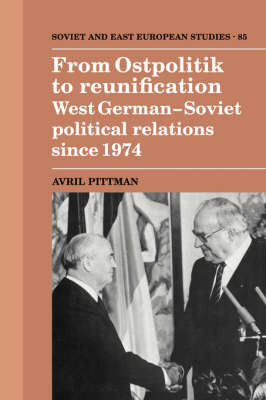
From Ostpolitik to Reunification
West German-Soviet Political Relations since 1974
Seiten
1992
Cambridge University Press (Verlag)
978-0-521-40166-1 (ISBN)
Cambridge University Press (Verlag)
978-0-521-40166-1 (ISBN)
Dr Avril Pittman outlines the main events after the Second World War and then focuses on four issues central to this relationship in the 1970s and early 1980s. She explores family reunification and emigration rights for ethnic Germans living in the Soviet Union.
With the signing of the Moscow Treaty in 1970, West German-Soviet relations came to the forefront of world politics. Two decades later, the historic opening of the Berlin Wall and German reunification once again focused world attention on the Federal Republic's relations with the USSR. This book explores the development of this relationship from the perspective of West Germany. Dr Avril Pittman outlines the main events after the Second World War and then focuses on four issues central to this relationship in the 1970s and early 1980s. She explores family reunification and emigration rights for ethnic Germans living in the Soviet Union; the central role of Berlin and the reasons why the city persisted as a serious bilateral problem; the triangular relations between West Germany, the Soviet Union and East Germany; and the significance of the Soviet intervention in Afghanistan which led to a sharp deterioration in East-West relations.
With the signing of the Moscow Treaty in 1970, West German-Soviet relations came to the forefront of world politics. Two decades later, the historic opening of the Berlin Wall and German reunification once again focused world attention on the Federal Republic's relations with the USSR. This book explores the development of this relationship from the perspective of West Germany. Dr Avril Pittman outlines the main events after the Second World War and then focuses on four issues central to this relationship in the 1970s and early 1980s. She explores family reunification and emigration rights for ethnic Germans living in the Soviet Union; the central role of Berlin and the reasons why the city persisted as a serious bilateral problem; the triangular relations between West Germany, the Soviet Union and East Germany; and the significance of the Soviet intervention in Afghanistan which led to a sharp deterioration in East-West relations.
List of tables; Preface; Note on text; Chronology; Introduction; 1. The Second World War and its aftermath, 1945–1974; 2. Ethnic Germans; 3. Berlin; 4. The Federal Republic of Germany's relations with the German Democratic Republic; 5. INF, Afghanistan and the post-Afghanistan period; 6. Assessment of the Federal Republic of Germany's relations with the Soviet Union, 1974–1982; 7. The Federal Republic of Germany's political relations with the Soviet Union after 1982; Appendices; Notes; Bibliography; Index.
| Erscheint lt. Verlag | 30.7.1992 |
|---|---|
| Reihe/Serie | Cambridge Russian, Soviet and Post-Soviet Studies |
| Verlagsort | Cambridge |
| Sprache | englisch |
| Maße | 159 x 239 mm |
| Gewicht | 461 g |
| Themenwelt | Geschichte ► Allgemeine Geschichte ► Neuzeit (bis 1918) |
| Geschichte ► Allgemeine Geschichte ► Zeitgeschichte | |
| Geisteswissenschaften ► Geschichte ► Regional- / Ländergeschichte | |
| Sozialwissenschaften ► Politik / Verwaltung ► Europäische / Internationale Politik | |
| ISBN-10 | 0-521-40166-6 / 0521401666 |
| ISBN-13 | 978-0-521-40166-1 / 9780521401661 |
| Zustand | Neuware |
| Informationen gemäß Produktsicherheitsverordnung (GPSR) | |
| Haben Sie eine Frage zum Produkt? |
Mehr entdecken
aus dem Bereich
aus dem Bereich
Geschichte einer wilden Handlung
Buch | Hardcover (2024)
C.H.Beck (Verlag)
CHF 47,60


