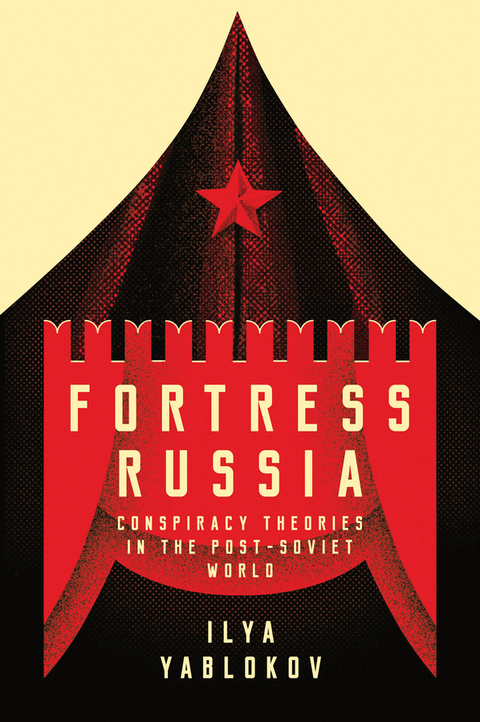
Fortress Russia (eBook)
John Wiley & Sons (Verlag)
978-1-5095-2269-9 (ISBN)
This book is the first-ever study of Russian conspiracy theories in the post-Soviet period. It examines why these conspiracy theories have emerged and gained currency in Russia and what role intellectuals have played in this process. The book shows how, in the new millennium, the image of the 'dangerous, conspiring West' provides national unity and has helped legitimize Russia's rapid turn to authoritarianism under Vladimir Putin.
Ilya Yablokov is a Teaching Fellow in Russian Studies at the University of Leeds.
Allegations of Russian conspiracies meddling in the affairs of Western countries have been a persistent feature of Western politics since the Cold War allegations of Russian interference in the US presidential election are only the most recent in a long series of conspiracy allegations that mark the history of the twentieth century. But Russian politics is rife with conspiracies about the West too. Everything bad that happens in Russia is traced back by some to an anti-Russian plot that is hatched in the West. Even the collapse of the Soviet Union this crucial turning point in world politics that left the USA as the only remaining superpower was, according to some Russian conspiracy theorists, planned and executed by Russia s enemies in the West. This book is the first-ever study of Russian conspiracy theories in the post-Soviet period. It examines why these conspiracy theories have emerged and gained currency in Russia and what role intellectuals have played in this process. The book shows how, in the new millennium, the image of the dangerous, conspiring West provides national unity and has helped legitimize Russia s rapid turn to authoritarianism under Vladimir Putin.
Ilya Yablokov is a Teaching Fellow in Russian Studies at the University of Leeds.
* Contents
* Introduction
* Chapter 1: Building 'Fortress Russia'
* Chapter 2: The Spectres of conspiracy mythmaking
* Chapter 3: In Search of the 'agents of perestroika'
* Chapter 4: Sovereign democracy and its enemies
* Chapter 5: Battling against 'foreign agents'
* Chapter 6: Shadows of the colour revolution
* Chapter 7: The War has begun
* Conclusion
'Fortress Russia is essential reading for anyone in the USA and Western Europe who wants a greater understanding of how Russia views the world. Yablokov provides key insights into the popular politics within Putin's Russia, much of it framed by conspiracy theories, at a time of rising populism and fearful nationalism around the world and much of which is keyed to conspiracies surrounding Putin himself. The book helps to reveal the dangerous hall of mirrors in which we live.'
Mark Fenster, author of Conspiracy Theories: Secrecy and Power in American Culture and The Transparency Fix.
'Ilya Yablokov takes us on a journey through the myriad conspiracy theories that flourish in post-Soviet political culture. The notion of a "subversive agency" is indeed a critical explanatory element for Russian society that gives sense to the profound and violent changes of the last three decades and has been opportunely instrumentalized by the Russian authorities to consolidate their legitimacy. Fortress Russia is a must-read for all those who wish to understand contemporary Russia and its perception of the world.'
Marlene Laruelle, The George Washington University
"Fortress Russia offers important insight into the origins, functions, and nature of Russian conspiracy theories, emphasizing continuities in their development since the Imperial period. It is sure to be a useful resource in a wide variety of subfields within Russian and East European Studies, while also offering generalizable insights that expand its relevance to historians, political scientists, and scholars of global cultural history."
The Russian Review
'Yablokov offers a convincing model of the function of conspiracy in post-Soviet Russia.'
East-West Review
"I certainly recommend Fortress Russia, particularly because of its contribution to the study of the toxic love affair between populist politics and conspiracy theories in authoritarian contexts... In a year that has catapulted QAnon to the very top of the trash can of history, the value of Yablokov's book has risen even more."
Eurasian Geography and Economics
Introduction
The attempted coup in August 1991, and the collapse of the Soviet Union in December of that year, produced a sense of bewilderment in Russians, from top-ranking politicians down to ordinary Russians. One explanation crops up again and again: conspiracy. Understood as a malevolent plot underlying historical and current events, the conspiracy theory has become a popular tool for interpreting the social and political realities of post-Soviet Russia. Its essential element – that there is an omnipotent secret group of people plotting to increase their own power at the expense of ordinary people – is espoused by people in all walks of Russian life.
In the post-Soviet period, the West, which is very often seen by Russians as a single entity, has emerged as an essential protagonist in conspiracy discourse. However, in 2016 and 2017 the West began engaging in its own conspiracy theories. The spirit of the Cold War and the witch-hunt for Russian agents both made a comeback. Today, the Kremlin is portrayed as the global puppet master who has successfully managed to appoint a loyal man to deal with the White House. ‘Russiagate’ and the media hype which surrounds it – that is, the Kremlin’s alleged meddling in the US elections, and its attempts to influence elections in the UK and France – revived the old fear of Russian spies. Hysteria about the Russians became a central element of the US domestic political agenda, and an almost mythologized Russia became the source of many of the troubles plaguing the American people (Beauchamp, 2017). Russian hackers were found to be behind the worst cyberattacks (Calabresi, 2017); indeed, who but Russians could cause such havoc? Foreign intelligence officers shared with journalists, albeit anonymously, the claim that Trump’s aides had contacts with Kremlin envoys (Schmidt et al., 2017), and that experienced villain Vladimir Putin was sending killers to neutralize all witnesses who could testify about Russian plots against the West (Bearak, 2017; Blake et al., 2017). Russian politicians and journalists loyal to the state have tried to convince the public that Russia’s very existence is dependent on Putin. The wave of Western conspiracy theories about Russia’s intrusion into US and European politics, in turn, made Russian politicians proud of ‘hacking the States’ (Cohen, 2017). The fears of Americans thus nurtured the feelings Russians had of being superior to their geopolitical enemy, and encouraged them to believe that they had, indeed, conspired to hack America.
Conspiracy theories have always been a fundamental element of popular culture and political thinking in America, prompting some scholars to define the country as an ‘empire of conspiracy’ (Melley, 2000). In this respect, despite their socio-economic and political differences, the USA and Russia have much in common. Russian history over the last few centuries has been filled with fears of conspiracy: Jews, Freemasons and Catholics have been considered major enemies (Davis, 1971; Bagdasarian, 1999). Furthermore, as in the USA, the messianic idea of the ‘City upon the Hill’ (Goldberg, 2001) and Moscow as the Third Rome (Duncan, 2005) provided fertile soil for suspicion and fear of others who wanted to prevent it from fulfilling its global mission. Yet, there is one major difference between these two cases. In the USA, conspiracy theories normally emerge from grassroots movements and are kept at the margins of official political discourse. In post-Soviet Russia the political and intellectual elites are major producers and disseminators of conspiracy theories. The top-down spread of these theories in Russia is reminiscent of countries in the Middle East, where the state is a ‘conspiracist narrator’ (Gray, 2010). As Gray shows, these theories provide the legitimization of political regimes and social cohesion in the face of mounting social and political challenges and the declining popularity of political leaders. What is special about the Russian case is that these ideas were initially employed to increase the popularity of the country’s leaders at a time of economic growth.
Years before the annexation of Crimea, and Russian accusations that the USA was out to destroy the Russian economy by means of economic sanctions, Mikhail Iur’ev, a businessman and member of parliament, published an article entitled ‘Fortress Russia: The Concept for the President’ (Iur’ev, 2004). He praised Russia’s radical economic and cultural isolation from the rest of the world, particularly the West; indeed, he called for complete severance of all ties with the West. He also argued that openness to the world would result in the destruction of the nation. This publication became iconic: from 2004, anti-Western conspiracy theories calling for isolation from the West began to infiltrate Russia’s public domain, and by 2017 had become an integral part of public debates, television programmes and state legislation. A careful analysis of the ideas proposed by Iur’ev in the book-length study (Leont’ev et al., 2005), reveals that this isolationist ideology contains elements both of traditional anti-Westernism in Imperial Russia, and Soviet Cold War narratives that criticized the Russias’ major rival, the USA. The crux of these ideas is the notion that ordinary Russians must unite with the authorities to deal with conspiracies on the part of the West, and that this unity will eventually turn Russia into a great world power. The Kremlin is not ready to cut all ties with the West at present. On the contrary, many Russian businessmen who keep loyalty to the Kremlin, prefer to keep their savings and invest money in assets in Europe and the USA (Maxwell, 2015; Cowdock, 2017). However, when fear of losing power begins to increase, political elites unhesitatingly attempt to turn Russia into a bastion of anti-Westernism.
Just as in the United States, conspiracy theories have long been a feature of Russian political discourse. This book will demonstrate that by the mid 2010s, the Russian political authorities, with the help of the media and public intellectuals (writers, journalists, media personalities, political scientists, spin doctors and those pseudoacademics who produce and disseminate conspiracy theories), had found a way of transforming these theories into an essential element of official political discourse that strengthened their legitimacy and helped keep society under control. In recent years we have learnt from Vladimir Putin that the Internet is an invention of the CIA and therefore part of the anti-Russian conspiracy (MacAskill, 2014); from Putin’s economic adviser, Sergei Glaz’ev, that the Russian government has been infiltrated by foreign agents that undermine its economic stability in the face of sanctions (Adrianova, 2016); and from first deputy prime minister, Arkadii Dvorkovich, that the price of oil is in decline because foreign plotters are trying to destroy oil-rich Russia (Kuvakin, 2015).
In simple terms, this study investigates the reasons why Russian politicians are so keen on conspiracy theories and explores how these ideas help Russian leaders to exercise power through anti-Western conspiratorial rhetoric. As this rhetoric is aimed primarily at the domestic audience, the book will explore how conspiracy theories become the means of achieving popular mobilization, nation-building and community cohesion.1 What role do public intellectuals play in developing and disseminating anti-Western conspiracy theories? What are the key events in Soviet and post-Soviet history that have generated the notion of anti-Western conspiracy? How do the political and intellectual elites of post-Soviet Russia use concepts which emerged in the Imperial and Soviet periods to produce and disseminate conspiracy theories? How do conspiracy theories enable political elites to reinforce their power? What is the impact of conspiracy theories on electoral campaigns? What role did anti-Western conspiracy theories play in framing the Ukraine crisis of 2014–16, and how were they used to help shape the unfolding crisis? These are some of the questions that this book tries to answer.
Because of the growing impact of conspiracy theories on Russian society today, I will focus on the post-Soviet period. The emergence of democratic and market institutions in Russia after the collapse of the USSR transformed society and opened the way for democratization. However, the rise of authoritarian trends has gradually undermined existing democratic institutions in the country, and this has led to doubts about how successful the Russian state’s transition from state socialism to democracy has been. Russia does still demonstrate many elements of a democratic state, but these have acquired a specific form, leading to a ‘hybrid regime’. Conspiracy theories play a crucial role in Russia’s turn to authoritarianism and have served as a trigger for numerous public campaigns to justify repressive legislation. Yet these ideas are also often marginalized and perceived as eccentric and paranoid and therefore their study lacks academic depth and rigour. This book aims to demarginalize conspiracy theories and approach them as an integral part of the political process. To do so, it will examine the extent to which models for studying conspiracy theories developed in Western democracies can be applied to a non-Western transitional regime.
Conceptual Framework
The topic of conspiracy theories is gradually gaining popularity in the field of Russian,...
| Erscheint lt. Verlag | 30.8.2018 |
|---|---|
| Sprache | englisch |
| Themenwelt | Sozialwissenschaften ► Politik / Verwaltung |
| Sozialwissenschaften ► Soziologie ► Spezielle Soziologien | |
| Schlagworte | European politics • Political Science • Political Sociology • Politics & the Media • Politik • Politik / Europa • Politik u. Medien • Politikwissenschaft • Politische Soziologie • Russian politics, Russian society, conspiracy theories, post-Soviet Russia, Vladimir Putin • Russland • Sociology • Soziologie |
| ISBN-10 | 1-5095-2269-7 / 1509522697 |
| ISBN-13 | 978-1-5095-2269-9 / 9781509522699 |
| Informationen gemäß Produktsicherheitsverordnung (GPSR) | |
| Haben Sie eine Frage zum Produkt? |
 EPUB (Adobe DRM)
Kopierschutz: Adobe-DRM
Adobe-DRM ist ein Kopierschutz, der das eBook vor Mißbrauch schützen soll. Dabei wird das eBook bereits beim Download auf Ihre persönliche Adobe-ID autorisiert. Lesen können Sie das eBook dann nur auf den Geräten, welche ebenfalls auf Ihre Adobe-ID registriert sind.
Details zum Adobe-DRM
Dateiformat: EPUB (Electronic Publication)
EPUB ist ein offener Standard für eBooks und eignet sich besonders zur Darstellung von Belletristik und Sachbüchern. Der Fließtext wird dynamisch an die Display- und Schriftgröße angepasst. Auch für mobile Lesegeräte ist EPUB daher gut geeignet.
Systemvoraussetzungen:
PC/Mac: Mit einem PC oder Mac können Sie dieses eBook lesen. Sie benötigen eine
eReader: Dieses eBook kann mit (fast) allen eBook-Readern gelesen werden. Mit dem amazon-Kindle ist es aber nicht kompatibel.
Smartphone/Tablet: Egal ob Apple oder Android, dieses eBook können Sie lesen. Sie benötigen eine
Geräteliste und zusätzliche Hinweise
Buying eBooks from abroad
For tax law reasons we can sell eBooks just within Germany and Switzerland. Regrettably we cannot fulfill eBook-orders from other countries.
aus dem Bereich