


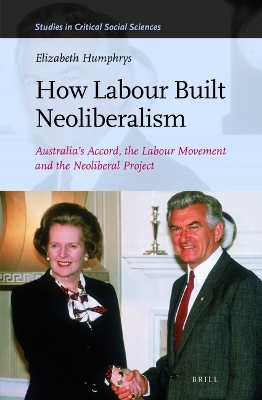
How Labour Built Neoliberalism
Brill (Verlag)
978-90-04-34900-1 (ISBN)
Why do we always assume it was the New Right that was at the centre of constructing neoliberalism? How might corporatism have advanced neoliberalism? And, more controversially, were the trade unions only victims of neoliberal change, or did they play a more contradictory role? In How Labour Built Neoliberalism, Elizabeth Humphrys examines the role of the Labor Party and trade unions in constructing neoliberalism in Australia, and the implications of this for understanding neoliberalism’s global advance. These questions are central to understanding the present condition of the labour movement and its prospects for the future.
Elizabeth Humphrys is a political economist at the University of Technology Sydney. She has published on trade union and social movement responses to crisis, including in Globalizations and Critical Sociology. She completed her Ph.D. (2016) at the University of Sydney.
Acknowledgements
List of Illustrations
List of Abbreviations
1 Introduction
1The ALP & ACTU Accord
2The Social Contract’s Gala Dinner
3Neoliberalism’s Corporatist Origins
4A Hegemonic Political Project
5Corporatist ‘involucro’
6A Note on Method
7Structure of the Book
2 Theorising the State–Civil Society Relationship
1Introduction
1.1Some Preliminary Comments
2Marx’s Critique of Hegel
3From Critique of Politics to Critique of Political Economy
4From Marx to Gramsci
4.1Lo stato integrale
5Gramsci contra Marx? The Limits of Integration
6Conclusion
3 Corporatism in Australia
1Introduction
2Understanding Corporatism
3Panitch’s Approach
4Corporatism and the Accord
5The Context of Arbitration
6Conclusion
4 Destabilising the Dominant Narrative
1Introduction
1.1Conceptual Diversity
2The Dominant Narrative
2.1Harvey: A Brief History of Neoliberalism
2.2Klein: The Shock Doctrine
2.3Peck, Theodore, Tickell and Brenner: ‘Neoliberalisation’
2.4Destabilising the Dominant Narrative
3A Class Approach to Neoliberalism
3.1Harvey: ‘The restoration of class power’
3.2Davidson: ‘An entirely new political regime’
3.3A Hegemonic Political Project
4Conclusion
5 Periodising Neoliberalism
1Introduction
2Periodising Neoliberalism in Australia
3Proto-neoliberal stage: 1973–1983
3.1The Economic Crisis
3.2The Whitlam Government
3.3The Fraser Government
4Vanguard Neoliberal Stage: 1983–1993
4.1The Impasse of the 1970s
4.2Developing the Accord
5Piecemeal Neoliberalisation Stage: 1993–2008
5.1Howard’s Piecemeal Neoliberalism
6Crisis stage: 2008 Onwards
7Conclusion
6 The Disorganisation of Labour
1Introduction
2The Accord Agreement
3Wages and the Accord
3.1The First Accord (1983)
3.2Accord Mark II (1985–1987)
3.3Accord Mark III (1986–1987)
3.4Accord Mark IV (1988–1989), V (1989–1990) & VI (1990–1993)
3.5Accord Mark VII (1993) & VIII (Draft Only)
4Wage Suppression
4.1Labour Disorganisation
5Conclusion
7 An Integral State
1Introduction
2Accord Divergences
2.1The National Economic Summit and Communiqué
2.2Prices
2.3‘Big bang’ and Other Neoliberal Reforms
2.4Trade Liberalisation
3Privatisation
4Social Wage and Contested Understandings
4.1Medicare
4.2Superannuation
4.3Worth the Cost?
5The Concord of Neoliberalism and the Accord
5.1A Brace against Neoliberalism?
5.2Theorising the Corporatism–Neoliberalism Connection
5.3An ‘informal Accord’?
5.4The Accord asinvolucro
6Conclusion
8 How Labour Made Neoliberalism
1Introduction
2From Worker Agency to State Agency
2.1The Shift to Support the Accord
2.2Planning as a Solution to Crisis?
2.3Consultation on, and Support for, the Accord
2.4Sticking with the Accord
2.5Industry policy and Australia Reconstructed
3Managing Dissent and Disorganising Labour
3.1Civil Legal Action against Labour Disputes
3.2Deregistration of the Builders Labourers’ Federation
3.3Pilots’ Dispute
4Enterprise Bargaining and the Antinomies of the Accord
4.1Hegemony Unravelling
5Conclusion
9 A Return to the International
1Introduction
2A Brief Detour in the Antipodes
3The British Social Contract (1974–1979)
4The Carter Administration (1977–1981) and Prior
5New York City Council Fiscal Crisis (1975–1981)
6Contemporary Finland
7Conclusion
10 Conclusion: Neoliberalism at Dusk
1Internal Relations
2Antinomies and Residues
3Neoliberalism at Dusk
Appendices
Appendix B: Timeline of Predecessors to the AMWU
References
Index
| Erscheinungsdatum | 16.10.2018 |
|---|---|
| Reihe/Serie | Studies in Critical Social Sciences ; 126 |
| Zusatzinfo | 5 Tables, black and white; 2 Line drawings, color; 4 Line drawings, black and white |
| Verlagsort | Leiden |
| Sprache | englisch |
| Maße | 155 x 235 mm |
| Gewicht | 572 g |
| Themenwelt | Sozialwissenschaften ► Politik / Verwaltung ► Politische Systeme |
| Sozialwissenschaften ► Politik / Verwaltung ► Politische Theorie | |
| Sozialwissenschaften ► Soziologie ► Mikrosoziologie | |
| ISBN-10 | 90-04-34900-6 / 9004349006 |
| ISBN-13 | 978-90-04-34900-1 / 9789004349001 |
| Zustand | Neuware |
| Informationen gemäß Produktsicherheitsverordnung (GPSR) | |
| Haben Sie eine Frage zum Produkt? |
aus dem Bereich


