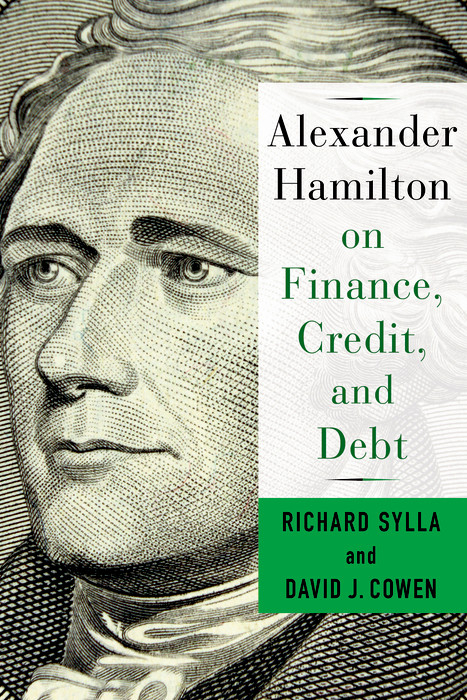
Alexander Hamilton on Finance, Credit, and Debt (eBook)
Columbia University Press (Verlag)
978-0-231-54555-6 (ISBN)
Richard Sylla is professor emeritus of economics and the former Henry Kaufman Professor of the History of Financial Institutions and Markets at New York University Stern School of Business. He is a research associate of the National Bureau of Economic Research and chairman of the Museum of American Finance. Among his books are Founding Choices: American Economic Policy in the 1790s (2011) and Alexander Hamilton: The Illustrated Biography (2016).David J. Cowen is president and CEO of the Museum of American Finance. He is author of The Origins and Economic Impact of the First Bank of the United States, 1791-1797 (2000) and coauthor of Financial Founding Fathers: The Men Who Made America Rich (2006).
"e;A treasure trove for financial and public policy geeks . . . will also help lay readers go beyond the hit musical in understanding Hamilton's lasting significance."e; -Publishers Weekly While serving as the first treasury secretary from 1789 to 1795, Alexander Hamilton engineered a financial revolution. He established the treasury debt market, the dollar, and a central bank, while strategically prompting private entrepreneurs to establish securities markets and stock exchanges and encouraging state governments to charter a number of commercial banks and other business corporations. Yet despite a recent surge of interest in Hamilton, US financial modernization has not been fully recognized as one of his greatest achievements. This book traces the development of Hamilton's financial thinking, policies, and actions through a selection of his writings. Financial historians and Hamilton experts Richard Sylla and David J. Cowen provide commentary that demonstrates the impact Hamilton had on the modern economic system, guiding readers through Hamilton's distinguished career. It showcases Hamilton's thoughts on the nation's founding, the need for a strong central government, problems such as a depreciating paper currency and weak public credit, and the architecture of the financial system. His great state papers on public credit, the national bank, the mint, and manufactures instructed reform of the nation's finances and jumpstarted economic growth. Hamilton practiced what he preached: he played a key role in the founding of three banks and a manufacturing corporation and his deft political maneuvering and economic savvy saved the fledgling republic's economy during the country's first full-blown financial crisis in 1792. "e;A fascinating examination of Hamiltonian economics."e; The Washington Times
Richard Sylla is professor emeritus of economics and the former Henry Kaufman Professor of the History of Financial Institutions and Markets at New York University Stern School of Business. He is a research associate of the National Bureau of Economic Research and chairman of the Museum of American Finance. Among his books are Founding Choices: American Economic Policy in the 1790s (2011) and Alexander Hamilton: The Illustrated Biography (2016).David J. Cowen is president and CEO of the Museum of American Finance. He is author of The Origins and Economic Impact of the First Bank of the United States, 1791–1797 (2000) and coauthor of Financial Founding Fathers: The Men Who Made America Rich (2006).
AcknowledgmentsIntroduction: Hamilton and the U.S. Financial Revolution 1. To — (December 1779–March 1780) 2. To James Duane (September 3, 1780)3. To Robert Morris (April 30, 1781)4. The Continentalist (1781–1782)5. Constitution of the Bank of New York (February 23–March 15, 1784)6. To Thomas Willing (September 13, 1789) 7. Report Relative to a Provision for the Support of Public Credit (January 9, 1790)8. To Wilhem and Jan Willink, Nicholaas and Jacob Van Staphorst, and Nicholas Hubbard (August 28, 1790)9. First Report on the Further Provision Necessary for Establishing Public Credit (December 13, 1790)10. Second Report on the Further Provision Necessary for Establishing Public Credit (Report on a National Bank, December 14, 1790) 11. Report on the Establishment of a Mint (January 28, 1791)12. Opinion on the Constitutionality of an Act to Establish a National Bank (February 23, 1791)13. Prospectus of the Society for Establishing Useful Manufactures (August 1791)14. Report on the Subject of Manufactures (December 5, 1791)15. Letters to William Seton (February 10 and March 22, 1792)16. Report on a Plan for the Further Support of Public Credit (January 16, 1795)17. The Defense of the Funding System (July 1795)18. Articles of Association of the Merchants Bank (April 7, 1803)19. Conclusion: Legacies of the U.S. Financial Revolution NotesIndex
| Erscheint lt. Verlag | 15.7.2020 |
|---|---|
| Verlagsort | New York |
| Sprache | englisch |
| Themenwelt | Geschichte ► Allgemeine Geschichte ► Neuzeit (bis 1918) |
| Geisteswissenschaften ► Geschichte ► Regional- / Ländergeschichte | |
| Geschichte ► Teilgebiete der Geschichte ► Wirtschaftsgeschichte | |
| Sozialwissenschaften ► Politik / Verwaltung ► Staat / Verwaltung | |
| Wirtschaft ► Betriebswirtschaft / Management ► Finanzierung | |
| ISBN-10 | 0-231-54555-X / 023154555X |
| ISBN-13 | 978-0-231-54555-6 / 9780231545556 |
| Informationen gemäß Produktsicherheitsverordnung (GPSR) | |
| Haben Sie eine Frage zum Produkt? |
 PDF (Wasserzeichen)
Größe: 698 KB
DRM: Digitales Wasserzeichen
Dieses eBook enthält ein digitales Wasserzeichen und ist damit für Sie personalisiert. Bei einer missbräuchlichen Weitergabe des eBooks an Dritte ist eine Rückverfolgung an die Quelle möglich.
Dateiformat: PDF (Portable Document Format)
Mit einem festen Seitenlayout eignet sich die PDF besonders für Fachbücher mit Spalten, Tabellen und Abbildungen. Eine PDF kann auf fast allen Geräten angezeigt werden, ist aber für kleine Displays (Smartphone, eReader) nur eingeschränkt geeignet.
Systemvoraussetzungen:
PC/Mac: Mit einem PC oder Mac können Sie dieses eBook lesen. Sie benötigen dafür einen PDF-Viewer - z.B. den Adobe Reader oder Adobe Digital Editions.
eReader: Dieses eBook kann mit (fast) allen eBook-Readern gelesen werden. Mit dem amazon-Kindle ist es aber nicht kompatibel.
Smartphone/Tablet: Egal ob Apple oder Android, dieses eBook können Sie lesen. Sie benötigen dafür einen PDF-Viewer - z.B. die kostenlose Adobe Digital Editions-App.
Buying eBooks from abroad
For tax law reasons we can sell eBooks just within Germany and Switzerland. Regrettably we cannot fulfill eBook-orders from other countries.
aus dem Bereich