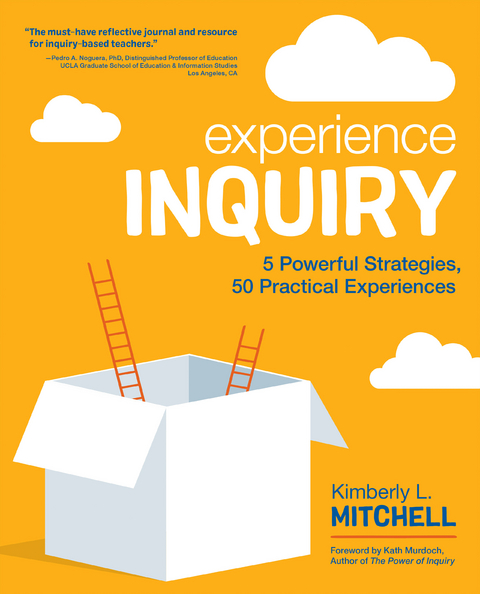
Experience Inquiry (eBook)
240 Seiten
Corwin (Verlag)
978-1-5443-1713-7 (ISBN)
Foreword
Acknowledgments
About the Author
Introduction
1. What Is Inquiry?
My Own Inquiry Journey
Experience #1: Inquiry Self-Survey
2. Beginning Your Inquiry Journey
How to Use This Book
Tips for Success
What’s the Role of Administration?
The Inquiry Leader Self-Reflection Tool
Staff Reflection Survey
The Importance of Balance and Harmony
3. Taking Stock of Your Classroom
Experience #2: How Do You Know If You’re “Doing” Inquiry?
Experience #3: What Do Your Students Think?
Experience #4: What Do Others See in Your Classroom?
Experience #5: What’s the Student Experience?
Experience #6: What Does All This Tell You?
4. What Does Inquiry Look Like?
The Inquiry Five Strategies
Experience #7: What Are Your Burning Questions About Inquiry?
Experience #8: Who, When, and How Should You Answer Questions?
Experience #9: How Can Questions Be Savored?
Experience #10: What Does Your “Ideal” Class Look Like?
5. Strategy #1: Get Personal
Introduction to Get Personal
Experience #11: Mad-Libs: Who Are You?
Experience #12: Who Were Your Teachers?
Experience #13: What Stories Can You Tell?
Experience #14: How Do You Tell a Story That Sticks to the Soul?
Experience #15: What Does Your Classroom Say About You?
Experience #16: Why Do You Teach?
Experience #17: What Is the Third Space?
Experience #18: Ask Me Anything!
6. Strategy #2: Stay Curious
Introduction to Stay Curious
Experience #19: What’s Your Expertise?
Experience #20: What Still Intrigues You?
Experience #21: Who Are Your Teachers Today?
Experience #22: Are You a Luddite or Linkedin?
Experience #23: What Do You Teach?
Experience #24: What Would Your Curriculum of Questions Look Like?
Experience #25: What’s Your Teaching Approach?
Experience #26: How Do You Respond to Students?
7. Strategy #3: Ask More, Talk Less
Introduction to Ask More, Talk Less
Experience #27: What’s Really Happening in Your Classroom?
Experience #28: Who Is Hiding in Plain Sight?
Experience #29: What Questions Are You Asking?
Experience #30: How Do You Teach With Your Mouth Shut?
Experience #31: How Do You Get Students to Listen to One Another?
Experience #32: How Do You Get Students to Talk Together?
Experience #33: What Are Socratic Seminars, Harkness, and Spider Web Discussions?
Experience #34: Which Questions Work Best in Inquiry Classrooms?
8. Strategy #4: Encourage Evidence
Introduction to Encourage Evidence
Experience #35: What’s the Most Important Question to Ask?
Experience #36: How Do You Get Your Students to Back Up Their Claims?
Experience #37: How Do You Teach “Crap Detection”?
Experience #38: How Do You Provoke Healthy Debates?
Experience #39: How Can You Practice the Evidence-Seeking Process?
9. Strategy #5: Extend Thinking Time
Introduction to Extend Thinking Time
Experience #40: How Do You Get Students to Think More?
Experience #41: How Can You Get Students to Ask More Questions?
Experience #42: How Do You Cede Control Without Losing It Completely?
Experience #43: How Do Inquiry and Mindfulness Connect?
Experience #44: How Can You Support Innovative Student Thinking?
Experience #45: How Do You Start Project-Based, Problem-Based, and Challenge-Based Learning?
10. Now What?
Experience #46: How Do You Plan for Inquiry?
Experience #47: How Do You Assess Inquiry?
Experience #48: How Do You Make Time for Inquiry?
Experience #49: How Do You Explain Inquiry to Skeptics?
Experience #50: What Does Inquiry Look Like to You?
11. Inquiry Resources
Kimberly’s Top Ten Lists
Inquiry Books
Inquiry Videos and Podcasts
Inquiry Organizations
Inquiry Blogs
Appendices
More Reasons to Fall in Love With Inquiry: the Inquiry Five (i5) and Alignment Documents
The i5 and Common Core State Standards
The i5 and Next Gen Science Standards
The i5 and Danielson Teaching Framework
The i5 and Marzano Framework
The i5 and Approaches to Teaching and Learning (International Baccalaureate)
The i5 and High Leverage Practice (TeachingWorks, University of Michigan)
Curriculum at-a-Glance (Southern Hemisphere)
References
Index
| Reihe/Serie | Corwin Teaching Essentials | Corwin Teaching Essentials |
|---|---|
| Verlagsort | Thousand Oaks |
| Sprache | englisch |
| Themenwelt | Schulbuch / Wörterbuch ► Unterrichtsvorbereitung |
| Sozialwissenschaften ► Pädagogik ► Allgemeines / Lexika | |
| Sozialwissenschaften ► Pädagogik ► Bildungstheorie | |
| Schlagworte | Concept-Based Curriculum and Instruction • Critical thinking skills • Curriculum Design • inquiry-based instruction • inquiry-based teaching • Teaching methods |
| ISBN-10 | 1-5443-1713-1 / 1544317131 |
| ISBN-13 | 978-1-5443-1713-7 / 9781544317137 |
| Informationen gemäß Produktsicherheitsverordnung (GPSR) | |
| Haben Sie eine Frage zum Produkt? |
 PDF (Adobe DRM)
Kopierschutz: Adobe-DRM
Adobe-DRM ist ein Kopierschutz, der das eBook vor Mißbrauch schützen soll. Dabei wird das eBook bereits beim Download auf Ihre persönliche Adobe-ID autorisiert. Lesen können Sie das eBook dann nur auf den Geräten, welche ebenfalls auf Ihre Adobe-ID registriert sind.
Details zum Adobe-DRM
Dateiformat: PDF (Portable Document Format)
Mit einem festen Seitenlayout eignet sich die PDF besonders für Fachbücher mit Spalten, Tabellen und Abbildungen. Eine PDF kann auf fast allen Geräten angezeigt werden, ist aber für kleine Displays (Smartphone, eReader) nur eingeschränkt geeignet.
Systemvoraussetzungen:
PC/Mac: Mit einem PC oder Mac können Sie dieses eBook lesen. Sie benötigen eine
eReader: Dieses eBook kann mit (fast) allen eBook-Readern gelesen werden. Mit dem amazon-Kindle ist es aber nicht kompatibel.
Smartphone/Tablet: Egal ob Apple oder Android, dieses eBook können Sie lesen. Sie benötigen eine
Geräteliste und zusätzliche Hinweise
Buying eBooks from abroad
For tax law reasons we can sell eBooks just within Germany and Switzerland. Regrettably we cannot fulfill eBook-orders from other countries.
aus dem Bereich