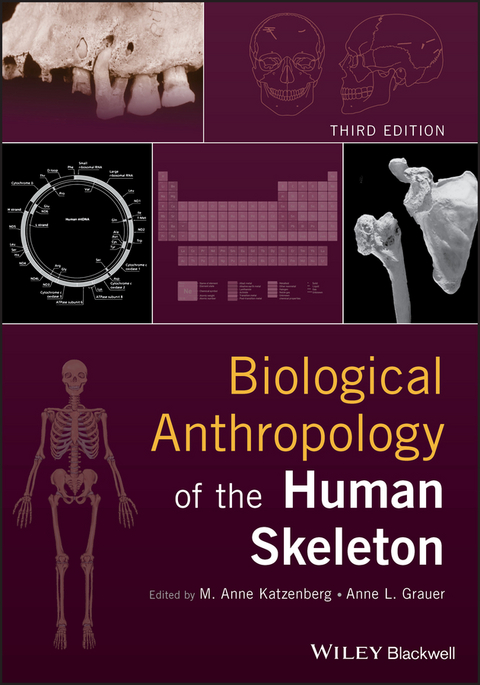
Biological Anthropology of the Human Skeleton (eBook)
John Wiley & Sons (Verlag)
978-1-119-15163-0 (ISBN)
An Indispensable Resource on Advanced Methods of Analysis of Human Skeletal and Dental Remains in Archaeological and Forensic Contexts
Now in its third edition, Biological Anthropology of the Human Skeleton has become a key reference for bioarchaeologists, human osteologists, and paleopathologists throughout the world. It builds upon basic skills to provide the foundation for advanced scientific analyses of human skeletal remains in cultural, archaeological, and theoretical contexts.
This new edition features updated coverage of topics including histomorphometry, dental morphology, stable isotope methods, and ancient DNA, as well as a number of new chapters on paleopathology. It also covers bioarchaeological ethics, taphonomy and the nature of archaeological assemblages, biomechanical analyses of archaeological human skeletons, and more.
- Fully updated and revised with new material written by leading researchers in the field
- Includes many case studies to demonstrate application of methods of analysis
- Offers valuable information on contexts, methods, applications, promises, and pitfalls
Covering the latest advanced methods and techniques for analyzing skeletal and dental remains from archaeological discoveries, Biological Anthropology of the Human Skeleton is a trusted text for advanced undergraduates, graduate students, and professionals in human osteology, bioarchaeology, and paleopathology.
M. Anne Katzenberg, Ph.D., is Professor in the Department of Anthropology and Archaeology at the University of Calgary, Canada. She is co-editor of the Journal of Anthropological Archaeology and an associate editor for the International Journal of Paleopathology. She has been published extensively, having co-edited seven contributed books and authored or co-authored over seventy journal articles and book chapters.
Anne L. Grauer, Ph.D., is Professor and Chair in the Department of Anthropology at Loyola University Chicago, USA. She is the editor-in-chief of the International Journal of Paleopathology, the editor of A Companion to Paleopathology (Wiley Blackwell, 2012) and numerous articles and book chapters, and is the president of the American Association of Physical Anthropology (2019-2021).
An Indispensable Resource on Advanced Methods of Analysis of Human Skeletal and Dental Remains in Archaeological and Forensic Contexts Now in its third edition, Biological Anthropology of the Human Skeleton has become a key reference for bioarchaeologists, human osteologists, and paleopathologists throughout the world. It builds upon basic skills to provide the foundation for advanced scientific analyses of human skeletal remains in cultural, archaeological, and theoretical contexts. This new edition features updated coverage of topics including histomorphometry, dental morphology, stable isotope methods, and ancient DNA, as well as a number of new chapters on paleopathology. It also covers bioarchaeological ethics, taphonomy and the nature of archaeological assemblages, biomechanical analyses of archaeological human skeletons, and more. Fully updated and revised with new material written by leading researchers in the field Includes many case studies to demonstrate application of methods of analysis Offers valuable information on contexts, methods, applications, promises, and pitfalls Covering the latest advanced methods and techniques for analyzing skeletal and dental remains from archaeological discoveries, Biological Anthropology of the Human Skeleton is a trusted text for advanced undergraduates, graduate students, and professionals in human osteology, bioarchaeology, and paleopathology.
M. Anne Katzenberg, Ph.D., is Professor in the Department of Anthropology and Archaeology at the University of Calgary, Canada. She is co-editor of the Journal of Anthropological Archaeology and an associate editor for the International Journal of Paleopathology. She has been published extensively, having co-edited seven contributed books and authored or co-authored over seventy journal articles and book chapters. Anne L. Grauer, Ph.D., is Professor and Chair in the Department of Anthropology at Loyola University Chicago, USA. She is the editor-in-chief of the International Journal of Paleopathology, the editor of A Companion to Paleopathology (Wiley Blackwell, 2012) and numerous articles and book chapters, and is the president of the American Association of Physical Anthropology (2019-2021).
Preface to the third edition xi
Preface to the first edition xiii
Notes on contributors xix
PART I THEORY AND APPLICATION IN STUDIES OF PAST PEOPLES 1
1 Bioarchaeological Ethics: Perspectives on the Use and Value of Human Remains in Scientific Research 3
Patricia M. Lambert and Phillip L. Walker (deceased)
2 Forensic Anthropology: Methodology and Applications 43
Douglas H. Ubelaker
3 Taphonomy and the Nature of Archaeological Assemblages 73
Ann L.W. Stodder
PART II MORPHOLOGICAL AND DEVELOPMENTAL ANALYSES 117
4 Children in Bioarchaeology: Methods and Interpretations 119
Mary E. Lewis
5 Histomorphometry of Human Cortical Bone: Applications to Age Estimation 145
Timothy P. Gocha, Alexander G. Robling, and Sam D. Stout
6 Biomechanical Analyses of Archaeological Human Skeletons 189
Christopher B. Ruff
7 Incremental Structures in Teeth: Keys to Unlocking and Understanding Dental Growth and Development 225
Daniel Antoine, Charles M. FitzGerald, and Jerome C. Rose
8 Dental Morphology 257
Richard Scott and Marin A. Pilloud
PART III PREHISTORIC HEALTH AND DISEASE 293
9 Dental Pathology 295
Simon Hillson
10 Analysis and Interpretation of Trauma in Skeletal Remains 335
Nancy C. Lovell and Anne L. Grauer
11 Understanding Bone Aging, Loss, and Osteoporosis in the Past 385
Sabrina C. Agarwal
12 Infectious and Metabolic Diseases: A Synergistic Relationship 415
Charlotte A. Roberts and Megan Brickley
13 Paleopathology: From Bones to Social Behavior 447
Anne L. Grauer
PART IV CHEMICAL AND GENETIC ANALYSES OF HARD TISSUES 467
14 Stable Isotope Analysis: A Tool for Studying Past Diet, Demography, and Life History 469
M. Anne Katzenberg and Andrea L. Waters-Rist
15 Strontium Isotopes and the Chemistry of Bones and Teeth 505
James Burton and M. Anne Katzenberg
16 Ancient DNA Analysis of Archaeological Remains 515
Maria A. Nieves-Colón and Anne C. Stone
PART V QUANTITATIVE METHODS AND POPULATION STUDIES 545
17 Traditional Morphometrics and Biological Distance: Methods and an Example 547
Michael Pietrusewsky
18 Paleodemography: Problems, Progress, and Potential 593
George R. Milner, James W. Wood, and Jesper L. Boldsen
Index 635
PREFACE TO THE FIRST EDITION
“What’s Bred in the Bone,” a novel by Robertson Davies, begins with the proverb, “What’s bred in the bone will not out in the flesh.” The story is about a man who supposedly reflects his “breeding” since his behaviour and characteristics are direct reflections of what he has inherited from his family. While biological determinism may work in fiction, it is anathema to the biological anthropologist. The cornerstone of biological anthropology is the interaction of culture and human biology. What is manifested in the physical and behavioral characteristics of any living being is a result of the intertwining of an inherited genome with environmental factors. Human osteologists have struggled with this concept from the earliest beginnings of skeletal studies and continue to struggle with it today. Ancient DNA studies suggest that we ultimately want to know the “inherent” properties coming out of the bones. If we could read the genome, we would “know” the person. But of course, we understand that, as living tissues, bones and teeth are influenced by environmental forces. Bones respond to mechanical forces and thus they alter in response to activities and stresses. Craniometric studies attempt to study population relationships, assuming that cranial shape and size reflect inherited features, but we know that cranial shape and size can be altered purposefully (e.g., head binding) or unintentionally (chewing stresses). It is the job of the human osteologist to study the interactions between inherited characteristics and their modification by the environment in order to understand, not just what is “bred” in the bone but what bones can tell us about the flesh, that is, the lives of earlier peoples.
Each of the following chapters deals with a specific type of advanced analysis of bones and teeth. The original plan for the book was to be a second edition of our earlier edited book, Skeletal Biology of Past People: Research Methods. However as work progressed, it seemed that with five additional chapters and many new contributors, it is really something different. The differences are directly related to changes that have occurred in the analysis of human skeletal and dental remains over the past few years. Most notably these changes include heightened ethical concerns about studying the skeletal remains of aboriginal peoples in many countries where those people are no longer the dominant culture. These concerns and the resulting legislation in some jurisdictions have radically changed the way physical anthropologists and archaeologists carry out their work. A second change is the rise of forensic anthropology and the fact that research in forensic anthropology, while still overlapping with more traditional approaches, now includes topics not central to studies of archaeological skeletons. We begin this book with chapters on the ethics of studying human remains and forensic anthropology.
An important theme that is found throughout the book is the progress of new methods. We were training to become anthropologists in the 1970s when many new research areas were emerging in physical anthropology. The earlier practice of providing descriptive osteological reports either as stand alone works, or more commonly, as appendices to archaeological site reports was fading out and more problem oriented research was emerging. Biological distance studies using both metric and nonmetric traits on human bones and teeth were carried out in order to investigate prehistoric migration and relatedness through time and space. Paleopathology was emerging as a means of addressing questions about prehistoric adaptations in contrast to the earlier emphasis on unusual cases of specific diseases. Paleodemography, similarly, addressed questions of adaptation of earlier populations. Since the initial enthusiastic studies all of these topics have undergone criticism and have emerged as perhaps humbled, but also strengthened by the critiques. The same is true of the more recently introduced methods involving biochemical analyses of bones and teeth. These include analyses of trace elements, stable isotopes and ancient DNA.
Each of these methods has undergone a series of stages that may be characterized as follows:
- Discovery – either entirely new or new to physical anthropology, a new method is discovered and the potential applications are explored.
- Applications to questions of interest regarding reconstructing past peoples.
- Critique, introspection, experimentation.
- Emergence in a stronger, more reasoned form.
NAGPRA (Native American Graves Protection and Repatriation Act) and similar legislation in other countries have led to a reconfiguring of how skeletal studies of past peoples are carried out. Some of these changes can be viewed in a positive light. For example, standards have been developed in the expectation that collections will not be curated indefinitely. These standards were needed even before the prospect of reburial emerged. In addition, an interesting configuration of events happened in the 1990s. As some Native Americans voiced their disapproval of skeletal studies, expanding urban development led to archaeological excavations of several large, historic cemeteries dating from the 18th and 19th centuries. These cemeteries contained the remains of Euroamericans and African Americans as well as other groups. At the same time, the growing number of students trained in human osteology provided a pool of individuals to excavate and study these remains. Debates about excavation and study continued but in many cases some period of time was allowed for proper scientific study. One special example of the cooperation between scientists and concerned descendants is the work being conducted at Howard University on a large African American slave cemetery discovered in New York City. In Europe, there is a long history of excavating historic cemeteries and the increasing number of trained human osteologists has led to larger scale studies (the St. Brides’ skeletal collection in London, England is a good example). The increased scientific study of skeletons from historic cemeteries has also provided opportunities for testing methods. In many cases, the identities of at least some of the individuals are known from legible coffin inscriptions or detailed cemetery maps. It has been possible to investigate the accuracy of methods of determining sex and age at death and to detect biases in mortality samples that are directly related to causes of death.
This book is organized into five parts. Part one, theory and application, features two chapters that describe recent shifts in skeletal studies. Walker’s chapter provides information on how humans have regarded the dead over time and across cultures. He grapples with the issues surrounding the ethics of skeletal research, the clash with cultural beliefs about treatment of the dead and the politics of communities. Taking a clearly anthropological approach to these questions, he shows us that there is a tremendous diversity of attitudes about the physical remains of the dead. He makes a strong case for the value of and the justification of scientific research. Ubelaker focuses on the development of forensic anthropology with its roots in descriptive osteology and its present form as an applied specialization of human osteology. He discusses the major comparative collections used for establishing standards including the recently developed forensic data bank. He then takes the reader through the various steps in forensic anthropology, including recovery, identification, sex and age determination, stature estimation and positive identification. He concludes with information on training opportunities and professional organizations dedicated to forensic anthropology.
Part 2 includes chapters on morphological analyses of bones and teeth and age changes. Four of these contributors prepared chapters for our earlier book and while the topics are similar, each chapter includes contributions and advances that have occurred throughout the 1990s. Ruff describes biomechanical analyses of bones and the applications of such studies to understanding past human behaviour ranging from fossil hominids through to early historic human groups. He draws from his own extensive research to provide examples of how biomechanical studies have improved our understanding of past activity patterns. Examples include changes in robusticity throughout human evolution, the relationship between subsistence and bone strength, and the relationship between gender roles and their biological manifestation in bone structure. Mayhall covers dental morphology highlighting newer methods of characterizing tooth size and shape, and the applications of such studies to biological and behavioral characteristics of past peoples. He emphasizes the importance of achieving precision of observations of both dental measures and dental morphological traits. He also argues for maintaining simplicity in our methodological approaches. Both of these aspects of the research process are absolutely necessary for us to make meaningful comparisons of the results obtained by different observers. Mayhall shows that knowledge in the field of dental morphology remains limited because the precision necessary for properly evaluating population variability has still not been achieved. Saunders covers the various types of studies that are specific to subadults, focusing on age determination but also considering sex determination and variations in growth and development. One problem with proceeding to studies of growth and development is that of sampling. Differential burial...
| Erscheint lt. Verlag | 15.8.2018 |
|---|---|
| Sprache | englisch |
| Themenwelt | Geisteswissenschaften ► Archäologie |
| Geschichte ► Allgemeine Geschichte ► Vor- und Frühgeschichte | |
| Naturwissenschaften ► Biologie ► Humanbiologie | |
| Sozialwissenschaften ► Ethnologie | |
| Sozialwissenschaften ► Soziologie | |
| Schlagworte | analysis of dental remains • Anatomie • Anatomie u. Physiologie • Anatomy & Physiology • anthropologic reconstruction • Anthropologie • Anthropology • Archaeological Reconstruction • Archaeological Science • archaeology • bioarchaeology</p> • Biological Anthropology • Biologische Anthropologie • Biowissenschaften • forensic anthropology • forensic biology • guide for medical examiner • guide to forensics • human osteology • human skeletal analysis • Life Sciences • <p>analysis of skeletal remains • Medical Anthropology • Medizinische Anthropologie • methods for skeletal biology • Paleopathology • physical anthropology • skeletal biology • skeletal biology research • skeletal biology techniques • Skelett |
| ISBN-10 | 1-119-15163-5 / 1119151635 |
| ISBN-13 | 978-1-119-15163-0 / 9781119151630 |
| Informationen gemäß Produktsicherheitsverordnung (GPSR) | |
| Haben Sie eine Frage zum Produkt? |
 EPUB (Adobe DRM)
Kopierschutz: Adobe-DRM
Adobe-DRM ist ein Kopierschutz, der das eBook vor Mißbrauch schützen soll. Dabei wird das eBook bereits beim Download auf Ihre persönliche Adobe-ID autorisiert. Lesen können Sie das eBook dann nur auf den Geräten, welche ebenfalls auf Ihre Adobe-ID registriert sind.
Details zum Adobe-DRM
Dateiformat: EPUB (Electronic Publication)
EPUB ist ein offener Standard für eBooks und eignet sich besonders zur Darstellung von Belletristik und Sachbüchern. Der Fließtext wird dynamisch an die Display- und Schriftgröße angepasst. Auch für mobile Lesegeräte ist EPUB daher gut geeignet.
Systemvoraussetzungen:
PC/Mac: Mit einem PC oder Mac können Sie dieses eBook lesen. Sie benötigen eine
eReader: Dieses eBook kann mit (fast) allen eBook-Readern gelesen werden. Mit dem amazon-Kindle ist es aber nicht kompatibel.
Smartphone/Tablet: Egal ob Apple oder Android, dieses eBook können Sie lesen. Sie benötigen eine
Geräteliste und zusätzliche Hinweise
Buying eBooks from abroad
For tax law reasons we can sell eBooks just within Germany and Switzerland. Regrettably we cannot fulfill eBook-orders from other countries.
aus dem Bereich