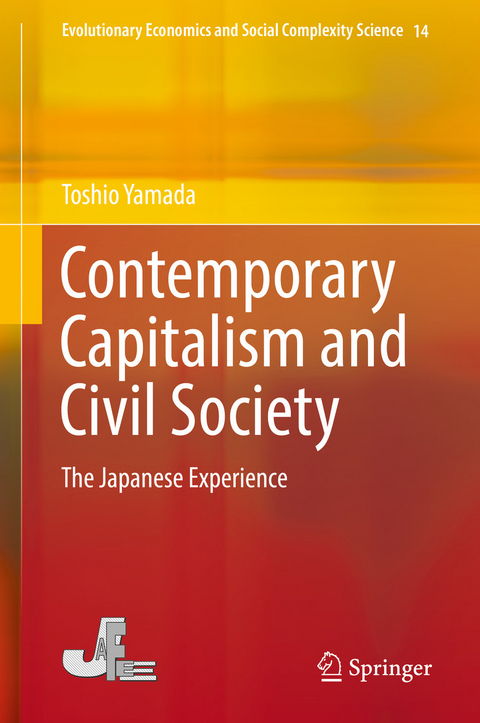
Contemporary Capitalism and Civil Society (eBook)
XVII, 225 Seiten
Springer Singapore (Verlag)
978-981-13-0517-7 (ISBN)
Toshio Yamada is Emeritus Professor at Nagoya University, having previously served as Professor of Economic Theories at Osaka City University, Nagoya University, etc. in Japan. He graduated from Graduate School of Economics of Nagoya University, and got a doctor's degree in economics from Osaka City University. He is a director of the Société Franco-Japonaise des Sciences Economiques and a member of the European Association for Evolutionary Political Economy. His research interests focus on French régulation theory, Japanese civil society thought, and contemporary capitalism. His works in English include Japanese Capitalism in Crisis: A Regulationist Interpretation (2000, co-edited with Robert Boyer).
This book is devoted to analyzing contemporary capitalism both in Japan and in the world economy by using the theoretical framework of the French regulation theory and by revisiting the theory of civil society in postwar Japan. The Japanese theory of civil society proposed unique thinking about "e;freedom and equality"e; and "e;human rights"e; in the postwar era but could not help to come up with effective concepts for an economic analysis of that capitalism of the period. On the other hand, the regulation theory born in the 1970s is well known by its definition of postwar capitalism as Fordism, based on the elaboration of a new conceptual framework, but it soon proved unable to directly explain Japan's experience by that central concept of Fordism. Inspired by consideration of Japanese civil society and also by the regulationist framework, the author has forged new analytical concepts such as "e;companyism"e; to understand Japanese capitalism including the recent "e;lost decades"e;, and he elaborates more carefully the concepts of "e;growth regime"e; and "e;institutional change"e; to grasp the dynamics of the world economy including today's neoliberal trend. The original benefits of the book consist in 1) reviving a Japanese theory of civil society in the postwar period, 2) applying the regulation theory to the analysis of contemporary Japan, and 3) offering theoretical reflections on the conception of the world economy. Consequently, the author pays special attention to the relationship between the political and the economic as well as regulationist tools and the theory of civil society's perspective. The principal message of the book is that capitalism or the market economy must be supported by a sound civil society.
Toshio Yamada is Emeritus Professor at Nagoya University, having previously served as Professor of Economic Theories at Osaka City University, Nagoya University, etc. in Japan. He graduated from Graduate School of Economics of Nagoya University, and got a doctor’s degree in economics from Osaka City University. He is a director of the Société Franco-Japonaise des Sciences Economiques and a member of the European Association for Evolutionary Political Economy. His research interests focus on French régulation theory, Japanese civil society thought, and contemporary capitalism. His works in English include Japanese Capitalism in Crisis: A Regulationist Interpretation (2000, co-edited with Robert Boyer).
Part I: Postwar Japan and the Theory of Civil Society.- Chapter 1: Political Economy in Japan after World War II.- Chapter 2: Yoshihiko Uchida and his Thoughts on Civil Society: Between Equality in Exchange and Equality as Human Beings.- Chapter 3: Kiyoaki Hirata and his Thoughts on Civil Society.- Part II: The Rise and Fall of Contemporary Japanese Capitalism.- Chapter 4: The Introduction of Régulation Theory in Japan.- Chapter 5: Postwar Japanese Capitalism and Companyist Régulation.- Chapter 6: The Collapse of Companyism and Today’s Post-companyist Transformation.- Chapter 7: Analyses of Japanese Capitalism Based on the Régulation Approach: An Overview of Thirty Years of Research.- Part III: Theoretical Considerations of Contemporary Capitalism.- Chapter 8: Stage Theory or Typology?: Methodological Reflections on the Comparative Analysis of Capitalism.- Chapter 9: Economic Crises and Growth Regimes.- Chapter 10: The Neoliberal Regime and its Possible Crisis: A Reflection from the Viewpoint of Institutional Change.- Chapter 11: Transition Economies and State Capitalism.
| Erscheint lt. Verlag | 15.8.2018 |
|---|---|
| Reihe/Serie | Evolutionary Economics and Social Complexity Science | Evolutionary Economics and Social Complexity Science |
| Zusatzinfo | XVII, 225 p. 21 illus. |
| Verlagsort | Singapore |
| Sprache | englisch |
| Themenwelt | Sozialwissenschaften ► Pädagogik ► Sozialpädagogik |
| Sozialwissenschaften ► Politik / Verwaltung | |
| Sozialwissenschaften ► Soziologie ► Spezielle Soziologien | |
| Wirtschaft ► Betriebswirtschaft / Management ► Unternehmensführung / Management | |
| Wirtschaft ► Volkswirtschaftslehre ► Makroökonomie | |
| Wirtschaft ► Volkswirtschaftslehre ► Wirtschaftspolitik | |
| Schlagworte | Civil Society • Companyist Régulation • Contemporary capitalism • Institutional Change • Régulation Theory |
| ISBN-10 | 981-13-0517-X / 981130517X |
| ISBN-13 | 978-981-13-0517-7 / 9789811305177 |
| Informationen gemäß Produktsicherheitsverordnung (GPSR) | |
| Haben Sie eine Frage zum Produkt? |
 PDF (Wasserzeichen)
DRM: Digitales Wasserzeichen
Dieses eBook enthält ein digitales Wasserzeichen und ist damit für Sie personalisiert. Bei einer missbräuchlichen Weitergabe des eBooks an Dritte ist eine Rückverfolgung an die Quelle möglich.
Dateiformat: PDF (Portable Document Format)
Mit einem festen Seitenlayout eignet sich die PDF besonders für Fachbücher mit Spalten, Tabellen und Abbildungen. Eine PDF kann auf fast allen Geräten angezeigt werden, ist aber für kleine Displays (Smartphone, eReader) nur eingeschränkt geeignet.
Systemvoraussetzungen:
PC/Mac: Mit einem PC oder Mac können Sie dieses eBook lesen. Sie benötigen dafür einen PDF-Viewer - z.B. den Adobe Reader oder Adobe Digital Editions.
eReader: Dieses eBook kann mit (fast) allen eBook-Readern gelesen werden. Mit dem amazon-Kindle ist es aber nicht kompatibel.
Smartphone/Tablet: Egal ob Apple oder Android, dieses eBook können Sie lesen. Sie benötigen dafür einen PDF-Viewer - z.B. die kostenlose Adobe Digital Editions-App.
Buying eBooks from abroad
For tax law reasons we can sell eBooks just within Germany and Switzerland. Regrettably we cannot fulfill eBook-orders from other countries.
aus dem Bereich