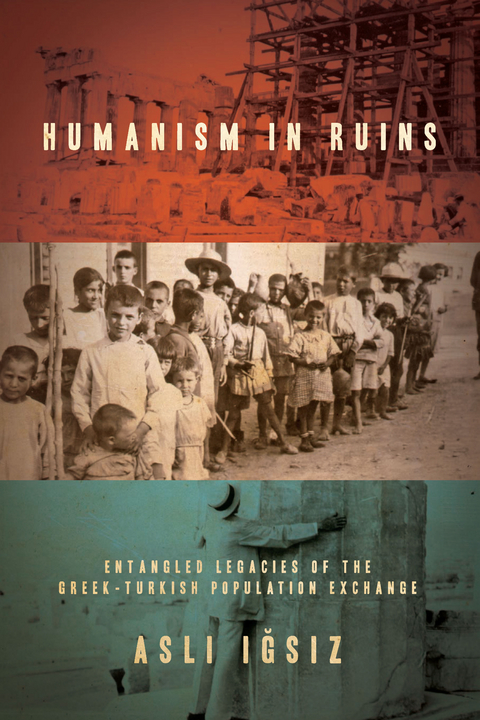
Humanism in Ruins (eBook)
344 Seiten
Stanford University Press (Verlag)
978-1-5036-0687-6 (ISBN)
Aslı Iğsız is Assistant Professor of Middle Eastern and Islamic Studies at New York University.
Contents and AbstractsBy Way of an Introduction: The Entangled Legacies of a Population Exchange chapter abstractThis chapter introduces the key concepts as well as the general approach and methodology of the book: biopolitics, humanism, ruins, and palimpsests. These concepts are later further developed in the relevant chapters, in relation to the analysis of the sources, but here they are laid out in relation to the entangled legacies of the 1923 exchange in general. The Introduction also provides a lengthy historicization of the 1923 exchange together with the notion of "racialized thinking" that constitutes the basis for the discussion of biopolitics and humanism.Part I: Humanism and Its Discontents: Biopolitics, the Politics of Expertise, and the Human Family chapter abstractThis chapter discusses various scholars—eugenicists, sociologists, anthropologists, and legal scholars among others—and their intellectual networks to unravel a complex, transnational intellectual and cultural history, and addresses the entangled dynamics revolving around the segregative legacy of the 1923 Greek-Turkish population exchange. Focusing on the first decade after 1945, this part traces how segregative biopolitics was addressed transnationally through a refugee association presided over by a Turkish eugenicist, Fahreddin Kerim Gökay, and founded in collaboration with an Italian eugenicist and statistician, Corrado Gini—who also was a supporter of Mussolini's fascism. The 1923 exchange was a reference point for the association and for the research it promoted. Against this backdrop, the chapter also analyzes the rise of UNESCO-oriented cultural policies developed to address alterity and race during that period, with a special focus on liberal humanism and a photography exhibition: The Family of Man.Part II: Of Origins and "Men": Family History, Genealogy, and Historicist Humanism Revisited chapter abstractThis part turns to the notions of genealogy and origins and attends to their different uses across time and space in relation to the 1923 exchange, racialized thinking, and historicist humanism. It begins with post-1990s Turkey and traces how legacies of segregative biopolitics were primarily engaged on a personal level through family histories configured as cultural heritage. Engaging individual and institutional practices that configured family histories as sites of articulating different backgrounds—alterity—after the 1980 military coup, the part considers the implications of engaging biopolitical ruins via individual genealogies and origins configured through the family. Next, it historicizes other forms of engaging genealogies and origins and examines this process through historicist humanism and racialized thinking, which were instrumental in categorizing peoples on the paths that led to segregative policies in general, the 1923 Greco-Turkish exchange in particular.Part III: Unity in Diversity: Culture, Social Cohesion, and Liberal Multiculturalism chapter abstractThis part traces the palimpsests of cultural policy pertaining to contemporary liberal multiculturalism in Turkey and the European Union. Addressing liberal and historicist humanism embedded in liberal multiculturalism narratives in Turkey and beyond, this part engages the discourses and policies that enabled the building of the first 1923 Greco-Turkish Population Exchange Museum in Turkey as part of the Istanbul 2010 European Capital of Culture project. Considering the impact of UNESCO's cultural policies on the EU, which then traveled to Turkey, this part addresses the limits of liberal multiculturalism and the form it took in Turkey: neo-Ottomanism. After tracing the transnational crossing of liberal multiculturalism to Turkey, the part turns to the local historical context that neo-Ottomanism draws from: cultural policy in the post-1980 coup era and the Turkish-Islamic synthesis and its broader implications for the fascistic historicist humanism mobilized during the 1980 coup era.In Lieu of a Conclusion: Cultural Analysis in an Age of Securitarianism chapter abstractThe Conclusion picks up the threads of the analysis laid out throughout the book and reconsiders the relevance of the book's key concepts such as biopolitics, segregation, and culture from the perspective of the contemporary rise of neofascism, securitarianism, and xenophobia.
| Erscheint lt. Verlag | 18.9.2018 |
|---|---|
| Sprache | englisch |
| Themenwelt | Geschichte ► Allgemeine Geschichte ► Neuzeit (bis 1918) |
| Geisteswissenschaften ► Geschichte ► Regional- / Ländergeschichte | |
| Sozialwissenschaften ► Ethnologie | |
| Sozialwissenschaften ► Soziologie | |
| Schlagworte | 1923 Greek-Turkish population exchange • Biopolitics • Cultural Policy • Eugenics • Humanism • racialized thinking • Refugee crisis • Segregation • Turkey |
| ISBN-10 | 1-5036-0687-2 / 1503606872 |
| ISBN-13 | 978-1-5036-0687-6 / 9781503606876 |
| Informationen gemäß Produktsicherheitsverordnung (GPSR) | |
| Haben Sie eine Frage zum Produkt? |
 EPUB (Adobe DRM)
Kopierschutz: Adobe-DRM
Adobe-DRM ist ein Kopierschutz, der das eBook vor Mißbrauch schützen soll. Dabei wird das eBook bereits beim Download auf Ihre persönliche Adobe-ID autorisiert. Lesen können Sie das eBook dann nur auf den Geräten, welche ebenfalls auf Ihre Adobe-ID registriert sind.
Details zum Adobe-DRM
Dateiformat: EPUB (Electronic Publication)
EPUB ist ein offener Standard für eBooks und eignet sich besonders zur Darstellung von Belletristik und Sachbüchern. Der Fließtext wird dynamisch an die Display- und Schriftgröße angepasst. Auch für mobile Lesegeräte ist EPUB daher gut geeignet.
Systemvoraussetzungen:
PC/Mac: Mit einem PC oder Mac können Sie dieses eBook lesen. Sie benötigen eine
eReader: Dieses eBook kann mit (fast) allen eBook-Readern gelesen werden. Mit dem amazon-Kindle ist es aber nicht kompatibel.
Smartphone/Tablet: Egal ob Apple oder Android, dieses eBook können Sie lesen. Sie benötigen eine
Geräteliste und zusätzliche Hinweise
Buying eBooks from abroad
For tax law reasons we can sell eBooks just within Germany and Switzerland. Regrettably we cannot fulfill eBook-orders from other countries.
aus dem Bereich