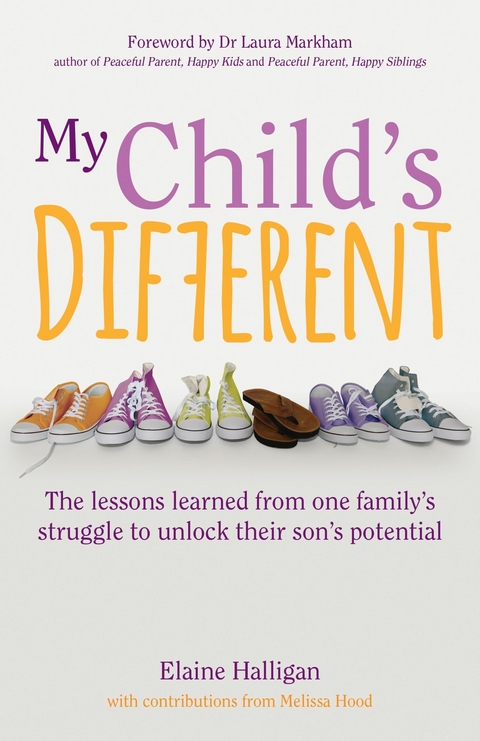
My Child's Different (eBook)
192 Seiten
Crown House Publishing (Verlag)
978-1-78583-344-1 (ISBN)
Elaine Halligan is a director at The Parent Practice and has been a parenting specialist since 2006, helping parents raise competent and confident children through parenting classes, private coaching and keynote speaking in schools and corporate settings both in the UK and overseas. She is frequently quoted in the broadsheet press and regularly appears on Sky News, BBC world news and BBC local radio. Her mission is to help parents find the holy grail of parenting: keeping calm and bringing out the best in their children.
Elaine Halligan's My Child's Different: The lessons learned from one family's struggle to unlock their son's potential explores the enabling role that parents can play in getting the best out of children who are seen as 'different' or 'difficult'. Foreword by Dr Laura Markham. Society favours children, and adults, who conform. The notion that our children may be shunned for being 'different' breaks our hearts, but there is plenty we can do to help such children develop into thriving, resilient adults. In My Child's Different Elaine shares the true story of her son Sam, who by the age of seven had been excluded from three schools and was later labelled with a whole host of conditions ranging from autistic spectrum disorder (ASD) to pathological demand avoidance (PDA), before finally being diagnosed with dyslexia. He had become 'the Alphabet Kid'. His family never gave up on him, however Drawing lessons from Sam's transformational journey from difficult child to budding entrepreneur, My Child's Different offers encouragement to parents who may be concerned about what the future might hold, and demonstrates how with the right support and positive parenting skills their children can grow up to surprise and delight them. The book chronicles Sam's journey from birth to adulthood, allowing readers to spot past and present patterns that may be comparable with their own children's experiences, and provides pragmatic parenting advice that will be of benefit to any parent whose children who may or may not have a diagnosed learning difficulty struggle with life educationally or socially. Elaine writes with warmth and compassion as she revisits the challenges faced, the obstacles overcome and the key interventions that helped instil in Sam a sense of self-belief, a drive to succeed and an emotional intelligence beyond his years. Interspersed throughout the narrative are the reflections and insights of parenting expert Melissa Hood, who illustrates the key concepts from Sam's story and shares practical positive parenting techniques to help parents better connect with their children. Also included are contributions from Sam himself providing an additional, uniquely rich perspective that will help deepen parents' understanding of their children's feelings and emotions. Suitable for parents, educators and anyone who works with children, My Child's Different is a celebration of all the unique qualities that those who are different bring to society.
When processing is disorderly, the brain cannot do its most important job of organizing sensory messages.
Carol Stock Kranowitz, The Out-of-Sync Child
We holidayed that first autumn in Portugal and it was a breeze. So the following year we decided to travel to New Zealand and introduce Sam to the Kiwi ‘rellies’.
I’ll never forget that flight to Christchurch.
Sam had just started to walk. Imagine: thirty-two hours door-to-door (with a stopover in Singapore), and your son suddenly discovers a new mobility – and boy, does he want to practise! Tony and I spent much of the flight trying to contain him.
There were none of the luxuries of personalised in-flight entertainment we enjoy today. This was 1997 and there was one large video screen for all to view. Sam, a rather large baby, would sleep for a few hours, then suddenly sit up in his bassinet, blocking the whole video screen for the rest of the passengers behind us. They were not happy, and understandably so. You may have already experienced a long-haul flight with children, or perhaps you’re planning one. If we knew then what we know now, I’m sure we would have tried to find the money for a proper seat for Sam.
Next, Sam felt it was time to get moving, so off he wobbled. He hadn’t got far before he let out an earth-shattering scream. We found him standing motionless in front of a Sikh gentleman who was wearing a bright yellow turban. The man was smiling blankly at Sam, while Sam was screaming back at him as if his life depended on it. Gathering Sam up into my arms, I apologised profusely to the gentleman. ‘I’m so sorry, I think my son must have got a fright when he spotted your turban. He’s never seen one up close before. I’m sorry if we caused you any embarrassment.’ Thankfully, he took it in good humour. Walking back to our seat, wishing the ground would swallow me up, I consoled myself with the thought that the situation wasn’t dissimilar to a young child seeing Father Christmas for the first time; that jolly old man with rosy cheeks, a big tummy, and a long beard can be, quite frankly, terrifying!
My mother and father – now Granny Mavis and Grandpa John – counselled me wisely from the day Sam was born. ‘You need to look after yourself,’ they would say. ‘And your relationship. Work hard to stop yourself becoming a unit dedicated purely to Sam.’ They felt so strongly about this that they made an agreement that Tony and I were to have a weekend away and a whole week off from our parental duties every year and they would come to London from Edinburgh to take care of Sam. I didn’t realise at the time how lucky we were to have such a supportive and energetic set of grandparents who adored their grandson. (In time, I began to appreciate that this generosity was not something experienced by many of my friends.)
At playgroups, the other children would love getting stuck in to messy play with sand and mud and finger paints, but Sam would avoid these activities and wander off to do something else. If he did get in the sandpit, it would be to throw sand at another child or snatch their bucket from them.
He hated having different foods together on his plate and would complain vociferously when foods touched. Chips and ketchup couldn’t be too close. Potatoes and peas were to be kept apart (no mean feat, with the peas rolling around on the dish).
Hair washing and nail cutting became stressful experiences, and with the screams he emitted at bath time our neighbours would be forgiven for thinking we were sticking hot needles in his eyes. He refused to wear a coat or hat or gloves, electing instead to wear shorts even in arctic conditions. We began to get disapproving looks – and I’m sure it seemed like I was neglecting my child – but I simply could not make Sam wear his coat. It was easier to make him realise the consequences of his actions for himself than go into battle.
We found ourselves spending more time criticising and scolding him than focusing on the things he was doing well. Granny Mavis, with her wisdom and years of experience, was the first to pick up on these signs that all was not well with Sam, but we put it down to normal naughtiness. We’d heard all about the ‘terrible twos’ and assumed we were in their throes and that this phase would soon pass.
I was delighted to fall pregnant again.
Question marks
When Sam was around two and a half, he started at a private day nursery. It was a wonderful, warm, friendly environment. It had a big, bright hall that opened out onto a lovely safe and secure garden, complete with slides and a messy play area with water and sand. A separate quiet space meant the children could have their lunchtime nap in a peaceful snug. There were themed spaces dotted around, of dinosaurs or the seaside, which I knew Sam would love. Together with the nature walks in the local park, and the young, energetic and caring staff, it seemed to me like the perfect environment for him.
Suddenly, life became quite stressful.
By this time, I was working three days a week as an accountancy lecturer. Tony regularly worked long hours, and frequently travelled abroad on business. At weekends, he was a hands-on dad, and it was wonderful to see him and Sam together. But during the week, I sometimes felt like a single parent, as he was rarely home to put Sam to bed or help with the morning mayhem. I’d struggle to get Sam to nursery on time, arrive at work at an acceptable hour, and maintain at least a semi-professional air.
Going to work felt like a blessed relief from managing Sam’s outbursts. These were increasing in frequency and intensity, and could be over anything – from the seam on his sock not fitting properly, to getting the Thomas the Tank Engine cup at breakfast instead of the Spongebob Squarepants one. Separating at the nursery gate was an experience I began to dread. Sam would work himself up into a hysterical mess and have to be peeled off me, yet the nursery always reported that once I had gone, he was fine. I felt the judgement of the other mothers on me as I rushed to drop him off and get to work on time. It was as anxiety inducing for me as it was for Sam, and I strongly felt working-parent guilt. I kept questioning whether it was healthy to leave him like this, or if I was damaging him by not being there for him around the clock. But if he was fine without me, as the nursery staff claimed, then perhaps he was manipulating me, and trying to make my life hard!
I also started to question whether his behaviour was ‘normal’, or if Granny Mavis had been right in her instinct that something more concerning might be underlying his antics. But I’d heard that lots of children have separation anxiety, so assumed he’d just grow out of it.
Instead, things only got worse. Birthday parties became a nightmare. While all the other children were able to sit and listen to the party entertainer, Sam would be running around doing his own thing. When he eventually joined in, he would act the clown to get attention from the other kids. At one party the following summer, Sam decided he was too hot, so without warning he stripped off his clothes and ran around naked! I was mortified. The other children found it hilarious, and Sam loved the attention, but I sensed the other parents looking on disapprovingly. On reflection, they may have pitied me.
This type of silly behaviour got the other children laughing, so he repeated it again and again. He had a formula that worked.
The intensity of emotions he showed and the impulsivity of many of his actions were bewildering to me. I had no point of reference to compare him to except the other children in our group, and it did seem to me that Sam was a bit different and more difficult than they were; but whenever I voiced my concerns to the parents, the response was a resounding ‘You’re worrying about nothing, he’s only young!’
‘It’s a typical boy thing,’ said one parent. ‘They have so much energy, they’re always messing around instead of listening.’
‘My son was exactly the same at Sam’s age!’ said another.
‘He’ll grow out of it,’ said a third.
There was one different voice at the time, though. A nursery friend, Pamela Wilson, came up to me one day when we were collecting the children.
‘I was thinking about Sam’s behaviour, as you seem to be so worried about it. Have you considered he might have a language processing issue?’
Pamela’s daughter had learning difficulties, so she was right to suggest this, but my hackles rose. ‘What do you mean he has language problems?’ I snapped. ‘Sam talks just fine – he obviously speaks well, and we’ve just had his hearing tested. The paediatrician said it’s all good.’
It wasn’t until much later that I realised language isn’t just about talking or hearing, but is made up of many different elements. It became clear that the issues he had – running around doing his own thing instead of listening to what the entertainer was saying, refusing to follow instructions at home or at nursery, ignoring the teacher during tennis lessons and making up his own rules, or messing around when he was supposed to be reading a storybook – were not down to...
| Erscheint lt. Verlag | 30.11.2018 |
|---|---|
| Verlagsort | London |
| Sprache | englisch |
| Themenwelt | Sachbuch/Ratgeber ► Gesundheit / Leben / Psychologie ► Familie / Erziehung |
| Sachbuch/Ratgeber ► Gesundheit / Leben / Psychologie ► Lebenshilfe / Lebensführung | |
| Sachbuch/Ratgeber ► Gesundheit / Leben / Psychologie ► Schwangerschaft / Geburt | |
| Schulbuch / Wörterbuch ► Unterrichtsvorbereitung ► Förder- / Sonderschule | |
| Sozialwissenschaften ► Pädagogik ► Sonder-, Heil- und Förderpädagogik | |
| Sozialwissenschaften ► Soziologie | |
| Schlagworte | adele faber • ADHD • Advice • alphabet kid • annabel rivkin • Aspergers Syndrome • Autism • bonnie harris • carol stock kranowitz • Childcare • Child Psychology • Children in Need • children learning • Children with autism • Coping • David Mitchell • descriptive praise • Different • Disability • disorder • dr laura markham • dyslexia • Education • emilie mcmeekan • Emotional Intelligence • Failure • Families • Family Health • grit • growth mindset • health education • Health Psychology • Home Education • How to Talk so Kids will Listen • inspiring • Issues • Jessie Hewitson • keiko yoshida • laura markham • learning disability • lifestyle • melissa hood • Mindset • My Child • my family • My School • My Struggle • naoki higashida • parenting • paul dix • Positive • postitive discipline • postitive parenting skills • Potential • Problem • Problem Child • Psychology in education • psychopathology • relationship advice • relfective listening • Resilience • rules and rewards • SENCO • Sensitivity • sensory integration disorder • SID • special education needs • spectrum • struggle • Support • the alphabet kid • the autistic brain |
| ISBN-10 | 1-78583-344-8 / 1785833448 |
| ISBN-13 | 978-1-78583-344-1 / 9781785833441 |
| Informationen gemäß Produktsicherheitsverordnung (GPSR) | |
| Haben Sie eine Frage zum Produkt? |
 EPUB (Wasserzeichen)
DRM: Digitales Wasserzeichen
Dieses eBook enthält ein digitales Wasserzeichen und ist damit für Sie personalisiert. Bei einer missbräuchlichen Weitergabe des eBooks an Dritte ist eine Rückverfolgung an die Quelle möglich.
Dateiformat: EPUB (Electronic Publication)
EPUB ist ein offener Standard für eBooks und eignet sich besonders zur Darstellung von Belletristik und Sachbüchern. Der Fließtext wird dynamisch an die Display- und Schriftgröße angepasst. Auch für mobile Lesegeräte ist EPUB daher gut geeignet.
Systemvoraussetzungen:
PC/Mac: Mit einem PC oder Mac können Sie dieses eBook lesen. Sie benötigen dafür die kostenlose Software Adobe Digital Editions.
eReader: Dieses eBook kann mit (fast) allen eBook-Readern gelesen werden. Mit dem amazon-Kindle ist es aber nicht kompatibel.
Smartphone/Tablet: Egal ob Apple oder Android, dieses eBook können Sie lesen. Sie benötigen dafür eine kostenlose App.
Geräteliste und zusätzliche Hinweise
Buying eBooks from abroad
For tax law reasons we can sell eBooks just within Germany and Switzerland. Regrettably we cannot fulfill eBook-orders from other countries.
aus dem Bereich