


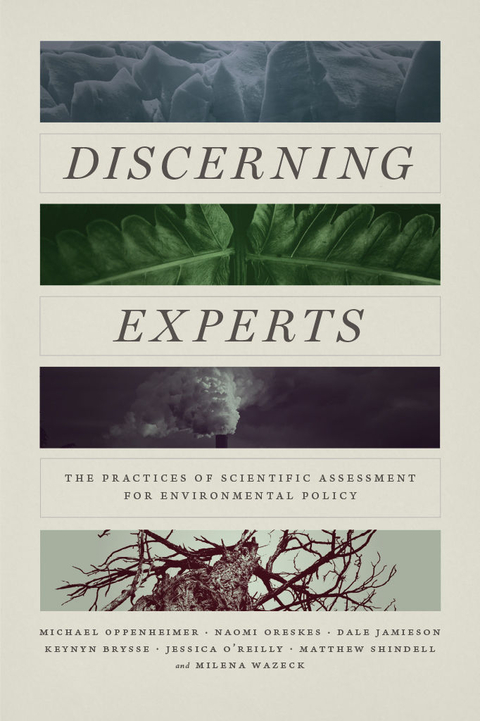
Discerning Experts
The Practices of Scientific Assessment for Environmental Policy
Seiten
2019
University of Chicago Press (Verlag)
978-0-226-60201-1 (ISBN)
University of Chicago Press (Verlag)
978-0-226-60201-1 (ISBN)
Evaluates expert assessments used by governments for advice on the science, economics, and policy options available to confront large-scale environmental problems
How do scientists evaluate environmental knowledge for public policy? Discerning Experts examines three sets of landmark environmental assessments involving acid rain, ozone depletion, and sea level rise, exploring how experts judge scientific evidence and determine what the scientific facts are. The three case studies also explore how scientists come to agreement on contested issues, why consensus is considered important, and what factors contribute to confusion, bias, and error, and how scientists understand and navigate the boundaries between science and policy. The authors also suggest strategies for improving the assessment process.
As the first study of the internal workings of large environmental assessments, this book explores the strengths and weaknesses of the assessment process and explains what it can—and cannot—be expected to contribute to public policy and the common good.
How do scientists evaluate environmental knowledge for public policy? Discerning Experts examines three sets of landmark environmental assessments involving acid rain, ozone depletion, and sea level rise, exploring how experts judge scientific evidence and determine what the scientific facts are. The three case studies also explore how scientists come to agreement on contested issues, why consensus is considered important, and what factors contribute to confusion, bias, and error, and how scientists understand and navigate the boundaries between science and policy. The authors also suggest strategies for improving the assessment process.
As the first study of the internal workings of large environmental assessments, this book explores the strengths and weaknesses of the assessment process and explains what it can—and cannot—be expected to contribute to public policy and the common good.
Michael Oppenheimer is the Albert G. Milbank Professor of Geosciences and International Affairs at Princeton University. Naomi Oreskes is professor of the history of science at Harvard University. Dale Jamieson is professor of environmental studies and philosophy at New York University. Keynyn Brysse is a historian of science with a focus on the history of paleontology. Jessica O'Reilly is an assistant professor of international studies at Indiana University Bloomington. Matthew Shindell is a space history curator at the Smithsonian's National Air and Space Museum in Washington, DC. Milena Wazeck is a historian of science and the author of Einstein's Opponents.
| Erscheinungsdatum | 04.02.2019 |
|---|---|
| Zusatzinfo | 1 halftone, 8 line drawings, 11 tables |
| Sprache | englisch |
| Maße | 152 x 229 mm |
| Themenwelt | Naturwissenschaften ► Biologie ► Ökologie / Naturschutz |
| Sozialwissenschaften ► Politik / Verwaltung ► Politische Theorie | |
| ISBN-10 | 0-226-60201-X / 022660201X |
| ISBN-13 | 978-0-226-60201-1 / 9780226602011 |
| Zustand | Neuware |
| Informationen gemäß Produktsicherheitsverordnung (GPSR) | |
| Haben Sie eine Frage zum Produkt? |
Mehr entdecken
aus dem Bereich


aus dem Bereich
Methoden – Lösungen – Anwendungen
Buch | Hardcover (2025)
Hanser (Verlag)
CHF 69,95


