


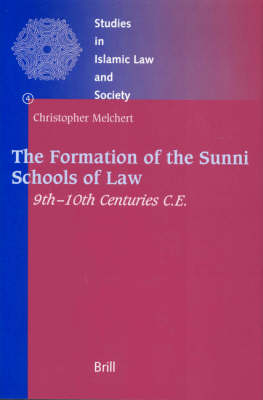
The Formation of the Sunni Schools of Law, 9th-10th Centuries C.E.
Seiten
1997
Brill (Verlag)
978-90-04-10952-0 (ISBN)
Brill (Verlag)
978-90-04-10952-0 (ISBN)
- Keine Verlagsinformationen verfügbar
- Artikel merken
Melchert traces the emergence of jurisprudence by ḥadīth, the personalization of the old regional schools in response, and finally the emergence of the classical, guild schools, with regular means of forming students, in the early tenth century.
The Sunni schools of law are named for jurisprudents of the eighth and ninth centuries, but they did not actually function so early. The main division at that time was rather between adherents of ra'y and ḥadīth. No school had a regular means of forming students.
Relying mainly on biographical dictionaries, this study traces the constitutive elements of the classical schools and finds that they first came together in the early tenth century, particularly with the work of Ibn Surayj (d. 306/918), al-Khallāl (d. 311/923), and a series of ḥanafī teachers ending with al-Karkhī (d. 340/952). Mālikism prospered in the West for political reasons, while the ẓāhirī and Jarīrī schools faded out due to their refusal to adopt the common new teaching methods.
In this book the author fleshes out these historical developments in a manner that will be extremely useful to the field, while at the same time developing some new and highly original perspectives.
The Sunni schools of law are named for jurisprudents of the eighth and ninth centuries, but they did not actually function so early. The main division at that time was rather between adherents of ra'y and ḥadīth. No school had a regular means of forming students.
Relying mainly on biographical dictionaries, this study traces the constitutive elements of the classical schools and finds that they first came together in the early tenth century, particularly with the work of Ibn Surayj (d. 306/918), al-Khallāl (d. 311/923), and a series of ḥanafī teachers ending with al-Karkhī (d. 340/952). Mālikism prospered in the West for political reasons, while the ẓāhirī and Jarīrī schools faded out due to their refusal to adopt the common new teaching methods.
In this book the author fleshes out these historical developments in a manner that will be extremely useful to the field, while at the same time developing some new and highly original perspectives.
Christopher Melchert, Ph.D. (1992) in History, University of Pennsylvania, is a student of Islamic movements and institutions of the ninth and tenth centuries C.E. He has published half a dozen articles besides this, his first book.
| Erscheint lt. Verlag | 1.11.1997 |
|---|---|
| Reihe/Serie | Studies in Islamic Law and Society ; 4 |
| Verlagsort | Leiden |
| Sprache | englisch |
| Maße | 155 x 235 mm |
| Gewicht | 562 g |
| Einbandart | Leinen |
| Themenwelt | Geschichte ► Allgemeine Geschichte ► Mittelalter |
| Geschichte ► Teilgebiete der Geschichte ► Kulturgeschichte | |
| Recht / Steuern ► Allgemeines / Lexika | |
| Recht / Steuern ► EU / Internationales Recht | |
| Sozialwissenschaften ► Soziologie | |
| ISBN-10 | 90-04-10952-8 / 9004109528 |
| ISBN-13 | 978-90-04-10952-0 / 9789004109520 |
| Zustand | Neuware |
| Informationen gemäß Produktsicherheitsverordnung (GPSR) | |
| Haben Sie eine Frage zum Produkt? |
Mehr entdecken
aus dem Bereich



aus dem Bereich
Geschichte einer Augsburger Familie (1367-1650)
Buch | Softcover (2024)
Kohlhammer (Verlag)
CHF 47,60


