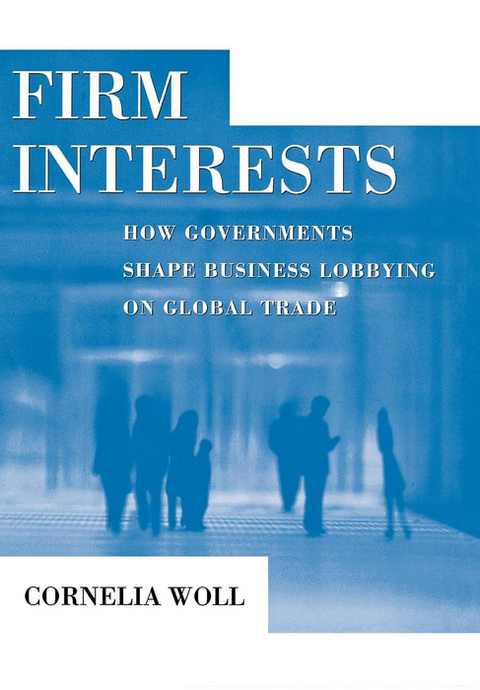
Firm Interests (eBook)
208 Seiten
Cornell University Press (Verlag)
978-1-5017-1149-7 (ISBN)
Firms are central to trade policy-making. Some analysts even suggest that they dictate policy on the basis of their material interests. Cornelia Woll counters these assumptions, arguing that firms do not always know what they want. To be sure, firms...
Firms are central to trade policy-making. Some analysts even suggest that they dictate policy on the basis of their material interests. Cornelia Woll counters these assumptions, arguing that firms do not always know what they want. To be sure, firms lobby hard to attain a desired policy once they have defined their goals. Yet material factors are insufficient to account for these preferences. The ways in which firms are embedded in political settings are much more decisive. Woll demonstrates her case by analyzing the surprising evolution of support from large firms for liberalization in telecommunications and international air transport in the United States and Europe. Within less than a decade, former monopolies with important home markets abandoned their earlier calls for subsidies and protectionism and joined competitive multinationals in the demand for global markets. By comparing the complex evolution of firm preferences across sectors and countries, Woll shows that firms may influence policy outcomes, but policies and politics in turn influence business demands. This is particularly true in the European Union, where the constraints of multilevel decision-making encourage firms to pay lip service to liberalization if they want to maintain good working relations with supranational officials. In the United States, firms adjust their sectoral demands to fit the government's agenda. In both contexts, the interaction between government and firm representatives affects not only the strategy but also the content of business lobbying on global trade.
Firms are central to trade policy-making. Some analysts even suggest that they dictate policy on the basis of their material interests. Cornelia Woll counters these assumptions, arguing that firms do not always know what they want. To be sure, firms lobby hard to attain a desired policy once they have defined their goals. Yet material factors are insufficient to account for these preferences. The ways in which firms are embedded in political settings are much more decisive.
Woll demonstrates her case by analyzing the surprising evolution of support from large firms for liberalization in telecommunications and international air transport in the United States and Europe. Within less than a decade, former monopolies with important home markets abandoned their earlier calls for subsidies and protectionism and joined competitive multinationals in the demand for global markets. By comparing the complex evolution of firm preferences across sectors and countries, Woll shows that firms may influence policy outcomes, but policies and politics in turn influence business demands. This is particularly true in the European Union, where the constraints of multilevel decision-making encourage firms to pay lip service to liberalization if they want to maintain good working relations with supranational officials. In the United States, firms adjust their sectoral demands to fit the government's agenda. In both contexts, the interaction between government and firm representatives affects not only the strategy but also the content of business lobbying on global trade.
Cornelia Woll is a Research Fellow at CERI-Sciences Po Paris, France, and the winner of the Seymour Martin Lipset Prize from the Society of Comparative Research in 2005.
| Erscheint lt. Verlag | 5.7.2018 |
|---|---|
| Reihe/Serie | Cornell Studies in Political Economy | Cornell Studies in Political Economy |
| Verlagsort | Ithaca |
| Sprache | englisch |
| Maße | 150 x 150 mm |
| Themenwelt | Sachbuch/Ratgeber ► Beruf / Finanzen / Recht / Wirtschaft ► Wirtschaft |
| Sozialwissenschaften ► Politik / Verwaltung ► Europäische / Internationale Politik | |
| Wirtschaft ► Betriebswirtschaft / Management ► Unternehmensführung / Management | |
| Wirtschaft ► Volkswirtschaftslehre ► Wirtschaftspolitik | |
| ISBN-10 | 1-5017-1149-0 / 1501711490 |
| ISBN-13 | 978-1-5017-1149-7 / 9781501711497 |
| Informationen gemäß Produktsicherheitsverordnung (GPSR) | |
| Haben Sie eine Frage zum Produkt? |
 PDF (Adobe DRM)
Kopierschutz: Adobe-DRM
Adobe-DRM ist ein Kopierschutz, der das eBook vor Mißbrauch schützen soll. Dabei wird das eBook bereits beim Download auf Ihre persönliche Adobe-ID autorisiert. Lesen können Sie das eBook dann nur auf den Geräten, welche ebenfalls auf Ihre Adobe-ID registriert sind.
Details zum Adobe-DRM
Dateiformat: PDF (Portable Document Format)
Mit einem festen Seitenlayout eignet sich die PDF besonders für Fachbücher mit Spalten, Tabellen und Abbildungen. Eine PDF kann auf fast allen Geräten angezeigt werden, ist aber für kleine Displays (Smartphone, eReader) nur eingeschränkt geeignet.
Systemvoraussetzungen:
PC/Mac: Mit einem PC oder Mac können Sie dieses eBook lesen. Sie benötigen eine
eReader: Dieses eBook kann mit (fast) allen eBook-Readern gelesen werden. Mit dem amazon-Kindle ist es aber nicht kompatibel.
Smartphone/Tablet: Egal ob Apple oder Android, dieses eBook können Sie lesen. Sie benötigen eine
Geräteliste und zusätzliche Hinweise
Buying eBooks from abroad
For tax law reasons we can sell eBooks just within Germany and Switzerland. Regrettably we cannot fulfill eBook-orders from other countries.
aus dem Bereich