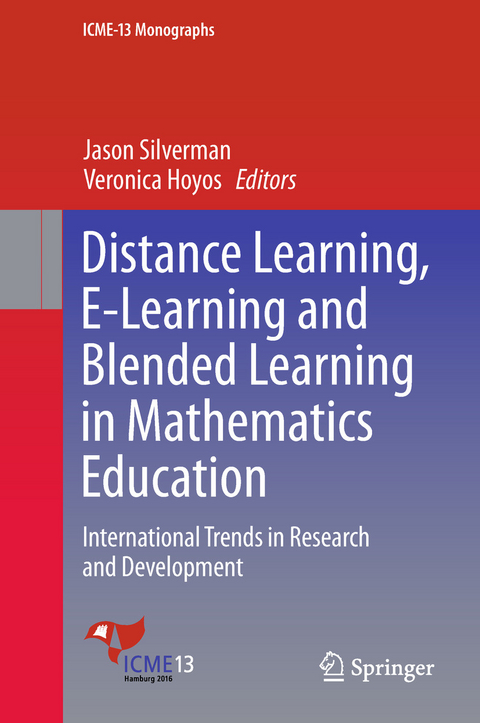
Distance Learning, E-Learning and Blended Learning in Mathematics Education (eBook)
VI, 220 Seiten
Springer International Publishing (Verlag)
978-3-319-90790-1 (ISBN)
This book builds on current and emerging research in distance learning, e-learning and blended learning. Specifically, it tests the boundaries of what is known by examining and discussing recent research and development in teaching and learning based on these modalities, with a focus on lifelong mathematics learning and teaching. The book is organized in four sections: The first section focuses on the incorporation of new technologies into mathematics classrooms through the construction or use of digital teaching and learning platforms. The second section presents a wide range of perspectives on the study and implementation of different tutoring systems and/or computer assisted math instruction. The third section presents four new innovations in mathematics learning and/or mathematics teacher education that involve the development of novel interfaces' for communicating mathematical ideas and analyzing student thinking and student work. Finally, the fourth section presents the latest work on the construction and implementation of new MOOCs and rich media platforms developed to carry out specialized mathematics teacher education.
Contents 6
1 Research on Technologically Mediated Mathematics Learning at a Distance: An Overview and Introduction 8
Abstract 8
1.1 Overview of Parts and Chapters 9
1.1.1 Part I: E-Learning and Blended Learning of Mathematics 9
1.1.2 Part II: Online Environments and Tutoring Systems for Leveling College Students’ Mathematics 10
1.1.3 Part III: Innovations on E-Math Learning and Teaching 11
1.1.4 Part IV: MOOC and Rich Media Platform for Mathematics Teacher Education 12
1.1.5 Purpose of This Monograph 13
E-Learning and Blended Learning of Mathematics 16
2 The Blended Learning Concept e:t:p:M@Math: Practical Insights and Research Findings 17
Abstract 17
2.1 Introduction: Challenging Trends in Higher Education 17
2.2 The Blended Learning Concept e:t:p:M® 18
2.2.1 “e” for E-Learning 18
2.2.2 “t” for Text and Theory Based 19
2.2.3 “p” for Practice-Oriented (and Attendance-Oriented) 19
2.2.4 “M” for Mentoring 20
2.3 Using e:t:p:M® in an Introductory Course in Mathematics 20
2.3.1 Existing Tools and e:t:p:M@Math Web-App 21
2.3.2 Research Questions 22
2.3.3 Series of Interactive Content (Sub-focus a) 22
2.3.4 Discussions (Sub-focus b) 23
2.3.5 Playground (Sub-focus c) 25
2.3.6 Content Editor (Sub-focus d) 25
2.3.7 Continuous Evaluation Strategy (Sub-focus e) 27
2.4 First Insights of the Use in Winter Semester 2015/2016 28
2.4.1 Evaluation Strategy and Questions 28
2.4.2 Usage of Web-Content (a) 29
2.4.3 Reconstruction of Interaction-Profiles (b) 30
2.4.3.1 Dataset and Analysis Toolkit 30
2.4.3.2 MCA Results and Interpretation 31
2.5 Conclusion 32
References 33
3 Challenges and Opportunities in Distance and Hybrid Environments for Technology-Mediated Mathematics Teaching and Learning 35
Abstract 35
3.1 Purpose of the Chapter 35
3.2 Hybrid Environments for the Integration of Technology into Mathematics Classroom 37
3.2.1 Antecedents in the Utilization of Hybrid Environments for Mathematics Teaching and Learning with Technology 37
3.2.2 Advances in Teacher Practice to Innovate by Involving Hybrid Learning Environments 38
3.3 The Challenge of Accomplishing Reflection Processes During Problem Solving in an Online Learning Environment 44
3.4 Conclusions 48
References 49
Online Environments and Tutoring Systems for Leveling College Students’ Mathematics Learning 52
4 Computer Assisted Math Instruction: A Case Study for MyMathLab Learning System 53
Abstract 53
4.1 Introduction 53
4.2 Significance of the Study 55
4.3 Theoretical Framework 56
4.3.1 Issues in Math Teaching and Learning 57
4.4 Methodology and Sampling 59
4.4.1 Methodology 59
4.4.2 Study Participants 60
4.4.3 Instrumentation 61
4.5 Data Analysis and Narrative of Findings 62
4.5.1 Hypothesis I 63
4.5.2 Hypothesis II 66
4.6 Discussion of Findings 67
4.7 Study Implications 68
4.8 Conclusion 69
References 70
5 Lessons Learned from a Calculus E-Learning System for First-Year University Students with Diverse Mathematics Backgrounds 73
Abstract 73
5.1 Introduction 74
5.2 Literature Review 75
5.3 Platform Design 76
5.4 Methodology 80
5.5 Data Analysis 81
5.5.1 Data Collection and Descriptive Statistics 81
5.5.2 Relationship Between E-Learning Participation and Calculus Background 83
5.5.3 Relationship Between Features of the Platform 86
5.5.4 Relationship Between Student Improvement and E-Learning Participation 88
5.5.5 Key Findings from Data Analyses 89
5.5.6 Reflections on Research Improvement 90
5.6 Policy Recommendations 90
5.6.1 Questionnaire Design 91
5.6.2 Recommendations for Future Improvement 91
5.7 Conclusion 94
Acknowledgements 94
Appendix 94
References 95
6 A Customized Learning Environment and Individual Learning in Mathematical Preparation Courses 97
Abstract 97
6.1 Introduction 98
6.1.1 Problems 98
6.1.2 Measures and Objectives 98
6.2 Customized Online Learning Environment 99
6.2.1 Mass Customization and Individualized Learning in an Adaptable Learning Environment 99
6.2.2 The Online Placement Test 99
6.2.3 The Personal Online Desk 103
6.2.4 Modules, Learning Sequences and Short Learning Track 104
6.2.5 Individualization Concerning the Field of Study 106
6.3 Repeated Opportunities to Practice 106
6.3.1 Questions and Exercises 106
6.3.2 Brief Activating Tasks and Applets 106
6.3.3 Exercises and Individual Feedback 107
6.3.4 Summative Assessment and Final Test 109
6.4 Matching Class Lectures 109
6.5 Evaluation Results 110
6.6 Summary and Outlook 113
Acknowledgements 114
References 114
Innovations on E-Math Learning and Teaching 116
7 Scripting Collaboration for Competence-Based Mathematics Learning: A Case Study on Argumentation 117
Abstract 117
7.1 Introduction 117
7.2 Theoretical Framework 118
7.3 The DIST-M Methodology 120
7.4 The Design of a DIST-M Concerning Argumentation 120
7.4.1 The Technological Innovations 121
7.4.2 The Frame Introduction 122
7.4.3 The Frame of Level 1 123
7.5 The Case Study 125
7.5.1 The Mathematical Problem 125
7.5.2 Methodology 125
7.5.3 Analysis Tools 126
7.6 Analysis and Discussion of the Outcomes 126
7.7 Conclusions 131
References 132
8 Effective Use of Math E-Learning with Questions Specification 134
Abstract 134
8.1 Introduction 135
8.2 Math E-Learning Systems in Japan 136
8.2.1 MATH ON WEB 136
8.2.2 STACK 137
8.2.3 Maple T.A. 138
8.2.4 Common Challenge 139
8.3 Math Input Interfaces 139
8.3.1 MathTOUCH 140
8.3.2 MathDox and FlickMath 141
8.4 Sharing Questions 142
8.4.1 Item Bank System: MathBank 143
8.4.2 Maple T.A. Cloud 143
8.4.3 Converting Content Between Different Systems and Building Common Base for Content Creation 143
8.4.4 Necessity of Common Base for Sharing Content 144
8.5 Mathematics E-Learning Questions Specification: MeLQS 144
8.5.1 Concept Design for Questions 145
8.5.2 Implementation Specification for Questions 145
8.5.3 Implementation of Questions in Math E-Learning System 146
8.6 Conclusion 146
Acknowledgements 147
References 147
9 Designing Interactive Technology to Scaffold Generative Pedagogical Practice 150
Abstract 150
9.1 Introduction 151
9.2 Designing the EnCoMPASS Environment 152
9.2.1 The Math Forum 153
9.2.2 The EnCoMPASS Environment 154
9.2.2.1 The Landscape of the EnCoMPASS Environment 154
9.2.2.2 Scaffolding Activities Consistent with the Math Forum’s Practices 156
9.2.2.3 Teachers’ Existing Practice 158
9.3 Examining Teachers’ Interactions Mediated by the EnCoMPASS Environment 159
9.3.1 Findings 159
9.3.1.1 Using the Tool’s Features for Their Intended Use 160
9.3.2 Linking Comments to Data 161
9.3.2.1 An Emerging Purpose for Feedback 162
9.4 Discussion 163
9.5 Conclusion 164
References 164
10 Supporting Teachers in Developing Their RiTPACK Through Using Video Cases in an Online Course 166
Abstract 166
10.1 Introduction 166
10.1.1 Overview of the Chapter 167
10.2 Context and Course Description 167
10.2.1 Course Curriculum and Organization 167
10.2.2 Theoretical Background: Pedagogical Underpinnings of Our Online Course 168
10.2.3 Course Evaluation and Reflections 169
10.3 The Study 170
10.3.1 The Aims of the Study 171
10.3.2 Using Video Cases—A Brief Review of Literature 172
10.3.3 Description of Our Video Cases 172
10.3.4 Piloting the Use of Video Cases 174
10.4 Participants and Data Sources 176
10.5 Data Analysis 176
10.5.1 The Case of Mark 177
10.5.1.1 Week 1 177
10.5.1.2 Week 2 177
10.5.1.3 Week 3 178
10.5.1.4 Week 4 179
10.5.1.5 End of Course Assignment 180
10.6 Implications and Conclusions 180
References 181
MOOC and Rich Media Platform for Mathematics Teacher Education 183
11 Design and Impact of MOOCs for Mathematics Teachers 184
Abstract 184
11.1 Introduction 185
11.2 Research on Design of Professional Development 186
11.2.1 Mathematics Professional Development 186
11.2.2 Online Professional Development 187
11.2.2.1 Personalization and Choice 187
11.2.2.2 Online Communities of Practice (CoP) 187
11.3 Design of Courses 188
11.3.1 Self-directed Learning 189
11.3.2 Peer-Supported Learning 189
11.3.3 Job-Connected Learning 190
11.3.4 Learning from Multiple Voices 190
11.4 Framing Learning Opportunities in the MOOC-Eds 191
11.5 Data Collection and Analysis 192
11.5.1 Engagement in the MOOCs 193
11.5.2 Impact of the MOOC-Eds on Educators’ Practices 194
11.6 Discussion/Conclusion 197
Acknowledgements 198
References 198
12 Describing Curricular Materials for Mathematics Teacher Education in an Online, Rich Media Platform 200
Abstract 200
12.1 Introduction 201
12.2 Considerations in Specifying the Content of Teacher Education 201
12.3 The Project and Platform Context that Informs This Chapter 202
12.4 Two Experiences that Illustrate What Teacher Educators Have Created and How Their Teacher Candidates Interact with Experiences 203
12.4.1 Representing Student Thinking in a Methods Course 204
12.4.2 Representing Classroom Teaching in a Mathematics Course 206
12.5 Describing the Fellows’ Teacher Education Materials 208
12.5.1 Representing Practice 209
12.5.2 Decomposing Practice into Practices and Representing Practices 211
12.5.3 Approximations of Practice and Representing One’s Practicing 213
12.5.3.1 Selecting a Response from a Fixed Set of Options 213
12.5.3.2 Respond as a Teacher 213
12.5.4 “Before” and “After” Depictions 215
12.6 Summary and Concluding Thoughts 216
Acknowledgements 216
References 217
| Erscheint lt. Verlag | 20.7.2018 |
|---|---|
| Reihe/Serie | ICME-13 Monographs | ICME-13 Monographs |
| Zusatzinfo | VI, 220 p. 55 illus. |
| Verlagsort | Cham |
| Sprache | englisch |
| Themenwelt | Sozialwissenschaften ► Pädagogik ► Schulpädagogik / Grundschule |
| Schlagworte | future education mathematics learning • hybrid education • Learning and Instruction • mathematics e-learning • mathematics learning and teaching • mathematics online education • mathematics online learning • mathematics online teaching • Mathematics Teaching • online education • Online Learning |
| ISBN-10 | 3-319-90790-5 / 3319907905 |
| ISBN-13 | 978-3-319-90790-1 / 9783319907901 |
| Informationen gemäß Produktsicherheitsverordnung (GPSR) | |
| Haben Sie eine Frage zum Produkt? |
 PDF (Wasserzeichen)
DRM: Digitales Wasserzeichen
Dieses eBook enthält ein digitales Wasserzeichen und ist damit für Sie personalisiert. Bei einer missbräuchlichen Weitergabe des eBooks an Dritte ist eine Rückverfolgung an die Quelle möglich.
Dateiformat: PDF (Portable Document Format)
Mit einem festen Seitenlayout eignet sich die PDF besonders für Fachbücher mit Spalten, Tabellen und Abbildungen. Eine PDF kann auf fast allen Geräten angezeigt werden, ist aber für kleine Displays (Smartphone, eReader) nur eingeschränkt geeignet.
Systemvoraussetzungen:
PC/Mac: Mit einem PC oder Mac können Sie dieses eBook lesen. Sie benötigen dafür einen PDF-Viewer - z.B. den Adobe Reader oder Adobe Digital Editions.
eReader: Dieses eBook kann mit (fast) allen eBook-Readern gelesen werden. Mit dem amazon-Kindle ist es aber nicht kompatibel.
Smartphone/Tablet: Egal ob Apple oder Android, dieses eBook können Sie lesen. Sie benötigen dafür einen PDF-Viewer - z.B. die kostenlose Adobe Digital Editions-App.
Buying eBooks from abroad
For tax law reasons we can sell eBooks just within Germany and Switzerland. Regrettably we cannot fulfill eBook-orders from other countries.
aus dem Bereich