


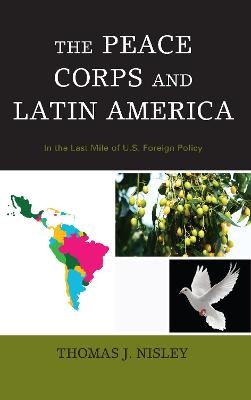
The Peace Corps and Latin America
In the Last Mile of U.S. Foreign Policy
Seiten
2018
Lexington Books (Verlag)
978-1-4985-4944-8 (ISBN)
Lexington Books (Verlag)
978-1-4985-4944-8 (ISBN)
- Titel ist leider vergriffen;
keine Neuauflage - Artikel merken
This book examines the role of the Peace Corps in U.S. foreign policy in Latin America from the 1960s to the present. The Peace Corps is an important tool of U.S. foreign policy that contributes on multiple levels in not only Latin America, but also everywhere the Peace Corps serves.
For almost 60 years, the United States government has sent more than 230,000 of its citizens abroad to serve as Peace Corps Volunteers (PCVs) for two-year tours, often in very poor countries. As these Volunteers work in grassroots development, helping to build local capacity, they also serve as citizen diplomats and contribute to U.S. public diplomacy. The unique experience of the Peace Corps provides the Volunteers knowledge and a profound understanding of another country or region of the world. Volunteers continue to serve their country as they bring their experience and knowledge back to the United States. Many of them go on to serve in the State Department and in the United States Agency for International Development. Some have even risen to the top ranks of the Foreign Service.
Thomas Nisley argues that the Peace Corps is an important tool of U.S. foreign policy that contributes on multiple levels. As these citizen diplomats do their work, they help to improve the popular image of the United States, contributing to U.S. “soft power.” Soft power is a co-optive power, getting others to want what you want.
After a general exploration of how the Peace Corps contributes to U.S. foreign policy, the book takes a direct focus on Latin America. Dr. Nisley provides evidence, along with a theoretical explanation, that PCVs do indeed improve the popular perception of the United States in Latin America. He then examines three different periods in U.S foreign policy toward Latin America and shows how the Peace Corps made its contribution.
Not all U.S. policy makers have equally recognized the role of the Peace Corps in U.S. foreign policy. Some have even dismissed it outright. This book argues that the Peace Corps plays an important role in U.S. foreign policy. Although the Peace Corps is much stronger today than it was in the late 1970s and early 1980s, U.S. foreign policy would be well served if the Peace Corps were further strengthen and expanded, not only in Latin America but in the world. We should consider the wider policy benefits of the Peace Corps.
For almost 60 years, the United States government has sent more than 230,000 of its citizens abroad to serve as Peace Corps Volunteers (PCVs) for two-year tours, often in very poor countries. As these Volunteers work in grassroots development, helping to build local capacity, they also serve as citizen diplomats and contribute to U.S. public diplomacy. The unique experience of the Peace Corps provides the Volunteers knowledge and a profound understanding of another country or region of the world. Volunteers continue to serve their country as they bring their experience and knowledge back to the United States. Many of them go on to serve in the State Department and in the United States Agency for International Development. Some have even risen to the top ranks of the Foreign Service.
Thomas Nisley argues that the Peace Corps is an important tool of U.S. foreign policy that contributes on multiple levels. As these citizen diplomats do their work, they help to improve the popular image of the United States, contributing to U.S. “soft power.” Soft power is a co-optive power, getting others to want what you want.
After a general exploration of how the Peace Corps contributes to U.S. foreign policy, the book takes a direct focus on Latin America. Dr. Nisley provides evidence, along with a theoretical explanation, that PCVs do indeed improve the popular perception of the United States in Latin America. He then examines three different periods in U.S foreign policy toward Latin America and shows how the Peace Corps made its contribution.
Not all U.S. policy makers have equally recognized the role of the Peace Corps in U.S. foreign policy. Some have even dismissed it outright. This book argues that the Peace Corps plays an important role in U.S. foreign policy. Although the Peace Corps is much stronger today than it was in the late 1970s and early 1980s, U.S. foreign policy would be well served if the Peace Corps were further strengthen and expanded, not only in Latin America but in the world. We should consider the wider policy benefits of the Peace Corps.
Thomas J. Nisley is professor of political science at Kennesaw State University
Ch. 1 - The Peace Corps Idea
Ch. 2 - The Peace Corps as an Instrument of U.S. Foreign Policy
Ch. 3 - The Contact Hypothesis, the Peace Corps and the Popular Perception of the U.S. in Latin America
Ch. 4 - Peace Corps, the Cold War, and Latin America: Alliance for Progress and Beyond
Ch. 5 - Reagan, the Peace Corps, and the Civil Wars in Central America
Ch. 6 - The Rise and Decline of the Peace Corps in Post-Cold War Latin America
Ch. 7 – Conclusion
| Erscheinungsdatum | 10.05.2021 |
|---|---|
| Zusatzinfo | 12 Tables |
| Sprache | englisch |
| Maße | 159 x 230 mm |
| Gewicht | 413 g |
| Themenwelt | Sozialwissenschaften ► Politik / Verwaltung ► Europäische / Internationale Politik |
| Sozialwissenschaften ► Politik / Verwaltung ► Politische Theorie | |
| ISBN-10 | 1-4985-4944-6 / 1498549446 |
| ISBN-13 | 978-1-4985-4944-8 / 9781498549448 |
| Zustand | Neuware |
| Informationen gemäß Produktsicherheitsverordnung (GPSR) | |
| Haben Sie eine Frage zum Produkt? |
Mehr entdecken
aus dem Bereich


aus dem Bereich
Amerikas Strategie der Vorherrschaft und der Kampf um Eurasien
Buch | Softcover (2024)
NOMEN Verlag
CHF 27,95
kurze Geschichte einer langen Beziehung
Buch | Hardcover (2025)
Suhrkamp (Verlag)
CHF 36,40
erfolgreiche Interessenvertretung durch Prozesskompetenz im komplexen …
Buch | Hardcover (2023)
Wiley-VCH (Verlag)
CHF 58,75


