


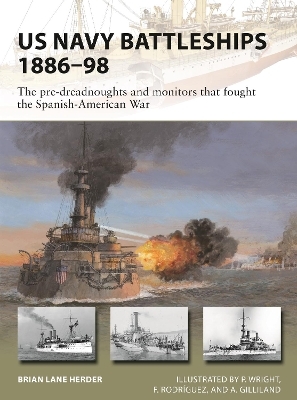
US Navy Battleships 1886–98
The pre-dreadnoughts and monitors that fought the Spanish-American War
Seiten
2019
Osprey Publishing (Verlag)
978-1-4728-3502-4 (ISBN)
Osprey Publishing (Verlag)
978-1-4728-3502-4 (ISBN)
The story of how the US Navy developed its first battleship fleet, their first combat test in the Spanish-American War and the battleships' careers through World War I.
After the American Civil War, the US Navy had been allowed to decay into complete insignificance.
Yet, the commissioning of the modern Brazilian battleship Riachuelo and poor performance against the contemporary Spanish fleet, forced the US out of its isolationist posture towards battleships.
The first true US battleships began with the experimental Maine and Texas, followed by the three-ship Indiana class, and the Iowa class, which incorporated lessons from the previous ships. These initial ships set the enduring US battleship standard of being heavily armed and armoured at the expense of speed.
This fully illustrated study examines these first six US battleships, a story of political compromises, clean sheet designs, operational experience, and experimental improvements. These ships directly inspired the creation of an embryonic American military-industrial complex, enabled a permanent outward-looking shift in American foreign policy and laid the foundations of the modern US Navy.
After the American Civil War, the US Navy had been allowed to decay into complete insignificance.
Yet, the commissioning of the modern Brazilian battleship Riachuelo and poor performance against the contemporary Spanish fleet, forced the US out of its isolationist posture towards battleships.
The first true US battleships began with the experimental Maine and Texas, followed by the three-ship Indiana class, and the Iowa class, which incorporated lessons from the previous ships. These initial ships set the enduring US battleship standard of being heavily armed and armoured at the expense of speed.
This fully illustrated study examines these first six US battleships, a story of political compromises, clean sheet designs, operational experience, and experimental improvements. These ships directly inspired the creation of an embryonic American military-industrial complex, enabled a permanent outward-looking shift in American foreign policy and laid the foundations of the modern US Navy.
Born in 1981, Brian Lane Herder graduated with a BA in History from the University of Kansas in 2003, and a Masters of Library Science from Emporia State University in 2009. He is a legislative librarian for the Kansas state government and his historical research interests include the US military, naval warfare, and World War II. He lives in Topeka, Kansas. Paul Wright has painted ships of all kinds for most of his career, specializing in steel and steam warships from the late 19th century to the present day.
Introduction
Development and Strategy
Design and Construction
US Battleship Weapons
The Last Monitors
The First Battleships
Operational History
The Spanish-American War 1898
Asiatic Operations
Conclusion
Bibliography
Index
| Erscheinungsdatum | 09.01.2019 |
|---|---|
| Reihe/Serie | New Vanguard |
| Illustrationen | Paul Wright, Felipe Rodríguez, Alan Gilliland |
| Zusatzinfo | Illustrated throughout with 40 photos and 8 pages of colour illustrations |
| Sprache | englisch |
| Maße | 180 x 239 mm |
| Gewicht | 196 g |
| Themenwelt | Sachbuch/Ratgeber ► Geschichte / Politik ► Allgemeines / Lexika |
| Geschichte ► Teilgebiete der Geschichte ► Militärgeschichte | |
| Sozialwissenschaften ► Politik / Verwaltung | |
| ISBN-10 | 1-4728-3502-6 / 1472835026 |
| ISBN-13 | 978-1-4728-3502-4 / 9781472835024 |
| Zustand | Neuware |
| Informationen gemäß Produktsicherheitsverordnung (GPSR) | |
| Haben Sie eine Frage zum Produkt? |
Mehr entdecken
aus dem Bereich



aus dem Bereich
von der Wiederbewaffnung bis zur Zeitenwende
Buch | Softcover (2025)
C.H.Beck (Verlag)
CHF 16,80
Deutschlands großer Volksaufstand
Buch | Softcover (2024)
Propyläen Verlag
CHF 30,80


