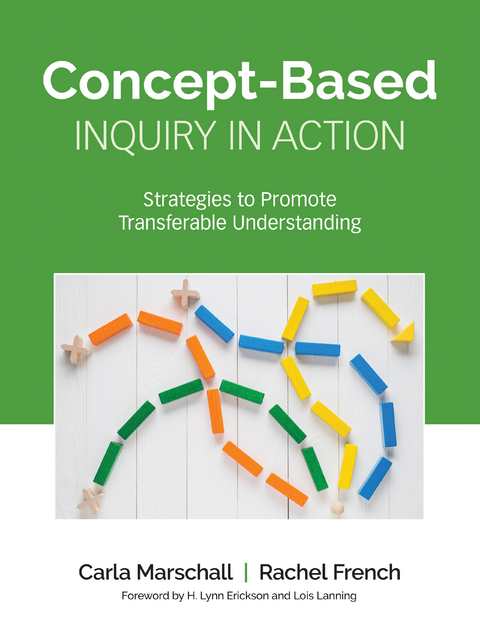
Concept-Based Inquiry in Action (eBook)
368 Seiten
Corwin (Verlag)
978-1-5063-9127-4 (ISBN)
Foreword by H. Lynn Erickson and Lois A. Lanning
Acknowledgments
About the Authors
About the Illustrator
Introduction
Chapter 1: The Foundations of Concept-Based Inquiry
Bringing Together Inquiry-Based and Concept-Based Learning
Part 1: Exploring Inquiry-Based Learning
Inquiry Approaches in Concept-Based Inquiry
Part 2: Exploring Concept-Based Learning
Concepts as Organizers
The Structures of Knowledge and Process
Disciplines Draw From Knowledge and Process
Pause and Reflect
Chapter 2: Concept-Based Inquiry
A Model of Concept-Based Inquiry
The Phases of Concept-Based Inquiry
The Complexity of Inquiry
Concept-Based Inquiry and the Inductive Approach
Creating a Culture of Concept-Based Inquiry
Pause and Reflect
Chapter 3: Planning for Concept-Based Inquiry
What Planning Steps Support Concept-Based Inquiry?
How Can Teachers Enhance Their Understanding of a Unit?
What Role Do Guiding Questions Play in Concept-Based Inquiry?
What Do the Phases of Concept-Based Inquiry Look Like in a Unit?
Pacing in Concept-Based Inquiry
How Do the Phases of Inquiry Support Teacher Planning for Concept-Based Inquiry?
What Are Approaches for Making Interdisciplinary Links?
Connecting to the Phases of Inquiry
Pause and Reflect
Chapter 4: Engage
Activating Prior Knowledge Using Engagement Strategies
Using Strategies to Motivate Students
Initial Questions, Initial Thinking
Rethinking Our Use of Engagement Strategies
Opinion-Based Strategies
Experiential Strategies
Discussion-Based Strategies
Assessment in the Engage Phase
Connecting Phases of Inquiry
Pause and Reflect
Chapter 5: Focus
Using Concept Formation Strategies to Focus an Inquiry
Concepts Provide Breadth and Depth
Levels of Conceptual Thinking
Effective Concept Formation Practices
Concept Formation Strategies: Deductive and Inductive Approaches
Choosing Concept Formation Strategies
Assessment in the Focus Phase
Connecting Phases of Inquiry
Pause and Reflect
Chapter 6: Investigate
The Power of Factual Examples
Case Study Approaches
Focus on Skill Development
A Preface to Strategies
Assessment in the Investigate Phase
Connecting Phases of Inquiry
Pause and Reflect
Chapter 7: Organize
Making Meaning Using Organizers
Cognitive Load Theory and the Importance of Organizing
Representation and Conceptual Understanding
Sharing Findings as a Community of Inquirers
A Preface to Strategies
Assessment in the Organize Phase
Connecting Phases of Inquiry
Pause and Reflect
Chapter 8: Generalize
An Inductive Approach to Generalizing
Developing Strong Generalizations
Scaffolding Thinking
The Value of Recording Generalizations
The Importance of Discussion
A Preface to Strategies
Assessment in the Generalize Phase
Connecting Phases of Inquiry
Pause and Reflect
Chapter 9: Transfer
Transfer That Deepens Understanding
Testing and Justifying Generalizations
Understanding New Events and Situations
Predicting and Hypothesizing
Applying Learning
Taking Action
Assessment in the Transfer Phase
Connecting Phases of Inquiry
Pause and Reflect
Chapter 10: Reflect
The Power of Reflection
The Reflective Cycle
Building Agency
Reflection Throughout the Inquiry
Assessing Reflection Throughout the Inquiry
Connecting Phases of Inquiry
Pause and Reflect
Chapter 11: Concluding Thoughts
A Vision for Thinking Classrooms
Understand and Adapt
Resources
Resource A. Concept-Based Inquiry Glossary of Terms
Resource B. Concept-Based Inquiry Planner
Resource C. Sample Concept-Based Inquiry Planner: Industrialization Unit
References
Index
| Reihe/Serie | Corwin Teaching Essentials | Corwin Teaching Essentials |
|---|---|
| Verlagsort | Thousand Oaks |
| Sprache | englisch |
| Themenwelt | Schulbuch / Wörterbuch ► Unterrichtsvorbereitung |
| Sozialwissenschaften ► Pädagogik | |
| Schlagworte | Teaching methods |
| ISBN-10 | 1-5063-9127-3 / 1506391273 |
| ISBN-13 | 978-1-5063-9127-4 / 9781506391274 |
| Informationen gemäß Produktsicherheitsverordnung (GPSR) | |
| Haben Sie eine Frage zum Produkt? |
 EPUB (Adobe DRM)
Kopierschutz: Adobe-DRM
Adobe-DRM ist ein Kopierschutz, der das eBook vor Mißbrauch schützen soll. Dabei wird das eBook bereits beim Download auf Ihre persönliche Adobe-ID autorisiert. Lesen können Sie das eBook dann nur auf den Geräten, welche ebenfalls auf Ihre Adobe-ID registriert sind.
Details zum Adobe-DRM
Dateiformat: EPUB (Electronic Publication)
EPUB ist ein offener Standard für eBooks und eignet sich besonders zur Darstellung von Belletristik und Sachbüchern. Der Fließtext wird dynamisch an die Display- und Schriftgröße angepasst. Auch für mobile Lesegeräte ist EPUB daher gut geeignet.
Systemvoraussetzungen:
PC/Mac: Mit einem PC oder Mac können Sie dieses eBook lesen. Sie benötigen eine
eReader: Dieses eBook kann mit (fast) allen eBook-Readern gelesen werden. Mit dem amazon-Kindle ist es aber nicht kompatibel.
Smartphone/Tablet: Egal ob Apple oder Android, dieses eBook können Sie lesen. Sie benötigen eine
Geräteliste und zusätzliche Hinweise
Buying eBooks from abroad
For tax law reasons we can sell eBooks just within Germany and Switzerland. Regrettably we cannot fulfill eBook-orders from other countries.
aus dem Bereich