


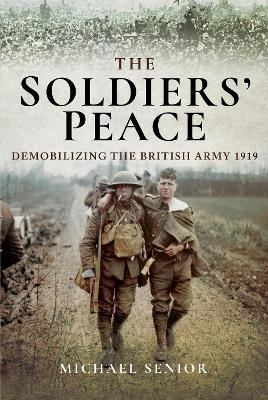
The Soldiers' Peace
Demobilizing the British Army 1919
Seiten
2018
Pen & Sword Military (Verlag)
978-1-5267-0304-0 (ISBN)
Pen & Sword Military (Verlag)
978-1-5267-0304-0 (ISBN)
A vivid, wide-ranging account of how Britain coped with the demobilization of the British army after the First World War, describes how over three million soldiers were returned to peacetime life.
Armistice in 1918 presented the British government with an enormous challenge - how could the British army that had been built up on an unprecedented scale during the war be cut back to a peacetime size and how could millions of soldiers be returned to civilian life?
In November 1918, the last month of the war, the British army numbered 3.75 million. One year later that number was reduced to 890,000/. This was a remarkable feat of demobilization but, as Michael Senior shows, it was by no means a trouble-free process. He describes in vivid detail how demobilization took place, the acute difficulties that arose, and how they were dealt with.
The obstacles that had to be overcome were legion, and urgent, for the task had to be completed rapidly to prevent social unrest. At the same time prisoners of war had to be repatriated, the wounded and maimed had to be cared for and permanent cemeteries had to be laid out for the battlefield dead. In addition, war materiel had to be disposed and the army had to be reorganized into a force suitable for the challenges of 1919/.
The task was immense, as were the risks, and Michael Senior's study makes fascinating reading.
Armistice in 1918 presented the British government with an enormous challenge - how could the British army that had been built up on an unprecedented scale during the war be cut back to a peacetime size and how could millions of soldiers be returned to civilian life?
In November 1918, the last month of the war, the British army numbered 3.75 million. One year later that number was reduced to 890,000/. This was a remarkable feat of demobilization but, as Michael Senior shows, it was by no means a trouble-free process. He describes in vivid detail how demobilization took place, the acute difficulties that arose, and how they were dealt with.
The obstacles that had to be overcome were legion, and urgent, for the task had to be completed rapidly to prevent social unrest. At the same time prisoners of war had to be repatriated, the wounded and maimed had to be cared for and permanent cemeteries had to be laid out for the battlefield dead. In addition, war materiel had to be disposed and the army had to be reorganized into a force suitable for the challenges of 1919/.
The task was immense, as were the risks, and Michael Senior's study makes fascinating reading.
Dr Michael Senior has had a life-long interest in the First World War and, since his retirement, he has devoted much of his time to research, lecturing and writing about aspects of the Western Front. He has had articles published by the Western Front Association of which he is a member. His books include Fromelles 1916, Haking: A Dutiful Soldier and Victory on the Western Front: The Development of the British Army 1914-1918.
| Erscheinungsdatum | 11.12.2018 |
|---|---|
| Zusatzinfo | 30 illustrations |
| Verlagsort | South Yorkshire |
| Sprache | englisch |
| Maße | 156 x 234 mm |
| Themenwelt | Geisteswissenschaften ► Geschichte ► Allgemeines / Lexika |
| Geschichte ► Allgemeine Geschichte ► Neuzeit (bis 1918) | |
| Geisteswissenschaften ► Geschichte ► Regional- / Ländergeschichte | |
| Sozialwissenschaften ► Politik / Verwaltung | |
| ISBN-10 | 1-5267-0304-1 / 1526703041 |
| ISBN-13 | 978-1-5267-0304-0 / 9781526703040 |
| Zustand | Neuware |
| Informationen gemäß Produktsicherheitsverordnung (GPSR) | |
| Haben Sie eine Frage zum Produkt? |
Mehr entdecken
aus dem Bereich

aus dem Bereich
Geschichte einer wilden Handlung
Buch | Hardcover (2024)
C.H.Beck (Verlag)
CHF 47,60


