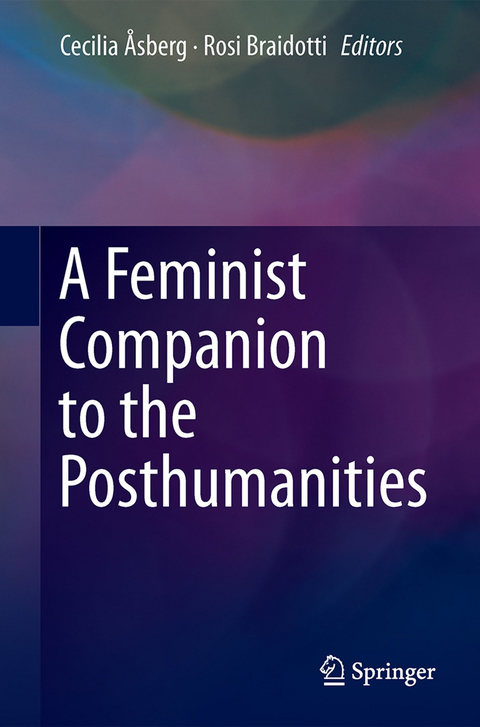
A Feminist Companion to the Posthumanities (eBook)
X, 245 Seiten
Springer International Publishing (Verlag)
978-3-319-62140-1 (ISBN)
This companion is a cutting-edge primer to critical forms of the posthumanities and the feminist posthumanities, aimed at students and researchers who want to catch up with the recent theoretical developments in various fields in the humanities, such as new media studies, gender studies, cultural studies, science and technology studies, human animal studies, postcolonial critique, philosophy and environmental humanities. It contains a collection of nineteen new and original short chapters introducing influential concepts, ideas and approaches that have shaped and developed new materialism, inhuman theory, critical posthumanism, feminist materialism, and posthuman philosophy. A resource for students and teachers, this comprehensive volume brings together established international scholars and emerging theorists, for timely and astute definitions of a moving target - posthuman humanities and feminist posthumanities.
Cecilia Åsberg, Professor of Gender, Nature, Culture at Tema Genus, Linköping University, is the founding director of The Posthumanities Hub and the Seed Box: An Environmental Humanities Collaboratory. She teaches, collaborates and publishes essays in the intersections of gender studies and feminist theory, media and cultural studies, science and technology studies, human animal studies and other forms of posthumanities such as medical, digital and environmental humanities. Recent publications include Debates in Nordic Gender Studies: Differences Within; Glocal Pharma: International Brands and the Imagination of Local Masculinity, with Ericka Johnson and Ebba Sjögren; Posthumanistiska nyckeltexter; Animal Places, with Tora Holmberg and Jacob Bull. Åsberg is Co-Director of GEXcel International Collegium for Advanced Trandisciplinary Gender Studes.
Rosi Braidotti (B.A. Hons. Australian National University, 1978; PhD, Université de Paris, Panthéon-Sorbonne, 1981; Honorary Degrees Helsinki, 2007 and Linkoping, 2013) is Distinguished University Professor and founding Director of the Centre for the Humanities at Utrecht University. Her latest books are: Conflicting Humanities (co-edited with Paul Gilroy), London: Bloomsbury, 2016; The Posthuman, Cambridge: Polity Press, 2013; Nomadic Subjects, New York: Columbia University Press, 2011 (second, revised ed.) and Nomadic Theory: The Portable Rosi Braidotti, Columbia University Press, 2011.
Cecilia Åsberg, Professor of Gender, Nature, Culture at Tema Genus, Linköping University, is the founding director of The Posthumanities Hub and the Seed Box: An Environmental Humanities Collaboratory. She teaches, collaborates and publishes essays in the intersections of gender studies and feminist theory, media and cultural studies, science and technology studies, human animal studies and other forms of posthumanities such as medical, digital and environmental humanities. Recent publications include Debates in Nordic Gender Studies: Differences Within; Glocal Pharma: International Brands and the Imagination of Local Masculinity, with Ericka Johnson and Ebba Sjögren; Posthumanistiska nyckeltexter; Animal Places, with Tora Holmberg and Jacob Bull. Åsberg is Co-Director of GEXcel International Collegium for Advanced Trandisciplinary Gender Studes. Rosi Braidotti (B.A. Hons. Australian National University, 1978; PhD, Université de Paris, Panthéon-Sorbonne, 1981; Honorary Degrees Helsinki, 2007 and Linkoping, 2013) is Distinguished University Professor and founding Director of the Centre for the Humanities at Utrecht University. Her latest books are: Conflicting Humanities (co-edited with Paul Gilroy), London: Bloomsbury, 2016; The Posthuman, Cambridge: Polity Press, 2013; Nomadic Subjects, New York: Columbia University Press, 2011 (second, revised ed.) and Nomadic Theory: The Portable Rosi Braidotti, Columbia University Press, 2011.
1. Feminist Posthumanities: An Introduction.- 2. Passionately Posthuman: From Feminist Disidentifications to Postdisciplinary Posthumanities.- 3. Posthuman Sexuality: From Ahumanity to Cosmogenic Desire.- 4. Material Feminism in the Anthropocene.- 5. Posthuman Phenomenologies for Planetary Bodies of Water.- 6.Couch grass: Ethics of the Rhizome.- 7. Algorithmic Tumult and the Brilliance of Chelsea Manning.- 8. Embodying the Posthuman Subject: Digital Humanities and Permeable Material Practice.- 9. Sonic Performance and Feminist Posthumanities: Democracy of Resonance and Machinic Sounds.- 10. Intersections: The Animal Question meets Feminist Theory.- 11. Archaeological Posthumanities: Feminist Re-invention of Science and Material Pasts.- 12. On Preparations: Engaging with Inhuman Materialities.- 13. Queer Disability, Postcolonial Feminism and the Monsters of Evolution.- 14. Re/membering the body.- 15. “Let me show you”: A caring ethnography of embodied knowledge in weaving and engineering.- 16. Anatomical Assemblages: Medical Technologies, Bodies and their Entangled Practices.- 17. Practising Ambivalence: The Feminist Politics of Engaging with Technoscience.- 18. The Fabrication of a New Materialisms Researcher Subjectivity.- 19. Posthumanist Performativity: Toward an Understanding of How Matter Comes to Matter.
| Erscheint lt. Verlag | 17.5.2018 |
|---|---|
| Zusatzinfo | X, 245 p. 14 illus. |
| Verlagsort | Cham |
| Sprache | englisch |
| Themenwelt | Geisteswissenschaften ► Philosophie ► Allgemeines / Lexika |
| Sozialwissenschaften ► Politik / Verwaltung | |
| Schlagworte | biomolecular archeology • Environmental Humanities • posthumanism • posthuman subjects and methods • post-structuralisms • trans-corporeal posthumanism |
| ISBN-10 | 3-319-62140-8 / 3319621408 |
| ISBN-13 | 978-3-319-62140-1 / 9783319621401 |
| Informationen gemäß Produktsicherheitsverordnung (GPSR) | |
| Haben Sie eine Frage zum Produkt? |
 PDF (Wasserzeichen)
DRM: Digitales Wasserzeichen
Dieses eBook enthält ein digitales Wasserzeichen und ist damit für Sie personalisiert. Bei einer missbräuchlichen Weitergabe des eBooks an Dritte ist eine Rückverfolgung an die Quelle möglich.
Dateiformat: PDF (Portable Document Format)
Mit einem festen Seitenlayout eignet sich die PDF besonders für Fachbücher mit Spalten, Tabellen und Abbildungen. Eine PDF kann auf fast allen Geräten angezeigt werden, ist aber für kleine Displays (Smartphone, eReader) nur eingeschränkt geeignet.
Systemvoraussetzungen:
PC/Mac: Mit einem PC oder Mac können Sie dieses eBook lesen. Sie benötigen dafür einen PDF-Viewer - z.B. den Adobe Reader oder Adobe Digital Editions.
eReader: Dieses eBook kann mit (fast) allen eBook-Readern gelesen werden. Mit dem amazon-Kindle ist es aber nicht kompatibel.
Smartphone/Tablet: Egal ob Apple oder Android, dieses eBook können Sie lesen. Sie benötigen dafür einen PDF-Viewer - z.B. die kostenlose Adobe Digital Editions-App.
Buying eBooks from abroad
For tax law reasons we can sell eBooks just within Germany and Switzerland. Regrettably we cannot fulfill eBook-orders from other countries.
aus dem Bereich