


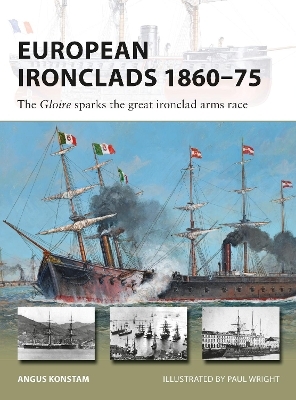
European Ironclads 1860–75
The Gloire sparks the great ironclad arms race
Seiten
2019
Osprey Publishing (Verlag)
978-1-4728-2676-3 (ISBN)
Osprey Publishing (Verlag)
978-1-4728-2676-3 (ISBN)
The story of the most revolutionary period in naval history - the first iron-hulled, steam-powered warships, their first battles at sea, and the great arms race that followed.
From Spain to Russia, and from Ottoman Turkey to Bismarck’s Prussia, this book explores 15 years that transformed European naval warfare.
When the Gloire slid down the Toulon slipway in 1859, it changed sea power forever. With this ship, the world’s first oceangoing ironclad, France had a warship that could sink any other, and which was proof against the guns of any wooden ship afloat. Instantly, an arms race began between the great navies of Europe – first to build their own ironclads, and then to surpass each other’s technology and designs.
As both armour and gun technology rapidly improved, naval architects found new ways to mount and protect guns. The ram briefly came back into fashion, and Italian and Austro-Hungarian fleets fought the ironclad era’s great battle at Lissa. By the end of this revolutionary period, the modern battleship was becoming recognizable, and new naval powers were emerging to dominate Europe’s waters.
From Spain to Russia, and from Ottoman Turkey to Bismarck’s Prussia, this book explores 15 years that transformed European naval warfare.
When the Gloire slid down the Toulon slipway in 1859, it changed sea power forever. With this ship, the world’s first oceangoing ironclad, France had a warship that could sink any other, and which was proof against the guns of any wooden ship afloat. Instantly, an arms race began between the great navies of Europe – first to build their own ironclads, and then to surpass each other’s technology and designs.
As both armour and gun technology rapidly improved, naval architects found new ways to mount and protect guns. The ram briefly came back into fashion, and Italian and Austro-Hungarian fleets fought the ironclad era’s great battle at Lissa. By the end of this revolutionary period, the modern battleship was becoming recognizable, and new naval powers were emerging to dominate Europe’s waters.
Angus Konstam is a Fellow of the Royal Historical Society and has written widely on naval history, with well over a hundred books in print. He is a former Royal Navy officer, maritime archaeologist and museum curator. Now a full-time author and historian, he lives in Orkney. Paul Wright has painted ships of all kinds for most of his career, specializing in steel and steam warships from the late 19th century to the present day. A Member of the Royal Society of Marine Artists, Paul lives and works in Surrey.
Introduction
Design & Development
Tactical Requirements
Armour
Ordnance
Propulsion
Life on Board
Ironclads in Action
Specifications
Bibliography
| Erscheinungsdatum | 22.04.2019 |
|---|---|
| Reihe/Serie | New Vanguard |
| Illustrationen | Paul Wright |
| Zusatzinfo | Illustrated throughout with 40 photos and 8 pages of colour illustrations |
| Sprache | englisch |
| Maße | 182 x 246 mm |
| Gewicht | 160 g |
| Themenwelt | Sachbuch/Ratgeber ► Geschichte / Politik ► Allgemeines / Lexika |
| Natur / Technik ► Fahrzeuge / Flugzeuge / Schiffe ► Militärfahrzeuge / -flugzeuge / -schiffe | |
| Geschichte ► Teilgebiete der Geschichte ► Militärgeschichte | |
| Sozialwissenschaften ► Politik / Verwaltung | |
| ISBN-10 | 1-4728-2676-0 / 1472826760 |
| ISBN-13 | 978-1-4728-2676-3 / 9781472826763 |
| Zustand | Neuware |
| Informationen gemäß Produktsicherheitsverordnung (GPSR) | |
| Haben Sie eine Frage zum Produkt? |
Mehr entdecken
aus dem Bereich
aus dem Bereich
von der frühen Neuzeit bis ins Computerzeitalter
Buch | Hardcover (2025)
De Gruyter (Verlag)
CHF 83,90


