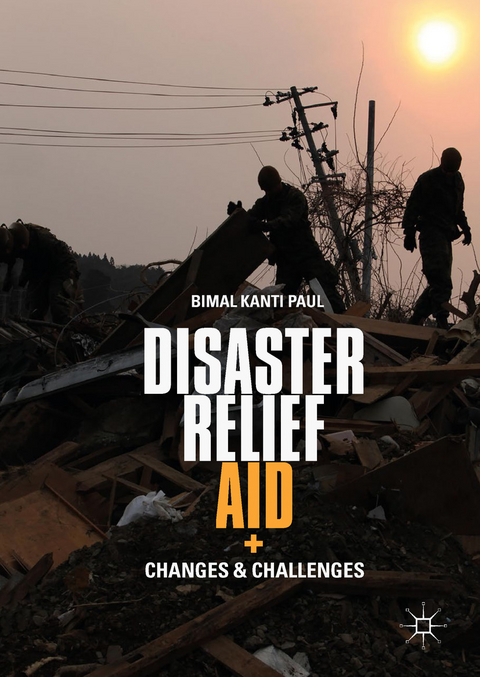
Disaster Relief Aid (eBook)
XXX, 262 Seiten
Springer International Publishing (Verlag)
9783319772820 (ISBN)
Disaster Relief Aid: Changes and Challenges provides a comprehensive analysis of disaster relief efforts undertaken globally during the last several decades, and examines the changes and challenges that have emerged over time. The book evaluates the current state of disaster relief and discusses how it may be improved. The author examines salient features of disaster relief operations and provides an overview of the development of global humanitarian assistance programs. The book also explores how disaster aid is channelled from non-affected areas to affected areas. Using five major natural and man-made disasters as case studies, the book analyses the nature and extent of emergency relief efforts undertaken for each. The final chapter covers the post-disaster convergence phenomenon; outlines the major challenges of international disaster relief operation and finally, posits recommendations on how to improve future disaster relief efforts.
This is an essential interdisciplinary text on disaster response for both undergraduate and graduate students as well as an invaluable resource for disaster researchers, managers, and numerous international and national non-governmental organizations (NGOs) and international agencies.
Bimal Kanti Paul is a Professor of Geography at Kansas State University, USA. His core areas of geographic research are in human-environment interactions, population and health geographies, geospatial analysis and application.
Bimal Kanti Paul is a Professor of Geography at Kansas State University, USA. His core areas of geographic research are in human-environment interactions, population and health geographies, geospatial analysis and application.
The first part of Chapter 1 defines salient features of disaster relief operations and briefly chronicles the development of global humanitarian assistance programs. The next section of Chapter 1 summarizes major criticisms of disaster aid provision and also outlines the need for disbursement of assistance to disaster survivors. This is accomplished in part by providing several definitions of natural disasters wherein the need for emergency relief aid for survivors of extreme natural events are either explicit or embedded. The chapter concludes with the book’s objectives and chapter outline. Disaster Relief Aid Background of Humanitarian Assistance Criticisms of Disaster Aid Provision Need for Disaster Relief Aid Objectives of this Book Chapter Arrangements Chapter 2 explains how disaster aid flows from a plethora of private, public, humanitarian, business, and non-profit organizations, as well as individuals from both affected and non-affected areas/countries, to survivors of extreme natural events. This chapter also covers other relevant information such as providers and distributors of emergency aid and issues associated with participation of domestic and foreign military forces in disaster relief operations. This is followed by a final section dealing with problems and challenges associated with disaster aid flows. International Humanitarian System Flash Appeal Pledge and Flow of Relief Aid Needs Assessment, Logistics and Management Providers of Disaster Aid Distributors of Disaster Aid Participation of Foreign Military Forces Participation of Domestic Military Forces Funding Guidelines (GHD and Others Determinants of Disaster Aid Crucial aspects of disaster relief (e.g., timeliness, appropriateness, and coordination and cooperation) that ultimately determine the success of any single operation are presented in Chapter 3, along with a discussion on how agencies involved in disaster relief operations and maintain partnerships and networks. This chapter provides background for understanding the strengths and weaknesses of disaster aid disbursement. Several disaster relief and network models are also discussed. Success/Failure Indicators of Disaster Relief Operations Timeliness Coordination and Cooperation Inequitable Distribution Human Right Violations Misuse and Non-use of Relief Fund Partnership and Networking Numerical Disaster Relief and Networks Models Chapter 4 provides an overview of the nature and extent of emergency relief efforts undertaken in countries impacted by the 2004 Indian Ocean Tsunami (IOT), Hurricane Katrina, and the Kashmir and Nepal earthquakes, along with some basic statistics regarding these disasters. The weaknesses and strengths of each one of these disaster operation are reviewed. This review is essential for improving future emergency relief operations. Additionally, each of the operation considered in this chapter is fundamental for understanding the dynamics of the relief process. The 2004 Indian Ocean Tsunami Global Generosity Domestic Generosity Competition and Cooperation The 2005 Hurricane Katrina Official Response Non-official Response International Response The 2005 Kashmir Earthquake Global Response Participation of Foreign Military Earthquake Relief and LoC Participation of National Army The 2015 Nepal Earthquake Problems in Organizing Disaster Relief Aid Domestic and International Response Effectiveness of Emergency Aid Unnecessary and useless relief items to those who have suffered a disaster have been a perpetual problem across the globe. This spontaneous flow of supplies hampers and complicates emergency relief efforts. This post-disaster convergence phenomenon is the subject of Chapter 5. There are three forms of convergence: personal (the influx of emergency response personnel and all types of individuals, including affiliated or non-affiliated local/national and foreign volunteers, and members of search, rescue and medical teams); informational (the flow of information and communication); and material (movement of physical resources, like (solicited or unsolicited) donated goods, supplies, and/or equipment sent by all entities in response to a disaster). All these components of convergence phenomenon and their effects on disaster relief activities are examined in this chapter. History of Convergence Phenomenon Convergence of Personnel Convergence of Information Convergence of Materials Advantages and Disadvantages Current Strategies Used to Control Convergence Recommendations The final chapter (Chapter 6) outlines the progress so far made in global disaster relief efforts during the last decades, along with the challenges such efforts have confronted in recent years. Based on these challenges, recommendations are made to improve future disaster relief efforts. Problems and Challenges Lessons Learned Progress Recommendations In addition, a glossary of disaster relief-related organizations and agencies (e.g., ALNAP, DAC, DEC, FTS, and GHD) will be included at the end of the proposed book.
| Erscheint lt. Verlag | 7.5.2018 |
|---|---|
| Zusatzinfo | XXX, 262 p. 7 illus. |
| Verlagsort | Cham |
| Sprache | englisch |
| Themenwelt | Naturwissenschaften ► Geowissenschaften ► Geografie / Kartografie |
| Sozialwissenschaften ► Politik / Verwaltung | |
| Sozialwissenschaften ► Soziologie | |
| Schlagworte | Acceptable list of necessary relief items • Biased relief distribution • disaster management • disaster relief aid • Environmental Geography • Environmental Management • Flow of Relief Aid and Pledge • Good Humanitarian Donorship • Human ecological tradition • Humanitarian Assistance • humanitarianism and volunteerism • natural disasters • Post-Disaster Needs Assessment • Social Networks as Providers and Distributors of Disaster Relief • Ways to Improve Humanitarian Logistics |
| ISBN-13 | 9783319772820 / 9783319772820 |
| Informationen gemäß Produktsicherheitsverordnung (GPSR) | |
| Haben Sie eine Frage zum Produkt? |
 PDF (Wasserzeichen)
DRM: Digitales Wasserzeichen
Dieses eBook enthält ein digitales Wasserzeichen und ist damit für Sie personalisiert. Bei einer missbräuchlichen Weitergabe des eBooks an Dritte ist eine Rückverfolgung an die Quelle möglich.
Dateiformat: PDF (Portable Document Format)
Mit einem festen Seitenlayout eignet sich die PDF besonders für Fachbücher mit Spalten, Tabellen und Abbildungen. Eine PDF kann auf fast allen Geräten angezeigt werden, ist aber für kleine Displays (Smartphone, eReader) nur eingeschränkt geeignet.
Systemvoraussetzungen:
PC/Mac: Mit einem PC oder Mac können Sie dieses eBook lesen. Sie benötigen dafür einen PDF-Viewer - z.B. den Adobe Reader oder Adobe Digital Editions.
eReader: Dieses eBook kann mit (fast) allen eBook-Readern gelesen werden. Mit dem amazon-Kindle ist es aber nicht kompatibel.
Smartphone/Tablet: Egal ob Apple oder Android, dieses eBook können Sie lesen. Sie benötigen dafür einen PDF-Viewer - z.B. die kostenlose Adobe Digital Editions-App.
Buying eBooks from abroad
For tax law reasons we can sell eBooks just within Germany and Switzerland. Regrettably we cannot fulfill eBook-orders from other countries.
aus dem Bereich