Rape and Resistance (eBook)
John Wiley & Sons (Verlag)
978-0-7456-9195-4 (ISBN)
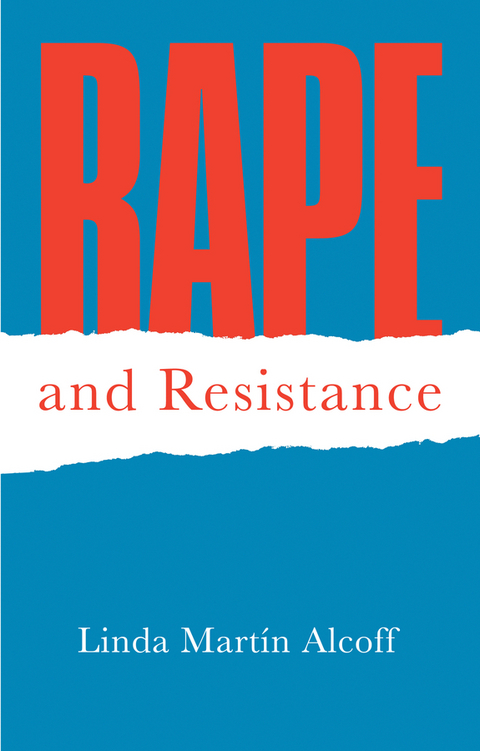
Sexual violence has become a topic of intense media scrutiny, thanks to the bravery of survivors coming forward to tell their stories. But, unfortunately, mainstream public spheres too often echo reports in a way that inhibits proper understanding of its causes, placing too much emphasis on individual responsibility or blaming minority cultures.
In this powerful and original book, Linda Martín Alcoff aims to correct the misleading language of public debate about rape and sexual violence by showing how complex our experiences of sexual violation can be. Although it is survivors who have galvanized movements like #MeToo, when their words enter the public arena they can be manipulated or interpreted in a way that damages their effectiveness. Rather than assuming that all experiences of sexual violence are universal, we need to be more sensitive to the local and personal contexts - who is speaking and in what circumstances - that affect how activists' and survivors' protests will be received and understood.
Alcoff has written a book that will revolutionize the way we think about rape, finally putting the survivor center stage.
Linda Martín Alcoff is Director of Women's Studies and Professor of Philosophy at Hunter College, City University of New York.
Sexual violence has become a topic of intense media scrutiny, thanks to the bravery of survivors coming forward to tell their stories. But, unfortunately, mainstream public spheres too often echo reports in a way that inhibits proper understanding of its causes, placing too much emphasis on individual responsibility or blaming minority cultures. In this powerful and original book, Linda Mart n Alcoff aims to correct the misleading language of public debate about rape and sexual violence by showing how complex our experiences of sexual violation can be. Although it is survivors who have galvanized movements like #MeToo, when their words enter the public arena they can be manipulated or interpreted in a way that damages their effectiveness. Rather than assuming that all experiences of sexual violence are universal, we need to be more sensitive to the local and personal contexts who is speaking and in what circumstances that affect how activists and survivors protests will be received and understood. Alcoff has written a book that will revolutionize the way we think about rape, finally putting the survivor center stage.
Linda Martín Alcoff is Director of Women's Studies and Professor of Philosophy at Hunter College, City University of New York.
* Contents
* Acknowledgments
* Introduction: Rape after Foucault
* 1. Global Resistance: A New Agenda for Theory
* 2. The Thorny Question of Experience
* 3. Norming Sexual Practices
* 4. Sexual Subjectivity
* 5. "Consent", "Victim", "Honor"
* 6. Speaking As (with Laura Gray-Rosendale)
* 7. The Problem of Speaking for Myself
* Conclusion: Standing in the Intersection
* Notes
* References
* Index
"Alcoff's work is consistently insightful, clearly written, and well argued. She bravely tackles a number of contemporary challenges to feminist philosophy, including attacks on the epistemic authority of sexual assault victims, worries about making normative judgments about sex, difficulties with defining the concept of rape, and the political dangers of public discourse. ... The best book I have read in several years."
Debra L. Jackson, California State University, Bakersfield
"What Alcoff achieves is a deftly crafted exploration of not only how rape impacts the self, but of what constitutes 'the self' and how our selves are constantly in the making. She challenges us to rethink many of the concepts discussed so widely today, doing so in a deeply informed and reflective way."
Criminal Law and Criminal Justice Books
1
Global Resistance: A New Agenda for Theory
Today, rape and sexual violations are front-page news across the globe. The media's newly awakened focus has been interestingly sustained but also politically complex. We should not assume that the new public focus on sexual violations will necessarily bring about transformative and lasting social change. A wave of reports can produce fatalism as easily as it can produce determination, lending support to the idea that sexual violence is a natural, inevitable, and universal feature of human behavior. Public outrage can be channeled toward critical and ungenerous judgments about the women who come forward, or toward the sexism of other cultures, or toward the actions and attitudes of a few individual perpetrators represented as pathological, or toward the “need” to close borders and shut out asylum seekers, as easily as it can become fuel for serious reflection and social criticism about the conventions of normalcy in one's own society, or campus, or religious community. So, productive political analysis and resistance is far from an inevitable result of heightened media attention.
Yet it is unquestionably significant that the enforcement of silence around this topic has receded. When I was growing up, sexual violation was rarely ever mentioned in public or private except as a part of comedy. Legal prosecutions were also rare and covered an extremely narrow range of cases, usually ones that could serve some racist agenda. Today, the topic is becoming more visible but it is entering into a market-driven media and a public domain of massive sexism and prejudices of all sorts, as well as serious ignorance about the nature of this problem.
The new resistance in new social movements around the world has been galvanized by survivors speaking out as perhaps never before in history. How can we take advantage of the new focus on rape and sexual violence and push toward more understanding and more effective resistance? I believe this question should set the agenda for theorists.
In this chapter I will seek to develop our understanding of the conditions in which survivors are speaking, including the ways in which this speech is reported, packaged, and interpreted.
I argue that we need a careful attention to the specificities of the contexts in which increased coverage is occurring, and I will make use, with some modifications, of three concepts from José Medina's work on the epistemology of resistance to help chart the current challenges and opportunities this new attention affords us: the concepts of meta-lucidity, epistemic friction, and echoing. I will argue that we need a program that focuses not simply on getting the word out, but on reforming and transforming the conditions of reception in the public domains in which our words emerge.
A Period of Heightened Visibility
To understand how the current visibility has come about, we need to recall some of the earlier discussions that made this possible. Surely an important moment that helped to transform the global coverage of sexual violence occurred in the early 1990s with the extensive focus on the so-called “rape camps” that were part of the war in the former Yugoslavia (Stiglmayer 1994; Zarkov 2007). What became clear from the testimony of the women who came forward was that these camps were set up, organized, and maintained by military institutions and leaders, and this helped to diminish the commonly held view prior to this that rape is a happenstance aspect of war, occurring in an arbitrary way as the product of social anarchy. What riveted (at least Western) public attention in the Yugoslavia case was the fact that the rapes were organized as part of a strategic campaign. They were key elements of a psychological operation to demoralize and weaken opposing communities and decimate the kinship ties of the next generation. They were not the result of social chaos but part of a calculated campaign to produce a kind of political chaos in the targeted communities.
Rape camps have been features of numerous wars, including in many parts of Central America, in Japan, and in the Democratic Republic of Congo; the systematic licensing of rape by US forces was also a well-known aspect of the war in Vietnam. The sexual atrocities that German girls and women experienced at the hands of Soviet troops after World War II has received a lot of attention, but more recent scholarship has unearthed widespread rapes committed by US troops during this war, the very troops often characterized as the “greatest generation” (Roberts 2013). If wartime rapes are widespread among a variety of diverse societies, one might want to draw universalist, even determinist, conclusions, but the analysis advanced in reports such as that by the United States Institute of Peace (USIP) actually suggests the opposite (Cohen et al. 2013). Comparative study indicates that wartime rape is not, in fact, a universal feature but widely variable: for example, in an extensive study of 48 armed conflicts in Africa, 64% – almost two-thirds – were found not to involve any form of sexual violence. The USIP report summarizes the existing data to show that rape is not a ubiquitous feature of ethnic-based struggles, nor is it more common within rebel or insurgent groups than state-sponsored forces, which would follow if the “social anarchy” idea were valid. In fact, the evidence suggests that rape is more common in state-orchestrated conflicts (Cohen et al. 2013). Hence, existing research counters the idea that rape is a “natural” byproduct of war or even of militarism and suggests instead that sexual violence is orchestrated, occurring widely only under certain kinds of conditions, commanders, and commandment structures. Hence, resistance and efforts at reform are far from hopeless. Denaturalizing the incidence of rape in war is an important step in making it possible to hold military institutions and commanders responsible, and to study the specific conditions under which rape becomes a systematic, sanctioned practice.
After the stories of rape camps in Bosnia were reported, advocates successfully organized around the idea that rape is a specific and actionable war crime and a violation of human rights. Subsequently, in both Yugoslavia and the aftermath of civil war in Sierra Leone, international institutions leveled charges of “slavery,” and in Sierra Leone the International Criminal Court (ICC) accepted charges of “sexual slavery,” further developing the idea that sexual violence was a war crime (Grewal 2016a). This helped to craft the rules of combat, setting out the domain of actionable criminal behavior. However, every such legal and discursive reform that enters an international community riven by racism, Islamophobia, and colonialisms of all kinds produces complex outcomes that bear close analysis; the outcomes of this reform are still under debate (Kapur 2002; Razack 2004).
For example, critics argue that prejudgments in the global North about arranged marriages caused the ICC to collapse the distinction between arranged and forced marriages. Arranged marriages actually occur under a variety of conditions, not all of which constitute coercion (e.g. when either partner can opt out, the arrangement is not necessarily coercive). In other cases, international agencies sought to replace bad wartime arrangements with bad conventional arrangements, so that the operable definition of “sexual slavery” was simply that bride price had not been paid and that the patriarchal elders had not been consulted (Grewal 2016a).
Nonetheless, by conceptualizing rape as an orchestrated practice rather than the result of individual deviance, rape began to be thought about in the 1990s in its relation to certain institutional contexts and political systems. Although in the beginning the institutions examined were mainly military, this new approach opened the door for considering other kinds of institutions, such as prisons, in which rape had long been taken as a kind of collateral damage rather than the intended effect of institutional choices. Once rape was defined as a violation of human rights, it could be more effectively condemned even when it occurred in prisons, in combat, or in peacetime army barracks.
Certainly, well before the 1990s, many Latin Americans knew about the systematic use of rape under military dictatorships as well as by US-sponsored campaigns against indigenous and guerrilla groups, and many in Asia knew about the use of rape by the Japanese army. But in this chapter I want to explore the global reverberations that have helped bring about a qualitative turn, helping even the victims of these earlier atrocities to gain larger public support for their demands for justice. Today it is more routine for well-publicized rape cases in one part of the world to echo in other places, emboldening victims and their allies. The increased decibels of outrage appear to indicate that, at least for some, rape is no longer viewed as inevitable.
Thus, the reports from Sarajevo arguably instigated a global discourse about the nature and cause of sexual violations that is still being echoed around the world concerning how these crimes may be encouraged and even orchestrated by state institutions, how they should be named and legally addressed, and how this is a global problem and not simply a feature of certain kinds of societies (e.g. those outside of “the West”). The growing testimonies of rape victims have also made visible to the...
| Erscheint lt. Verlag | 4.5.2018 |
|---|---|
| Sprache | englisch |
| Themenwelt | Geisteswissenschaften ► Philosophie ► Allgemeines / Lexika |
| Sozialwissenschaften ► Kommunikation / Medien ► Medienwissenschaft | |
| Sozialwissenschaften ► Soziologie | |
| Schlagworte | Cultural Studies • Epistemology • Feminism • Feminist philosophy • Foucault • Frauenforschung • Gender & Philosophy • Geschlechterfragen u. Philosophie • Kulturwissenschaften • Philosophie • Philosophie in den Gesellschaftswissenschaften • Philosophy • Philosophy of social science • Rape • resistance • Sexual Violence • Sociology • women's issues • women's studies |
| ISBN-10 | 0-7456-9195-1 / 0745691951 |
| ISBN-13 | 978-0-7456-9195-4 / 9780745691954 |
| Informationen gemäß Produktsicherheitsverordnung (GPSR) | |
| Haben Sie eine Frage zum Produkt? |
 EPUB (Adobe DRM)
Kopierschutz: Adobe-DRM
Adobe-DRM ist ein Kopierschutz, der das eBook vor Mißbrauch schützen soll. Dabei wird das eBook bereits beim Download auf Ihre persönliche Adobe-ID autorisiert. Lesen können Sie das eBook dann nur auf den Geräten, welche ebenfalls auf Ihre Adobe-ID registriert sind.
Details zum Adobe-DRM
Dateiformat: EPUB (Electronic Publication)
EPUB ist ein offener Standard für eBooks und eignet sich besonders zur Darstellung von Belletristik und Sachbüchern. Der Fließtext wird dynamisch an die Display- und Schriftgröße angepasst. Auch für mobile Lesegeräte ist EPUB daher gut geeignet.
Systemvoraussetzungen:
PC/Mac: Mit einem PC oder Mac können Sie dieses eBook lesen. Sie benötigen eine
eReader: Dieses eBook kann mit (fast) allen eBook-Readern gelesen werden. Mit dem amazon-Kindle ist es aber nicht kompatibel.
Smartphone/Tablet: Egal ob Apple oder Android, dieses eBook können Sie lesen. Sie benötigen eine
Geräteliste und zusätzliche Hinweise
Buying eBooks from abroad
For tax law reasons we can sell eBooks just within Germany and Switzerland. Regrettably we cannot fulfill eBook-orders from other countries.
aus dem Bereich