


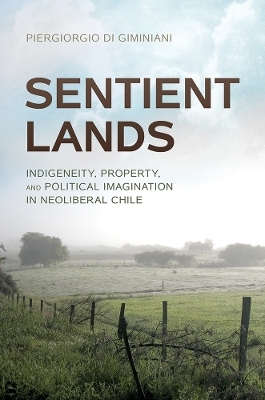
Sentient Lands
Indigeneity, Property, and Political Imagination in Neoliberal Chile
Seiten
2018
University of Arizona Press (Verlag)
978-0-8165-3552-1 (ISBN)
University of Arizona Press (Verlag)
978-0-8165-3552-1 (ISBN)
- Titel ist leider vergriffen;
keine Neuauflage - Artikel merken
Provides an historically grounded ethnography of the Mapuche people's engagement with state-run reconciliation and land-restitution efforts. Piergiorgio Di Giminiani analyses environmental relations, property, state power, market forces, and indigeneity to illustrate how land connections are articulated, both in landscape experiences and in land claims.
In 1990, when Augusto Pinochet's 17-year military dictatorship ended, democratic rule returned to Chile. Since then, Indigenous organizations have mobilized to demand restitution of their ancestral territories seized over the past 150 years.
Sentient Lands is a historically grounded ethnography of the Mapuche people's engagement with state-run reconciliation and land-restitution efforts. Piergiorgio Di Giminiani analyzes environmental relations, property, state power, market forces, and indigeneity to illustrate how land connections are articulated, both in landscape experiences and in land claims. Rather than viewing land claims as simply bureaucratic procedures imposed on local understandings and experiences of land connections, Di Giminiani reveals these processes to be disputed practices of world making.
Ancestral land formation is put in motion by the entangled principles of Indigenous and legal land ontologies, two very different and sometimes conflicting processes. Indigenous land ontologies are based on a relation between two subjects—land and people—both endowed with sentient abilities. By contrast, legal land ontologies are founded on the principles of property theory, wherein land is an object of possession that can be standardized within a regime of value. Governments also use land claims to domesticate Indigenous geographies into spatial constructs consistent with political and market configurations.
Exploring the unexpected effects on political activism and state reparation policies caused by this entanglement of legal and Indigenous land ontologies, Di Giminiani offers a new analytical angle on Indigenous land politics.
In 1990, when Augusto Pinochet's 17-year military dictatorship ended, democratic rule returned to Chile. Since then, Indigenous organizations have mobilized to demand restitution of their ancestral territories seized over the past 150 years.
Sentient Lands is a historically grounded ethnography of the Mapuche people's engagement with state-run reconciliation and land-restitution efforts. Piergiorgio Di Giminiani analyzes environmental relations, property, state power, market forces, and indigeneity to illustrate how land connections are articulated, both in landscape experiences and in land claims. Rather than viewing land claims as simply bureaucratic procedures imposed on local understandings and experiences of land connections, Di Giminiani reveals these processes to be disputed practices of world making.
Ancestral land formation is put in motion by the entangled principles of Indigenous and legal land ontologies, two very different and sometimes conflicting processes. Indigenous land ontologies are based on a relation between two subjects—land and people—both endowed with sentient abilities. By contrast, legal land ontologies are founded on the principles of property theory, wherein land is an object of possession that can be standardized within a regime of value. Governments also use land claims to domesticate Indigenous geographies into spatial constructs consistent with political and market configurations.
Exploring the unexpected effects on political activism and state reparation policies caused by this entanglement of legal and Indigenous land ontologies, Di Giminiani offers a new analytical angle on Indigenous land politics.
Piergiorgio Di Giminiani is an associate professor of anthropology at the Pontificia Universidad Católica de Chile.
| Erscheinungsdatum | 30.10.2018 |
|---|---|
| Zusatzinfo | 13 Black & white photographs, 3 maps |
| Verlagsort | Tucson |
| Sprache | englisch |
| Maße | 154 x 231 mm |
| Gewicht | 513 g |
| Themenwelt | Sozialwissenschaften ► Ethnologie ► Völkerkunde (Naturvölker) |
| Sozialwissenschaften ► Soziologie | |
| ISBN-10 | 0-8165-3552-3 / 0816535523 |
| ISBN-13 | 978-0-8165-3552-1 / 9780816535521 |
| Zustand | Neuware |
| Informationen gemäß Produktsicherheitsverordnung (GPSR) | |
| Haben Sie eine Frage zum Produkt? |
Mehr entdecken
aus dem Bereich

aus dem Bereich
die Ethnologische Sammlung der Georg-August-Universität Göttingen
Buch | Softcover (2024)
Universitätsverlag Göttingen
CHF 58,75
Schweden : Ambiguitäten verhandeln - Tolerieren als soziale und …
Buch | Softcover (2023)
Brill Schöningh (Verlag)
CHF 78,40


