


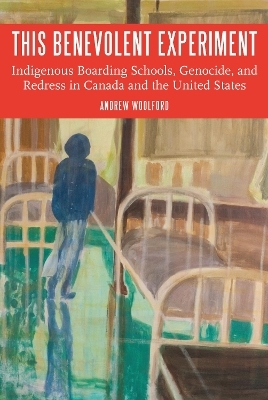
This Benevolent Experiment
Indigenous Boarding Schools, Genocide, and Redress in Canada and the United States
Seiten
2018
University of Nebraska Press (Verlag)
978-1-4962-0386-1 (ISBN)
University of Nebraska Press (Verlag)
978-1-4962-0386-1 (ISBN)
At the end of the nineteenth century, Indigenous boarding schools were touted as the means for solving the “Indian problem” in both the United States and Canada. This Benevolent Experiment offers a multilayered, comparative analysis of Indigenous boarding schools.
AChoice Outstanding Academic Title, 2017
This important book, which students, scholars, and policy makers in the U.S. and Canada should read, is a testament to the quality of the work and the still limited understanding of its subject in both countries.-C. R. King, Choice
At the end of the nineteenth century, Indigenous boarding schools were touted as the means for solving the “Indian problem” in both the United States and Canada. With the goal of permanently transforming Indigenous young people into Europeanized colonial subjects, the schools were ultimately a means for eliminating Indigenous communities as obstacles to land acquisition, resource extraction, and nation-building. Andrew Woolford analyzes the formulation of the “Indian problem” as a policy concern in the United States and Canada and examines how the “solution” of Indigenous boarding schools was implemented in Manitoba and New Mexico through complex chains that included multiple government offices with a variety of staffs, Indigenous peoples, and even nonhuman actors such as poverty, disease, and space. The genocidal project inherent in these boarding schools, however, did not unfold in either nation without diversion, resistance, and unintended consequences.
Inspired by the signing of the 2007 Indian Residential School Settlement Agreement in Canada, which provided a truth and reconciliation commission and compensation for survivors of residential schools, This Benevolent Experimentoffers a multilayered, comparative analysis of Indigenous boarding schools in the United States and Canada. Because of differing historical, political, and structural influences, the two countries have arrived at two very different responses to the harm caused by assimilative education.
AChoice Outstanding Academic Title, 2017
This important book, which students, scholars, and policy makers in the U.S. and Canada should read, is a testament to the quality of the work and the still limited understanding of its subject in both countries.-C. R. King, Choice
At the end of the nineteenth century, Indigenous boarding schools were touted as the means for solving the “Indian problem” in both the United States and Canada. With the goal of permanently transforming Indigenous young people into Europeanized colonial subjects, the schools were ultimately a means for eliminating Indigenous communities as obstacles to land acquisition, resource extraction, and nation-building. Andrew Woolford analyzes the formulation of the “Indian problem” as a policy concern in the United States and Canada and examines how the “solution” of Indigenous boarding schools was implemented in Manitoba and New Mexico through complex chains that included multiple government offices with a variety of staffs, Indigenous peoples, and even nonhuman actors such as poverty, disease, and space. The genocidal project inherent in these boarding schools, however, did not unfold in either nation without diversion, resistance, and unintended consequences.
Inspired by the signing of the 2007 Indian Residential School Settlement Agreement in Canada, which provided a truth and reconciliation commission and compensation for survivors of residential schools, This Benevolent Experimentoffers a multilayered, comparative analysis of Indigenous boarding schools in the United States and Canada. Because of differing historical, political, and structural influences, the two countries have arrived at two very different responses to the harm caused by assimilative education.
Andrew Woolford is a professor of sociology and criminology at the University of Manitoba and a recipient of a Fulbright Scholar Award. He is the author of Between Justice and Certainty: Treaty-Making in British Columbia and the coeditor of Colonial Genocide in Indigenous North America.
List of IllustrationsPreface1. Introduction2. Settler Colonial Genocide in North America3. Framing the Indian as a Problem4. Schools, Staff, Parents, Communities, and Students5. Discipline and Desire as Assimilative Techniques6. Knowledge and Violence as Assimilative Techniques7. Local Actors and Assimilation8. Aftermaths and Redress9. Conclusion NotesReferencesIndex
| Erscheinungsdatum | 14.09.2018 |
|---|---|
| Reihe/Serie | Indigenous Education |
| Zusatzinfo | 12 photographs, 1 illustration, index |
| Verlagsort | Lincoln |
| Sprache | englisch |
| Maße | 152 x 229 mm |
| Themenwelt | Sachbuch/Ratgeber ► Geschichte / Politik ► Allgemeines / Lexika |
| Geisteswissenschaften ► Geschichte ► Allgemeine Geschichte | |
| Geisteswissenschaften ► Geschichte ► Regional- / Ländergeschichte | |
| Geschichte ► Teilgebiete der Geschichte ► Kulturgeschichte | |
| Sozialwissenschaften ► Ethnologie | |
| Sozialwissenschaften ► Pädagogik ► Allgemeines / Lexika | |
| Sozialwissenschaften ► Soziologie | |
| ISBN-10 | 1-4962-0386-0 / 1496203860 |
| ISBN-13 | 978-1-4962-0386-1 / 9781496203861 |
| Zustand | Neuware |
| Informationen gemäß Produktsicherheitsverordnung (GPSR) | |
| Haben Sie eine Frage zum Produkt? |
Mehr entdecken
aus dem Bereich



aus dem Bereich
Die Revolution des Gemeinen Mannes
Buch | Softcover (2024)
C.H.Beck (Verlag)
CHF 16,80
Eine Geschichte des Geschmacks
Buch | Hardcover (2025)
C.H.Beck (Verlag)
CHF 49,95
vom Mittelalter bis zur Gegenwart
Buch | Softcover (2024)
C.H.Beck (Verlag)
CHF 16,80


