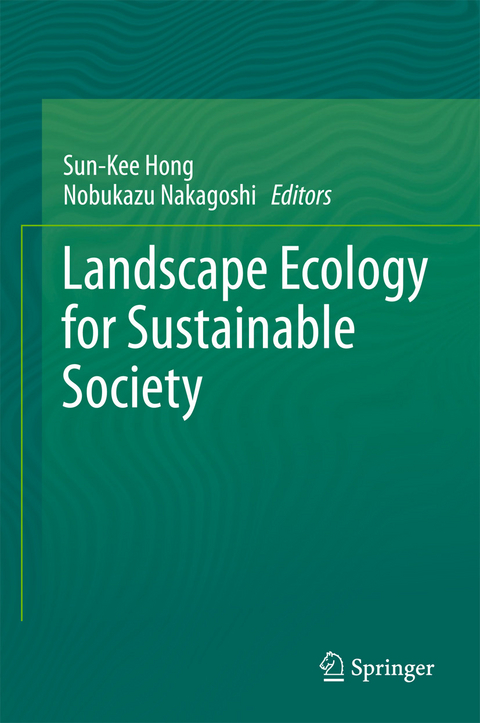
Landscape Ecology for Sustainable Society (eBook)
XIV, 383 Seiten
Springer International Publishing (Verlag)
978-3-319-74328-8 (ISBN)
Sun-Kee Hong (Mokpo, Republic of Korea) is currently Humanities Korea Professor of the the Institution for Marine and Island Cultures (MIC) of Mokpo National University. He obtained a master degree in Plant Ecology at Chungnam National University (1985). He obtained a Ph.D. degree in Landscape Ecology and Environmental Planning at Hiroshima University (Japan) in 1994; his thesis dealt with vegetation ecology and human impact in Asian cultural landscapes. He has organized 20 international symposia on global issues, landscape ecology and biocultural diversity relating “islandscapes” and urban-rural landscapes issues during IUCN, IALE, INTECOL and EAFES. He published international books of Ecological Issues in a Changing World (Kluwer, 2004), Landscape Ecological Applications in Man-influenced Areas: Linking Man and Nature Systems (Springer, 2007), Landscape Ecology in Asian Cultures (Springer-Tokyo, 2011), Biocultural Landscapes (Springer, 2014) and 70 papers. He was secretary general of the 8th INTECOL (2002, Seoul) and the chairperson of the local organizing committee of the 55th IAVS conference (2012, Mokpo). He is the founder and Editor-in-Chief of the Journal of Marine and Island Cultures. He is a board member of INTECOL (including Editor of the INTECOL e-Bulletin). He is the Director of the Center for Island Sustainability (CIS) at Mokpo National University.Nobukazu Nakagoshi (Higashi-Hiroshima, Japan) is Professor Emeritus of Hiroshima University (HU) and lecturing at Graduate School for International Development and Cooperation, HU as a Special Appointed Professor from 2017. He is Invited Professors of Ecology at Capital Normal University, Beijing from 2004 and Inner Mongolia University, Huhhot, China from 2008. He obtained a master degree in Plant Ecology at HU (1976) and a degree Doctor of Science (Botany) in Plant Ecology at HU (1979): his thesis dealt with soil seed banks in temperate forests. He has organized scores international symposia on community, conservation and landscape ecologies during INTECOL, IAVS, IALE, ICB, ICLEE, URBIO, ESJ, Eco-summit and EAFES. He published international books Coniferous Forest Ecology, from an International Perspectives (SPB Academic Publishing bv, 1991) with Frank B. Golley, Designing Low Carbon Societies in Landscapes (Springer, 2014) with Jhonamie A. Mabuhay and 298 papers. He was President of Japan Association for Landscape Ecology (2000-2007) and a Vice President of IALE (2003-2007). His current scientific interests are eco-tourism in natural landscapes, sustainable managements of cultural landscapes, and green infrastructures associated with resilience in urban landscapes.
Part I: Concept and Approaches.-Chapter 1. Guiding young scholars in order to integrate their various research into landscape ecology.-Chapter 2. Island biocultural diversity initiative for sustainable society in Asia-Pacific island regions.-Chapter 3. Multi-Criteria Decision Analysis (MCDA) technique for evaluating health status of landscape ecology.-Chapter 4. Investigating impacts of major events on land use development of European and Asiatic landscapes.-Chapter 5. Developing strategies for landscape sustainability: An Indonesian national strategic plan of action in the heart of Borneo.-Part II: System Management and Conservation.-Chapter 6. Satoyama landscape of Japan - Past, Present and Future.-Chapter 7. Change of landscape and ecosystem services of semi-natural grassland in Mt. Sanbe, Shimane Prefecture, Japan.-Chapter 8. Diverse patterns of vegetation change after upland field abandonment in Japan.-Chapter 9. Traditional ecological knowledge determined tree species choice in the construction of traditional folk houses in a snowy rural landscape in central Japan.-Chapter 10. Priorities mapping in landscape; Spatial decision support of the Indonesia forest landscape.- Chapter 11. Forest management based on site suitability: A case study of Odai town, Mie Prefecture, Japan.- Chapter 12. Participatory wetland management: A Case study of Xe Champhone wetland, Lao PDR.- Chapter 13. Resident-initiated practice of a habitat of Iris rossii, a national natural monument in the rural landscape of Japan.-Chapter 14. Arthropod diversity in conventional Citrus Orchard at Selorejo village, East Java.-Part III: Community Development for Sustainable Society.-Chapter 15. Management of landscape services for improving community welfare in West Java, Indonesia.-Chapter 16. Using vegetation greenness as a criterion in multi-criteria analysis of recreational land suitability in protected area: A case study of Krau wildlife reserve, peninsular Malaysia.-Chapter 17. Green open space demand and community place attachment in Batu, East Java.-Chapter 18. Perception of citizens towards implementation of urban forestry: A case of a local city in the Philippines.-Chapter 19. Forest ownership patterns impacting on landscape structure of vegetation in a mountainous farm village, western Japan.-Chapter 20. Spatial and temporal patterns of groundwater quality in Selangor, Malaysia.-Chapter 21. Cultural landscape preservation and ecotourism development in Blambangan Biosphere Reserve, East Java.-Part IV: Remarks.-Chapter 22.Bridge and Islandscape: Questions for sustainability and resilience of island societies in Korea and Japan.
| Erscheint lt. Verlag | 23.3.2018 |
|---|---|
| Zusatzinfo | XIV, 383 p. 114 illus., 83 illus. in color. |
| Verlagsort | Cham |
| Sprache | englisch |
| Themenwelt | Naturwissenschaften ► Biologie ► Ökologie / Naturschutz |
| Sozialwissenschaften ► Politik / Verwaltung | |
| Schlagworte | Biodiversity conservation • Environmental change • environmental planning • landscape and society • sustainability • urban geography and urbanism |
| ISBN-10 | 3-319-74328-7 / 3319743287 |
| ISBN-13 | 978-3-319-74328-8 / 9783319743288 |
| Informationen gemäß Produktsicherheitsverordnung (GPSR) | |
| Haben Sie eine Frage zum Produkt? |
 PDF (Wasserzeichen)
DRM: Digitales Wasserzeichen
Dieses eBook enthält ein digitales Wasserzeichen und ist damit für Sie personalisiert. Bei einer missbräuchlichen Weitergabe des eBooks an Dritte ist eine Rückverfolgung an die Quelle möglich.
Dateiformat: PDF (Portable Document Format)
Mit einem festen Seitenlayout eignet sich die PDF besonders für Fachbücher mit Spalten, Tabellen und Abbildungen. Eine PDF kann auf fast allen Geräten angezeigt werden, ist aber für kleine Displays (Smartphone, eReader) nur eingeschränkt geeignet.
Systemvoraussetzungen:
PC/Mac: Mit einem PC oder Mac können Sie dieses eBook lesen. Sie benötigen dafür einen PDF-Viewer - z.B. den Adobe Reader oder Adobe Digital Editions.
eReader: Dieses eBook kann mit (fast) allen eBook-Readern gelesen werden. Mit dem amazon-Kindle ist es aber nicht kompatibel.
Smartphone/Tablet: Egal ob Apple oder Android, dieses eBook können Sie lesen. Sie benötigen dafür einen PDF-Viewer - z.B. die kostenlose Adobe Digital Editions-App.
Buying eBooks from abroad
For tax law reasons we can sell eBooks just within Germany and Switzerland. Regrettably we cannot fulfill eBook-orders from other countries.
aus dem Bereich