


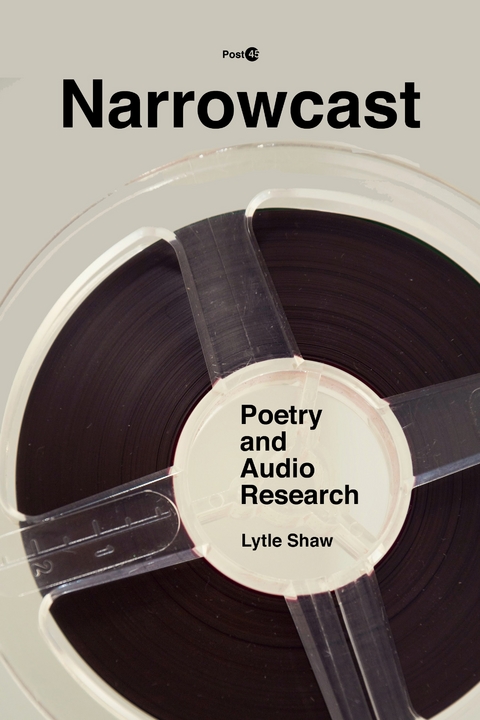
Narrowcast (eBook)
272 Seiten
Stanford University Press (Verlag)
9781503606579 (ISBN)
Narrowcast explores how mid-century American poets associated with the New Left mobilized tape recording as a new form of sonic field research even as they themselves were being subjected to tape-based surveillance. Media theorists tend to understand audio recording as a technique for separating bodies from sounds, but this book listens closely to tape's embedded information, offering a counterintuitive site-specific account of 1960s poetic recordings. Allen Ginsberg, Charles Olson, Larry Eigner, and Amiri Baraka all used recording to contest models of time being put forward by dominant media and the state, exploring non-monumental time and subverting media schedules of work, consumption, leisure, and national crises. Surprisingly, their methods at once dovetailed with those of the state collecting evidence against them and ran up against the same technological limits. Arguing that CIA and FBI "e;researchers"e; shared unexpected terrain not only with poets but with famous theorists such as Fredric Jameson and Hayden White, Lytle Shaw reframes the status of tape recordings in postwar poetics and challenges notions of how tape might be understood as a mode of evidence.
Lytle Shaw is Professor of English at New York University.
Contents and Abstracts1Third Personism: The FBI's Poetics of Immediacy in the 1960s chapter abstractThis chapter uses the reel-to-reel recordings Allen Ginsberg made on a cross-country trip in 1966 to focalize the contested status of audio research as it was then fought over by the New Left and the U.S. state. Reframing Frank O'Hara's suggestion in "Personism" that greater immediacy with his friends "Allen" (Ginsberg) and "Roi" (LeRoi Jones) might be achieved by calling them, the chapter considers what it means for postwar poetics that such New Left poets were often under state audio surveillance. Bringing poets, literary critics and the state into unexpected proximity, the chapter offers an account of the guiding assumptions and pitfalls associated with the CIA and FBI's often Yale-trained literary critics, demonstrating how all three confront the overwhelming of voice by its noisy sonic environment and how the state's theory of totality might be compared to that of famous literary theorists like Fredric Jameson.2The Eigner Sanction: Keeping Time from the American Century chapter abstractChapter two explores Larry Eigner's development of a counter-temporality in relation to his dominant reception, the domestic mediascape he daily negotiated, the surrounding cold war defense infrastructure, and the Luce media empire's regulation of Americans' experience of time. Presenting Eigner's reflexive daily neighborhood sound and sight monitoring as a counterpoint to the Cold War surveillance jets that performed the same function over his neighborhood, the chapter shows how the urgent events that course through Eigner's airspace get recast by the poet's horizontal model of time. Eigner's role as an alternate broadcasting system then gets drawn out through an analysis of the ways that the Luce media (referenced by Eigner) took on the roll of organizing national time at the level of the week, month, year and even century.3Olson's Sonic Walls: Citizenship and Surveillance from the OWI to the Nixon Tapes chapter abstractChapter three positions Charles Olson's education in American studies at Harvard and his work for the OWI in relation to postwar area studies and models of evidence, research and network building demonstrated on his recordings, whose confrontational dynamics and insistence on the real time of research are related to postwar sound and performance art. The chapter then uses Henry Kissinger's Harvard education, including Paul de Man's French tutoring, as a way to study the infrastructure of postwar area studies that underlay Kissinger's later audio surveillance, including his taping of Allen Ginsberg. Comparing Kissinger's understanding of tape to Olson's, the chapter draws out the "avant-garde" nature of Kissinger's audio research in which documentation transcends a hypothesis, a claim that gets tested by considering a 1975 court case in which Hayden White brought suit against the LAPD for planting officer pretending to be students in his class at UCLA.4"The Strategic Idea of North: Glenn Gould, Sergeant Jones and White Alice" chapter abstractConsidering the sound documentaries of R. Murray Schafer and Glenn Gould, this chapter first places the origins of sound studies within nationalist Canadian conceptions of geography and culture before then outlining the American Cold War technological infrastructure that preceded these musicians' movements into Canadian space, especially the three lines of radar stations erected to monitor Soviet incursions into the North American continent. The chapter then considers the mechanics of this system via a case study of one of its functionaries, sergeant LeRoi Jones, whose practice missions of atomic reprisal aboard a B36 peacemaker were signaled by a hellish siren particularly noted by the sergeant. The chapter concludes by following this siren-sound into the poet and music critic's later work, as Amiri Baraka, fashioning exemplary sounds of Black Nationalism.
| Erscheint lt. Verlag | 12.6.2018 |
|---|---|
| Reihe/Serie | Post*45 | Post*45 |
| Zusatzinfo | 25 halftones |
| Sprache | englisch |
| Themenwelt | Geisteswissenschaften ► Sprach- / Literaturwissenschaft ► Anglistik / Amerikanistik |
| Geisteswissenschaften ► Sprach- / Literaturwissenschaft ► Literaturwissenschaft | |
| Sozialwissenschaften ► Kommunikation / Medien ► Medienwissenschaft | |
| Schlagworte | Allen Ginsberg • Amiri Baraka • charles olson • Historiography • Larry Eigner • Postwar American Poetry • Sound Studies • Surveillance • tape recording • the New Left |
| ISBN-13 | 9781503606579 / 9781503606579 |
| Informationen gemäß Produktsicherheitsverordnung (GPSR) | |
| Haben Sie eine Frage zum Produkt? |
 EPUB (Adobe DRM)
Kopierschutz: Adobe-DRM
Adobe-DRM ist ein Kopierschutz, der das eBook vor Mißbrauch schützen soll. Dabei wird das eBook bereits beim Download auf Ihre persönliche Adobe-ID autorisiert. Lesen können Sie das eBook dann nur auf den Geräten, welche ebenfalls auf Ihre Adobe-ID registriert sind.
Details zum Adobe-DRM
Dateiformat: EPUB (Electronic Publication)
EPUB ist ein offener Standard für eBooks und eignet sich besonders zur Darstellung von Belletristik und Sachbüchern. Der Fließtext wird dynamisch an die Display- und Schriftgröße angepasst. Auch für mobile Lesegeräte ist EPUB daher gut geeignet.
Systemvoraussetzungen:
PC/Mac: Mit einem PC oder Mac können Sie dieses eBook lesen. Sie benötigen eine
eReader: Dieses eBook kann mit (fast) allen eBook-Readern gelesen werden. Mit dem amazon-Kindle ist es aber nicht kompatibel.
Smartphone/Tablet: Egal ob Apple oder Android, dieses eBook können Sie lesen. Sie benötigen eine
Geräteliste und zusätzliche Hinweise
Buying eBooks from abroad
For tax law reasons we can sell eBooks just within Germany and Switzerland. Regrettably we cannot fulfill eBook-orders from other countries.
aus dem Bereich


