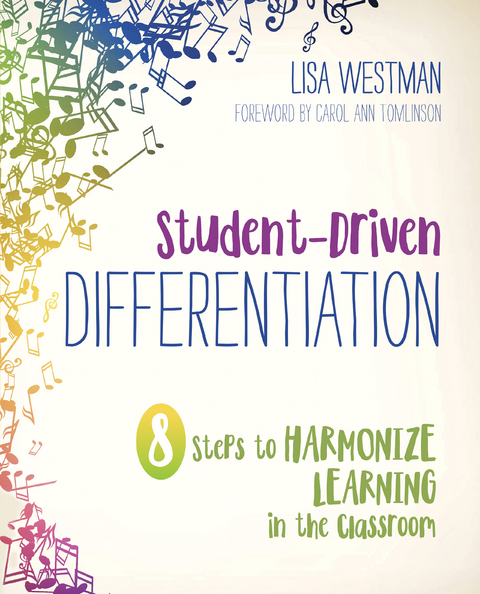
Student-Driven Differentiation (eBook)
216 Seiten
Corwin (Verlag)
9781506396583 (ISBN)
List of Online Tools and Resources
Foreword
Preface
Why Did I Write This Book?
What Is Student-Driven Differentiation?
Student-Driven Leadership: A Crucial Component to Student-Driven Differentiation
How to Read This Book
Acknowledgments
About the Author
Part I: Foundation
Chapter 1: Relationships Come First
What Are the Criteria for Positive Teacher–Student Relationships?
How Do You Build Respectful Relationships?
Discussion Questions
Chapter 2: Differentiation Is What Happens When Teachers Focus on Student Growth
Differentiation Lessons Learned
Lesson 1: Differentiation Is Not a Goal—It Is a Result
Lesson 2: The Terms Data and Assessment Are Often Misunderstood
Lesson 3: It Is Easy to See Different—It Is Not Easy to See Differentiation
Lesson 4: Differentiation May Never Feel “Easy”
Lesson 5: There Will Always Be Challenges and a Way to Overcome Them
Discussion Questions
Chapter 3: Four Areas to Differentiate
Content: What Is to Be Learned?
Process: How Students Acquire Knowledge
Product: How Students Demonstrate Learning
Learning Environment: Where and With Whom Students Learn
Discussion Questions
Part II: Implementation
Chapter 4: Planning Student- Driven Differentiation
Step 1: Define
Step 2: Hook
Step 3: Assess and Analyze
Step 4: Group Students Strategically
Discussion Questions
Chapter 5: Include Student Voice
Step 5: Set a Goal
Step 6: Differentiate
Step 7: Monitor Progress
Step 8: Assess Again
Discussion Questions
Chapter 6: Student-Driven Differentiation Through Experiential Learning
Student-Driven Differentiation Example 1: Shark Tank
Student-Driven Differentiation Example 2: Mock Trial
Student-Driven Differentiation Example 3: The Amazing Geography Race
Student-Driven Differentiation Example 4: Mock ER
Discussion Questions
Part III: Reimagining Schools
Chapter 7: Create Learning Environments That Promote Student Ownership
Don’t Update the Factory Model; Discard It Altogether
Meet the Needs of All Students
Design Classrooms Conducive to Student-Driven Differentiation
Make Student Ownership Part of the Classroom Culture
Use Technology to Promote Learning and Creativity
Monitor Student Progress Toward Learning Intentions
Enlist Parents’ Help in Furthering Student Learning
Discussion Questions
Chapter 8: The Role of Choice in Meeting Learning Intentions
Offer Choices That Fulfill Learning Needs
Example 1: Use Choice as Part of Curriculum Compacting
Example 2: Align Choice to Learning Intentions
Example 3: Incorporate Choice in Homework Assignments
Example 4: Use Choice to Give Students Ownership of Their Own Learning
Example 5: Use Choice to Allow Students to Work at Their Own Pace
Example 6: Use Choice to Promote Student Autonomy and Student Efficacy
Lack of Choice Can Inhibit Creativity
Discussion Questions
Chapter 9: Your Journey With Student-Driven Differentiation
We Are Entrusted With Instilling the Desire to Learn
We Are Better Together: Collective Efficacy
Mastery Experience: Set Goals to Increase Efficacy
Vicarious Experiences: Observe Teachers in Action
Social Persuasion: Inspire Through Storytelling
Affective States: Support Fellow Educators Through Positive Communication
Now What? Summing It All Up
Discussion Questions
Afterword
Glossary
References
Index
| Reihe/Serie | Corwin Teaching Essentials | Corwin Teaching Essentials |
|---|---|
| Verlagsort | Thousand Oaks |
| Sprache | englisch |
| Themenwelt | Schulbuch / Wörterbuch ► Unterrichtsvorbereitung |
| Sozialwissenschaften ► Pädagogik | |
| Schlagworte | Differentiation • growth mindset • instructional coaching • learning • student motivation • Teaching • Teaching methods |
| ISBN-13 | 9781506396583 / 9781506396583 |
| Informationen gemäß Produktsicherheitsverordnung (GPSR) | |
| Haben Sie eine Frage zum Produkt? |
 PDF (Adobe DRM)
Kopierschutz: Adobe-DRM
Adobe-DRM ist ein Kopierschutz, der das eBook vor Mißbrauch schützen soll. Dabei wird das eBook bereits beim Download auf Ihre persönliche Adobe-ID autorisiert. Lesen können Sie das eBook dann nur auf den Geräten, welche ebenfalls auf Ihre Adobe-ID registriert sind.
Details zum Adobe-DRM
Dateiformat: PDF (Portable Document Format)
Mit einem festen Seitenlayout eignet sich die PDF besonders für Fachbücher mit Spalten, Tabellen und Abbildungen. Eine PDF kann auf fast allen Geräten angezeigt werden, ist aber für kleine Displays (Smartphone, eReader) nur eingeschränkt geeignet.
Systemvoraussetzungen:
PC/Mac: Mit einem PC oder Mac können Sie dieses eBook lesen. Sie benötigen eine
eReader: Dieses eBook kann mit (fast) allen eBook-Readern gelesen werden. Mit dem amazon-Kindle ist es aber nicht kompatibel.
Smartphone/Tablet: Egal ob Apple oder Android, dieses eBook können Sie lesen. Sie benötigen eine
Geräteliste und zusätzliche Hinweise
Buying eBooks from abroad
For tax law reasons we can sell eBooks just within Germany and Switzerland. Regrettably we cannot fulfill eBook-orders from other countries.
aus dem Bereich