The Bloomsbury Companion to Arendt
Bloomsbury Academic (Verlag)
978-1-350-05329-8 (ISBN)
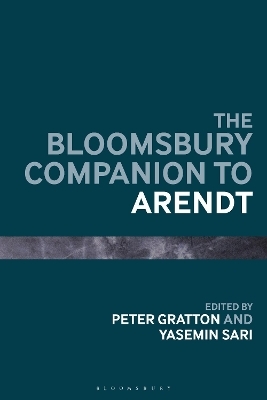
The Bloomsbury Companion to Arendt offers the definitive guide to her writings and ideas, her influences and commentators, as well as the reasons for her lasting significance, with 66 original essays taking up in accessible terms the myriad ways in which one can take up her work and her continuing importance. These essays, written by an international set of her best readers and commentators, provides a comprehensive coverage of her life and the contexts in which her works were written. Special sections take up chapters on each of her key writings, the reception of her work, and key ways she interpreted those who influenced her. If one has come to Arendt from one of her essays on freedom, or from yet another bombastic account of her writings on Adolph Eichmann, or as as student or professor working in the field of Arendt studies, this book provides the ideal tool for thinking with and rediscovering one of the most important intellectuals of the past century. But just as importantly, contributors advance the study of Arendt into neglected areas, such as on science and ecology, to demonstrate her importance not just to debates in which she was well known, but those touched off only after her death. Arendt’s approaches as well as her concrete claims about the political have much to offer given the current ecological and refugee crises, among others. In sum, then, the Companion provides a tool for thinking with Arendt, but also for showing just where those thinking with her can take her work today.
Peter Gratton is Professor of Philosophy at Memorial University of Newfoundland, Canada. He is author of Speculative Realism: Problems and Prospects (Bloomsbury, 2014) asemin Sari is Assistant Professor of Philosophy at the University of Northern Iowa, USA.
Acknowledgments
Notes on contributors
Editor’s Introduction, Peter Gratton and Yasemin Sari
Part I: Sources, Influences, and Encounters
1. Arendt and the Roman Tradition, Dean Hammer
2. Concepts of love in Augustine, Charles Synder
3. Thomas Hobbes: the emancipation of the political-economic, Peg Birmingham
4. Arendt, Montesquieu, and the spirits of politics, Lucy Cane
5. Jean-Jacques Rousseau’s sovereign intimacy, Peg Birmingham
6. Arendt and Kant’s moral philosophy, Robert Burch
7. Arendt and Kant’s categorical imperative, William Clohesy
8. Hannah Arendt and Karl Marx: beyond the human condition, Tama Weisman
9. Max Weber: methodology, action, and politics, Philip Walsh
10. Phenomenology: Arendt’s politics of appearance, Peter Gratton
11. Martin Heidegger: love and the world, Jennifer Gaffney
12. Karl Jaspers, Arendt, and the love of citizens, Ian Storey
13. Isaiah berlin: liberty, liberalism, and anti-totalitarianism, Kei Hiruta
14. Arendt and America, Richard H. King
15. Franz Kafka and Arendt: pariahs in thought, Ian Storey
16. Walter Benjamin and Arendt: a relation of sorts, Andrew Benjamin
17. Merleau-Ponty: hiding, showing, being, Kascha Semonovitch
18. Arendt and critical theory: impossible friends, Rick Elmore
19. Arendt and the New York intellectuals, Richard H. King
Part II: Key Writings
20. Love and st. Augustine, Charles Snyder
21. Rahel Varnhagen, Samir Gandesha
22. The origins of totalitarianism, Richard Bernstein
23. The human condition, Peter Gratton
24. Eichmann in Jerusalem, Leora Bilsky
25. Between past and future, Emily Zakin
26. On revolution, Robert Fine
27. Lectures on Kant’s political philosophy, Matthew wester
28. The life of the mind, Robert Burch
Part III: themes and topics
Ontology
29. Arendt and appearance, Jeremy Elkins
30. Arendt on the activity of thinking, Wout Cornelissen
31. Judaism in the human condition, Bonnie Honig
32. Life and human plurality, Dianna Taylor
33. Natality and the birth of politics, Anne O’Byrne
34. Place: the familiar table and chair, Peter f. Cannavò
35. Plurality, Catherine Kellogg
36. The right to have rights, Yasemin Sari
37. Truth, Ronald Beiner
38. Two-in-one, Robert Burch
Politics
39. Artificial equality: procedural, epistemic, and performative, Yasemin Sari
40. Arendt and Ecological politics, Kerry H. Whiteside
41. Evil, James Bernauer
42. Freedom, Catherine Kellogg
43. Imperialism, Jennifer Gaffney
44. International law: its promise and limits, Natasha Saunders
45. Justice: Arendt in jerusalem and the problem of judgment, Vincent Lefebve
46. Law: nomos and lex, constitutionalism and totalitarianism in Arendt’s thought, Vincent Lefebve
47. On the lost spirit of revolution, Samantha Rose Hill
48. Power, Patrick Hayden
49. Radical democracy within limits, Andrew Schaap
50. Reconciliation, Roger Berkowitz
51. Responsibility, Phillip Nelson
52. The sensus communis and common sense: the worldly, affective sense of judging spectators, Peg Birmingham
53. Sovereignty, Christian Volk
54. Violence: illuminating its political meaning and limits, Maša Mrovlje
Society
55. Arendt’s alteration of tone, Susannah Gottlieb
56. Art and performance, Cecilia Sjöholm
57. Biopolitics: racing and “managing” human populations, Dianna Taylor
58. The “conscious pariah”: beyond identity and difference, Samir Gandesha
59. Education: Arendt against the politicization of the university, Peter Baehr
60. Expropriation: the loss of land as place in the world, James Barry, Jr
61. Arendt and Feminism, Julian Honkasalo
62. Labor: the liberation and the rise of the life society, James Barry, Jr
63. Narrative, Adriana Caverero
64. Political philosophy of science: from cosmos to power, Eve Seguin
65. Arendt on Race and Racism, Grayson Hunt
66. The stateless: the logic of the camp, Samir Gandesha
67. World alienation and the search for home in Arendt’s philosophy, David Macauley
Index
| Erscheinungsdatum | 02.10.2020 |
|---|---|
| Reihe/Serie | Bloomsbury Companions |
| Verlagsort | London |
| Sprache | englisch |
| Maße | 164 x 238 mm |
| Gewicht | 1200 g |
| Themenwelt | Sachbuch/Ratgeber ► Geschichte / Politik ► Allgemeines / Lexika |
| Geisteswissenschaften ► Philosophie ► Philosophie der Neuzeit | |
| Sozialwissenschaften ► Politik / Verwaltung ► Politische Theorie | |
| Sozialwissenschaften ► Soziologie ► Spezielle Soziologien | |
| ISBN-10 | 1-350-05329-5 / 1350053295 |
| ISBN-13 | 978-1-350-05329-8 / 9781350053298 |
| Zustand | Neuware |
| Informationen gemäß Produktsicherheitsverordnung (GPSR) | |
| Haben Sie eine Frage zum Produkt? |
aus dem Bereich