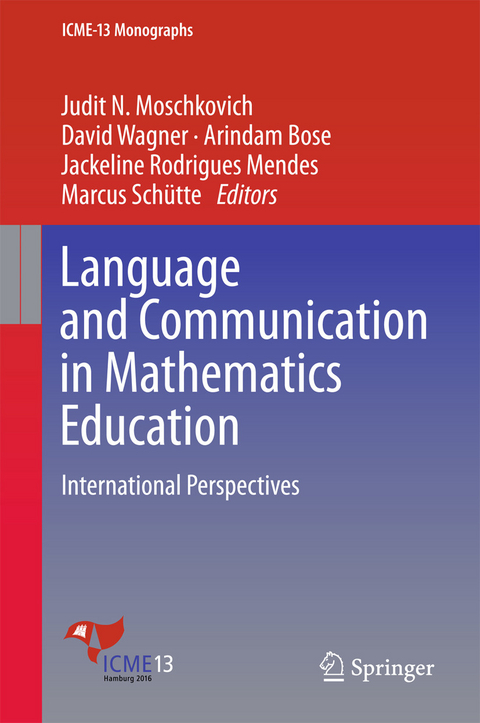
Language and Communication in Mathematics Education (eBook)
VI, 279 Seiten
Springer International Publishing (Verlag)
978-3-319-75055-2 (ISBN)
This book considers some of the outstanding questions regarding language and communication in the teaching and learning of mathematics - an established theme in mathematics education research, which is growing in prominence. Recent research has demonstrated the wide range of theoretical and methodological resources that can contribute to this area of study, including those drawing on cross-disciplinary perspectives influenced by, among others, sociology, psychology, linguistics, and semiotics.
Examining language in its broadest sense to include all modes of communication, including visual and gestural as well as spoken and written modes, it features work presented and discussed in the Language and Communication topic study group (TSG 31) at the 13th International Congress on Mathematical Education (ICME-13). A joint session with participants of the Mathematics Education in a Multilingual and Multicultural Environment topic study group (TSG 32) enhanced discussions, which are incorporated in elaborations included in this book.
Discussing cross-cutting topics it appeals to readers from a wide range of disciplines, such as mathematics education and research methods in education, multilingualism, applied linguistics and beyond.1. Introduction,Judit Moschkovich (USA) and Arindam Bose (India)2. Fifty years of language data in mathematics education: A brief historyDavid Pimm (Canada)3. Explaining as mathematical discursive practices of navigating through different epistemic fieldsKirstin Erath (Germany)4. Subject-specific academic language versus mathematical discourseMarcus Schütte (Germany)5. Authority and politeness: Complementary analyses of mathematics teaching episodesKonstantinos Tatsis (Greece) and David Wagner (Canada)6. The interplay of language and objects in the process of abstractingMarei Fetzer (Germany) and Kerstin Tiedemann (Germany)7. Interactional processes in inclusive mathematics teachingJudith Jung (Germany)8. How learners communicate their mathematics reasoning in a mathematics discourseBenadette Aineamani (South Africa)9. “I am sorry. I did not understand you”: The learning of dialogue by prospective teachersRaquel Milani (Brazil)10. Dealing with function word problems: Identifying and interpreting verbal representationsCarina Zindel (Germany)11. 4-year-old language repertoire in a counting situationDavid Wagner (Canada) and Annica Andersson (Sweden)12. Making student explanations relevant in whole class discussionJenni Ingram, Nick Andrews and Andrea Pitt (United Kingdom)13. A teacher’s use of revoicing in mathematical discussionsKaouthar Boukafri (Spain), Marta Civil (USA) and Núria Planas (Spain)14. Podcasts in second language math teaching as an instrument for measuring teachers’ language awarenessPelagia Papadopoulou-Tzaki and Christine Bescherer (Germany)15. The meaning of ‘number’ in Kaiabi language: Indigenous teachers’ identity discourses in a multilingual settingJackeline Rodrigues Mendes (Brazil)16. The use of language in the construction of the natural number meaningLorena Trejo-Guerrero and Marta Elena Valdemoros-Álvarez (Mexico)17. Exploring how a grade 7 teacher promotes mathematical reasoning in multilingual mathematics class of English second language learnersLindiwe Tshabalala (South Africa)18. Identity fostered language communication in a mathematics classroom: An analysisArindam Bose (India), K. Subramaniam (India) and Mamokgethi Phakeng (South Africa)19. Recommendations for research on language and learning mathematicsJudit Moschkovich (USA)
| Erscheint lt. Verlag | 27.3.2018 |
|---|---|
| Reihe/Serie | ICME-13 Monographs | ICME-13 Monographs |
| Zusatzinfo | VI, 279 p. 27 illus. |
| Verlagsort | Cham |
| Sprache | englisch |
| Themenwelt | Sozialwissenschaften ► Pädagogik ► Schulpädagogik / Grundschule |
| Schlagworte | communication of mathematics reasoning • identifying and interpreting verbal representation • inclusive mathematics teaching • language and learning mathematics • language data in mathematics education • language in mathematics • Learning and Instruction • learning dialogue in mathematics • mathematical discourse • mathematics communication • mathematics discursive practices • mathematics edcuataion • mathematics reasoning • multilingual mathematics • prospective mathematics teachers • teaching mathematics |
| ISBN-10 | 3-319-75055-0 / 3319750550 |
| ISBN-13 | 978-3-319-75055-2 / 9783319750552 |
| Informationen gemäß Produktsicherheitsverordnung (GPSR) | |
| Haben Sie eine Frage zum Produkt? |
 PDF (Wasserzeichen)
DRM: Digitales Wasserzeichen
Dieses eBook enthält ein digitales Wasserzeichen und ist damit für Sie personalisiert. Bei einer missbräuchlichen Weitergabe des eBooks an Dritte ist eine Rückverfolgung an die Quelle möglich.
Dateiformat: PDF (Portable Document Format)
Mit einem festen Seitenlayout eignet sich die PDF besonders für Fachbücher mit Spalten, Tabellen und Abbildungen. Eine PDF kann auf fast allen Geräten angezeigt werden, ist aber für kleine Displays (Smartphone, eReader) nur eingeschränkt geeignet.
Systemvoraussetzungen:
PC/Mac: Mit einem PC oder Mac können Sie dieses eBook lesen. Sie benötigen dafür einen PDF-Viewer - z.B. den Adobe Reader oder Adobe Digital Editions.
eReader: Dieses eBook kann mit (fast) allen eBook-Readern gelesen werden. Mit dem amazon-Kindle ist es aber nicht kompatibel.
Smartphone/Tablet: Egal ob Apple oder Android, dieses eBook können Sie lesen. Sie benötigen dafür einen PDF-Viewer - z.B. die kostenlose Adobe Digital Editions-App.
Buying eBooks from abroad
For tax law reasons we can sell eBooks just within Germany and Switzerland. Regrettably we cannot fulfill eBook-orders from other countries.
aus dem Bereich