


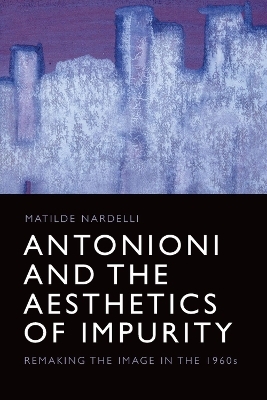
Antonioni and the Aesthetics of Impurity
Remaking the Image in the 1960s
Seiten
2020
Edinburgh University Press (Verlag)
978-1-4744-4404-0 (ISBN)
Edinburgh University Press (Verlag)
978-1-4744-4404-0 (ISBN)
The book offers a radical rethinking of Michelangelo Antonioni’s work. It argues against prevalent understandings of it in terms of both cinematic purity and indebtedness to painting.
Influential, innovative and aesthetically experimental, the films of Michelangelo Antonioni are widely recognized as both exemplars of cinema and key in ushering in its ‘new’ or ‘modern’ incarnation around 1960. Antonioni and the Aesthetics of Impurity offers a radical rethinking of the director’s work. It argues against prevalent understandings of it in terms of both cinematic purity and indebtedness to painting. Reconnecting Antonioni’s aesthetically audacious films of the 1960s and 1970s to the ferment of their historical time, Antonioni and the Aesthetics of Impurity brings into relief these works’ crucial, yet overlooked, affinity with the new, ‘impure’, art practices – of John Cage, Franco Vaccari, Robert Smithson, Piero Gilardi and Andy Warhol among others – that precipitated the demotion of painting from its privileged position as a paradigm for all the arts. Revealing an Antonioni who embraced both mixed and mass media and reflected on them via cinema, the book replaces auteuristic, if not hagiographic, accounts of the director’s work with a new understanding of its critical significance across the modern visual arts and culture more broadly.
Influential, innovative and aesthetically experimental, the films of Michelangelo Antonioni are widely recognized as both exemplars of cinema and key in ushering in its ‘new’ or ‘modern’ incarnation around 1960. Antonioni and the Aesthetics of Impurity offers a radical rethinking of the director’s work. It argues against prevalent understandings of it in terms of both cinematic purity and indebtedness to painting. Reconnecting Antonioni’s aesthetically audacious films of the 1960s and 1970s to the ferment of their historical time, Antonioni and the Aesthetics of Impurity brings into relief these works’ crucial, yet overlooked, affinity with the new, ‘impure’, art practices – of John Cage, Franco Vaccari, Robert Smithson, Piero Gilardi and Andy Warhol among others – that precipitated the demotion of painting from its privileged position as a paradigm for all the arts. Revealing an Antonioni who embraced both mixed and mass media and reflected on them via cinema, the book replaces auteuristic, if not hagiographic, accounts of the director’s work with a new understanding of its critical significance across the modern visual arts and culture more broadly.
Dr Matilde Nardelli is a Senior Lecturer in the London School of Film, Media and Design at the University of West London.
List of FiguresAcknowledgements
Introduction
1. Impure Pictoriality: The Matter of Painting
2. Performing the Mind: Interiority, Television and Artificial Brains
3. (Quietly) Noisy Images: Sonic Landscapes, Audiotape and ‘the New Musicality’
4. The ‘Image-World’ and the Reality of Photography
5. Uncinematic Provocations and the Pursuit of Boredom
Bibliography Index
| Erscheinungsdatum | 18.09.2020 |
|---|---|
| Zusatzinfo | 35 black and white illustrations |
| Verlagsort | Edinburgh |
| Sprache | englisch |
| Maße | 156 x 234 mm |
| Gewicht | 516 g |
| Themenwelt | Kunst / Musik / Theater ► Film / TV |
| Sozialwissenschaften ► Kommunikation / Medien ► Medienwissenschaft | |
| ISBN-10 | 1-4744-4404-0 / 1474444040 |
| ISBN-13 | 978-1-4744-4404-0 / 9781474444040 |
| Zustand | Neuware |
| Informationen gemäß Produktsicherheitsverordnung (GPSR) | |
| Haben Sie eine Frage zum Produkt? |
Mehr entdecken
aus dem Bereich


aus dem Bereich


