


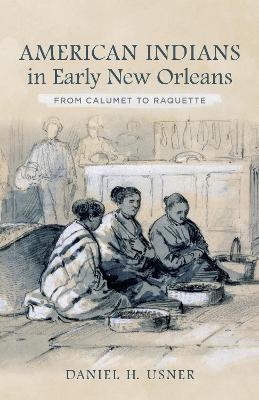
American Indians in Early New Orleans
From Calumet to Raquette
Seiten
2018
Louisiana State University Press (Verlag)
978-0-8071-7009-0 (ISBN)
Louisiana State University Press (Verlag)
978-0-8071-7009-0 (ISBN)
- Lieferbar (Termin unbekannt)
- Versandkostenfrei
- Auch auf Rechnung
- Artikel merken
Lays to rest assumptions that American Indian communities vanished long ago from urban south Louisiana and recovers the experiences of Native Americans in Old New Orleans from their perspective.
From a peace ceremony conducted by Chitimacha diplomats before Governor Bienville's makeshift cabin in 1718 to a stickball match played by Choctaw teams in 1897 in Athletic Park, American Indians greatly influenced the history and culture of the Crescent City during its first two hundred years. In American Indians in Early New Orleans, Daniel H. Usner lays to rest assumptions that American Indian communities vanished long ago from urban south Louisiana and recovers the experiences of Native Americans in Old New Orleans from their perspective.
Centuries before the arrival of Europeans, American Indians controlled the narrow strip of land between the Mississippi River and present-day Lake Pontchartrain to transport goods, harvest resources, and perform rituals. The birth and growth of colonial New Orleans depended upon the materials and services provided by Native inhabitants as liaisons, traders, soldiers, and even slaves. Despite losing much of their homeland and political power after the Louisiana Purchase, Lower Mississippi Valley Indians refused to retreat from New Orleans's streets and markets; throughout the 1800s, Choctaw and other nearby communities improvised ways of expressing their cultural autonomy and economic interests- as peddlers, laborers, and performers- in the face of prejudice and hostility from non-Indian residents. Numerous other American Indian tribes, forcibly removed from the southeastern United States, underwent a painful passage through the city before being transported farther up the Mississippi River. At the dawn of the twentieth century, a few Indian communities on the north shore of Lake Pontchartrain continued to maintain their creative relationship with New Orleans by regularly vending crafts and plants in the French Market.
In this groundbreaking narrative, Usner explores the array of ways that Native people used this river port city, from its founding to the World War I era, and demonstrates their crucial role in New Orleans's history.
From a peace ceremony conducted by Chitimacha diplomats before Governor Bienville's makeshift cabin in 1718 to a stickball match played by Choctaw teams in 1897 in Athletic Park, American Indians greatly influenced the history and culture of the Crescent City during its first two hundred years. In American Indians in Early New Orleans, Daniel H. Usner lays to rest assumptions that American Indian communities vanished long ago from urban south Louisiana and recovers the experiences of Native Americans in Old New Orleans from their perspective.
Centuries before the arrival of Europeans, American Indians controlled the narrow strip of land between the Mississippi River and present-day Lake Pontchartrain to transport goods, harvest resources, and perform rituals. The birth and growth of colonial New Orleans depended upon the materials and services provided by Native inhabitants as liaisons, traders, soldiers, and even slaves. Despite losing much of their homeland and political power after the Louisiana Purchase, Lower Mississippi Valley Indians refused to retreat from New Orleans's streets and markets; throughout the 1800s, Choctaw and other nearby communities improvised ways of expressing their cultural autonomy and economic interests- as peddlers, laborers, and performers- in the face of prejudice and hostility from non-Indian residents. Numerous other American Indian tribes, forcibly removed from the southeastern United States, underwent a painful passage through the city before being transported farther up the Mississippi River. At the dawn of the twentieth century, a few Indian communities on the north shore of Lake Pontchartrain continued to maintain their creative relationship with New Orleans by regularly vending crafts and plants in the French Market.
In this groundbreaking narrative, Usner explores the array of ways that Native people used this river port city, from its founding to the World War I era, and demonstrates their crucial role in New Orleans's history.
Born and raised in New Orleans, Daniel H. Usner is the Holland N. McTyeire Professor of History at Vanderbilt University. He is the author of Indians, Settlers, and Slaves in a Frontier Exchange Economy: The Lower Mississippi Valley before 1783; American Indians in the Lower Mississippi Valley: Social and Economic Histories; Indian Work: Language and Livelihood in American History; and Weaving Alliances with Other Women: Chitimacha Indian Work in the New South.
| Erscheinungsdatum | 11.09.2018 |
|---|---|
| Verlagsort | Baton Rouge |
| Sprache | englisch |
| Maße | 140 x 216 mm |
| Gewicht | 404 g |
| Themenwelt | Sachbuch/Ratgeber ► Geschichte / Politik ► Allgemeines / Lexika |
| Geisteswissenschaften ► Geschichte ► Regional- / Ländergeschichte | |
| Geschichte ► Teilgebiete der Geschichte ► Kulturgeschichte | |
| Sozialwissenschaften ► Ethnologie | |
| Sozialwissenschaften ► Soziologie ► Spezielle Soziologien | |
| ISBN-10 | 0-8071-7009-7 / 0807170097 |
| ISBN-13 | 978-0-8071-7009-0 / 9780807170090 |
| Zustand | Neuware |
| Informationen gemäß Produktsicherheitsverordnung (GPSR) | |
| Haben Sie eine Frage zum Produkt? |
Mehr entdecken
aus dem Bereich



aus dem Bereich
Die Revolution des Gemeinen Mannes
Buch | Softcover (2024)
C.H.Beck (Verlag)
CHF 16,80
Eine Geschichte des Geschmacks
Buch | Hardcover (2025)
C.H.Beck (Verlag)
CHF 49,95
vom Mittelalter bis zur Gegenwart
Buch | Softcover (2024)
C.H.Beck (Verlag)
CHF 16,80


