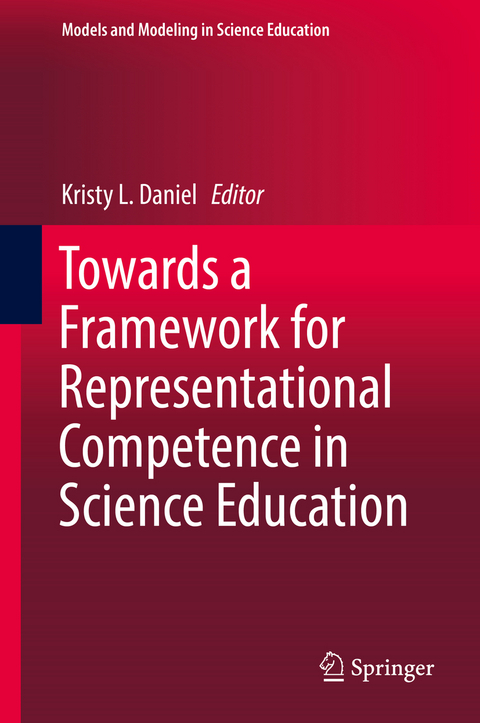
Towards a Framework for Representational Competence in Science Education
Springer International Publishing (Verlag)
978-3-319-89943-5 (ISBN)
This book covers the current state of thinking and what it means to have a framework of representational competence and how such theory can be used to shape our understanding of the use of representations in science education, assessment, and instruction. Currently, there is not a consensus in science education regarding representational competence as a unified theoretical framework. There are multiple theories of representational competence in the literature that use differing perspectives on what competence means and entails. Furthermore, dependent largely on the discipline, language discrepancies cause a potential barrier for merging ideas and pushing forward in this area. While a single unified theory may not be a realistic goal, there needs to be strides taken toward working as a unified research community to better investigate and interpret representational competence. An objective of this book is to initiate thinking about a representational competence theoretical framework across science educators, learning scientists, practitioners and scientists. As such, we have divided the chapters into three major themes to help push our thinking forward: presenting current thinking about representational competence in science education, assessing representational competence within learners, and using our understandings to structure instruction.
Section A: The Importance of Representational Competence.- 1. Towards a Definition of Representational Competence, Kristy L. Daniel, Carrie Jo Bucklin, E. Austin Leone, and Jenn Idema.- 2. Representational Fluency: A Means for Students to Develop STEM Literacy, Tamara J. Moore , S. Selcen Guzey, Gillian H. Roehrig, and Richard A. Lesh.- 3. Similar Information - Different Representations: Designing a Learning Environment for Promoting Transformational Competence, Billie Eilam and Shlomit Ofer.- 4. Agreeing to disagree: Students negotiating visual Ambiguity through scientific argumentation, Camillia Matuk.- 5. A Learning Performance Perspective on Representational Competence in Elementary Science Education, Laura Zangori.- Section B: Teaching Towards Representational Competence.- 6. Supporting Representational Competences Through Adaptive Educational Technologies, Martina A. Rau.- 7. Instructional Representations as Tools to Teach Systems Thinking, Tammy Lee and Gail Jones.- 8. Leveraging on Assessment of Representational Competence to Improve Instruction with External Representations, Mounir R. Saleh and Kristy L. Daniel.- 9. Improving Students' Representational Competence through a Course-based Undergraduate Research Experience, Chandrani Mishra, Kari Clase, Carrie Jo Bucklin, and Kristy L. Daniel.- Section C: The Assessment and Attainment of Representational Competence.- 10. Using Gesture Analysis to Assess Students' Developing Representational Competence, Matthew E. Lira and Mike Stieff.- 11. Assessing Representational Competence with Eye Tracking Technology, Inga Ubben, Sandra Nitz, Kristy L. Daniel, and Annette Upmeier zu Belzen.- 12. The Use of a Representational Triplet Model as the Basis for the Evaluation of Students' Representational Competence, Jill D. Maroo and Sara L. Johnson.- 13. Representational Competence in Science Education - from Theory to Assessment, Jochen Scheid, Andreas Müller, Rosa Hettmannsperger, and Wolfgang Schnotz.
| Erscheinungsdatum | 08.07.2018 |
|---|---|
| Reihe/Serie | Models and Modeling in Science Education |
| Zusatzinfo | VI, 277 p. 88 illus. |
| Verlagsort | Cham |
| Sprache | englisch |
| Maße | 155 x 235 mm |
| Gewicht | 590 g |
| Themenwelt | Sozialwissenschaften ► Pädagogik ► Erwachsenenbildung |
| Schlagworte | adaptive education technologies • assessment in science education • designing a learning environment • develop STEM literacy • elementary science education • external representations • Instructional representations • Inter-modality transformation competence • Inter-representational transformation competence • Learning progressionsx1 • LESH translation model • Meta-representational competence • Representational fluency • Representational skills • Representational theoretical framework • science learning • STEM and STEAM integration • teaching towards representational competence • Theoretical framework model • transformational affordances |
| ISBN-10 | 3-319-89943-0 / 3319899430 |
| ISBN-13 | 978-3-319-89943-5 / 9783319899435 |
| Zustand | Neuware |
| Informationen gemäß Produktsicherheitsverordnung (GPSR) | |
| Haben Sie eine Frage zum Produkt? |
aus dem Bereich