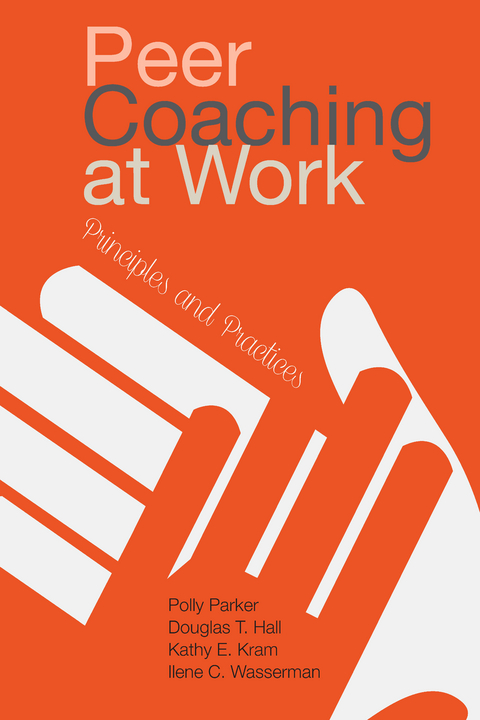
Peer Coaching at Work (eBook)
216 Seiten
Stanford University Press (Verlag)
978-1-5036-0506-0 (ISBN)

When it comes to mentoring, peer coaching is an undervalued workhorse. It's effective, inexpensive, widely applicable, and relatively easy to implement. Many coaches consider it to be the next wave in professional development. Peer Coaching at Work draws on research and practice to deliver a hands-on guide to this powerful relational learning technique.The authors all leaders in the field present a rigorously tested three-part model for facilitating peer coaching relationships in one-on-one settings and in larger groups. With lively case studies, they define peer coaching as a focused relationship between equals who supportively learn from, actively listen to, and judiciously question each other, which leads to breakthroughs that may otherwise lie dormant in one's career. A fundamental guide for anyone with an interest in mentoring and transformational learning, this book is a must-have for the talent management bookshelf.
Polly Parker is Professor of Leadership and Associate Dean (Academic), Faculty of Business, Economics and Law at the University of Queensland. Douglas T. Hall is Morton H. and Charlotte Friedman Professor of Management Emeritus and Founding Director of the Executive Development Roundtable at Boston University's Questrom School of Business. Kathy E. Kram is R.C. Shipley Professor in Management Emerita at Boston University's Questrom School of Business and Principal of ICW Consulting Group. Ilene C. Wasserman is President of ICW Consulting Group and a Senior Leadership Fellow at the Wharton School where she is the lead coach of their executive leadership program. She is also on the faculty of the ODL Program at the Philadelphia College of Osteopathic Medicineand isan Executive in Residence with the Center for Creative Leadership (CCL).
Contents and AbstractsIntroduction chapter abstractThe introduction provides an overview of this book, which is about the principles and practices of peer coaching, a unique type of relational learning. The authors define peer coaching as a focused relationship between individuals of equal status who support each other's personal and professional development goals. Peer coaching is most effective when participants are intentional and share a desire to provide and experience reciprocal support. Together peers strive to establish high-quality relationships characterized by trust and open communication. The 3-step model of peer coaching that represents the core of this book is outlined. Step 1 focuses on building the relationship, Step 2 on creating success, and Step 3 on making peer coaching a habit.1Learning in the VUCA Environment chapter abstractThis chapter builds on the introduction by examining the turbulent environmental contexts in which peer coaching takes place and how peer coaching relationships are both embedded in and shaped. The U.S. Army described the environment in which all work takes place and in which work relationships exist a "VUCA" environment: volatile, uncertain, complex, and ambiguous. Thomas Friedman describes the rate of change in this environment as "dizzying acceleration." Consequently, there is an ever-increasing demand on individuals to grow continuously and pressure on organizations to adapt successfully. Peer coaching is discussed as an effective yet low-cost resource to address these lifelong learning needs of individuals and organizations operating in these turbulent contexts.2Step 1: Build the Developmental Relationship chapter abstractThis chapter introduces Step 1 of the 3-step model of peer coaching. The focus is on building an effective relationship between peers to establish a secure holding environment as a strong foundation for their coaching. We encourage peers to engage in particular behaviors systematically to create trust and psychological safety. Three pairs of peer coaches illustrate the steps using models of coordinated management of meaning. Specific actions include selecting partners, beginning sessions with a check-in, jointly developing a working agreement, increasing self-awareness through sharing stories, and deep listening. Qualities such as a positive mind-set, a genuine sense of curiosity, and acting as a critical friend all foster effective interactions and enhance building the relationship.3Step 2: Hone Relational Practices to Create Success chapter abstractThis chapter focuses on Step 2 of the 3-step model of peer coaching, which focuses on creating success. Two primary developmental tasks that hone success and lead to a critical reflective practice are increasing self-awareness through self-disclosure and receiving feedback. Others include self-regulation and deep listening. The relational communication lens is introduced to assist peers with several tools from the coordinated management of meaning theory. Three pairs of peer coaches illustrate how these tools can readily support sense making, deepen their relationships, and build success. Peers are encouraged to adopt a dual focus as they consider content as well as patterns of meaning created between them in their relationship.4Step 3: Make Peer Coaching a Habit chapter abstractThis chapter introduces and illustrates Step 3 of the Peer Coaching model, making peer coaching a habit. Step 3 invites individuals to continue to develop self-awareness, reflective skills, and apply CMM tools and communication skills acquired in Step 2. Individuals are urged to practice this relational communication approach in current and new peer coaching relationships. The third step invites readers to consider their current developmental networks and assess opportunities to deepen relationship quality using the scaffolding necessary for effective peer coaching. Readers are invited to consider existing or new relationships inside and outside work that may have the potential to be transformed into connections that lead to mutual learning and growth.5Peer Coaching Groups chapter abstractIn this chapter the 3-step model of peer coaching is applied to groups. While peer coaching groups are small collectives that take many forms, the primary purpose is to support one another's learning. Groups increase the complexity of the process, and a paradox of structure becomes evident as more people bring greater potential benefit and more complexity to manage. The relational dynamic among members may be deceptively simple, which can obscure the potential challenges and pitfalls. Relational skills, emotional and social competencies such as self-awareness and self-regulation, contribute to interactional capacities and further builds them. Successful outcomes are more likely when members have experience in peer coaching and group dynamics.6Peer Coaching for Deep Learning chapter abstractIn this chapter, focus shifts to peer coaching as a powerful tool to facilitate deep learning. Not all peer coaching interactions result in deep learning, as the process is difficult to create yet has potentially powerful outcomes. Deep learning involves the whole person, including identity, which goes to the core of who the person is, incorporating thoughts, feelings, observations, values, and inherent assumptions. Personal transformation is more likely to occur when peers have enough experience and expertise to structure the process to inquire at the level of underlying assumptions. This chapter is a call to action, a call to develop the potential to structure peer coaching to facilitate deep learning outcomes.7Peer Coaching for Everyday Learning chapter abstractThis chapter describes the conditions and processes that support peer coaching as a regular everyday practice. It is important to be intentional about applying each of the three steps of the model so that peer coaching is valued explicitly as a way for everyone to learn and develop at work. Peer coaching as an everyday practice embeds attitudes and behaviors that integrate learning and performance for people in any roles and at all levels. A supportive culture would align job design, reward systems, and build peer coaching into team structures and the fabric of the organization's routines. Managers, leaders, and organizational development/human resource professionals all have a role to play.8Cautionary Tales in Peer Coaching chapter abstractThis chapter suggests caution in engaging in peer coaching, as it can fail to meet its potential. Risk factors that cause peer coaching relationships to go awry include lack of self-awareness, unrealistic expectations, failure to renegotiate when changes occur, lack of empathy, lack of relational competence, a highly competitive culture, and inappropriate incentives and rewards. One or more of these factors can lead to negative outcomes, including frustration, increased stress, lowered job satisfaction, anxiety, poor performance, and turnover. Several examples are revisited to demonstrate how these risk factors can be minimized. HR/OD professionals and organizational leaders are reminded that the underlying cultural context must be addressed before peer coaching relationships can thrive.Conclusions and Going Forward chapter abstractThis final chapter discusses examples of how leaders and organizations have integrated peer coaching into their basic toolkits after following through the 3-step Peer Coaching model: (1) how to build effective relationships in peer dyads or groups, (2) how to create success experiences for students with peer coaching by honing their relational skills, and (3) how to make peer coaching a habit. Peer coaching is a relational process comprising an attitude, a set of behaviors, and a set of skills focused on supporting a peer, not to solve their problems. Using the 3-step process, individuals can acquire and practice attitudes and behaviors that will foster mutual learning in relationships with their peers.
| Erscheint lt. Verlag | 10.4.2018 |
|---|---|
| Sprache | englisch |
| Themenwelt | Sachbuch/Ratgeber ► Beruf / Finanzen / Recht / Wirtschaft ► Bewerbung / Karriere |
| Sozialwissenschaften ► Pädagogik ► Berufspädagogik | |
| Wirtschaft ► Betriebswirtschaft / Management ► Personalwesen | |
| Wirtschaft ► Betriebswirtschaft / Management ► Planung / Organisation | |
| Schlagworte | coordinated management of meaning • Deep learning • Learning Culture • Peer coaching • peer coaching groups • relational learning • risk factors • VUCA |
| ISBN-10 | 1-5036-0506-X / 150360506X |
| ISBN-13 | 978-1-5036-0506-0 / 9781503605060 |
| Informationen gemäß Produktsicherheitsverordnung (GPSR) | |
| Haben Sie eine Frage zum Produkt? |
 EPUB (Adobe DRM)
Kopierschutz: Adobe-DRM
Adobe-DRM ist ein Kopierschutz, der das eBook vor Mißbrauch schützen soll. Dabei wird das eBook bereits beim Download auf Ihre persönliche Adobe-ID autorisiert. Lesen können Sie das eBook dann nur auf den Geräten, welche ebenfalls auf Ihre Adobe-ID registriert sind.
Details zum Adobe-DRM
Dateiformat: EPUB (Electronic Publication)
EPUB ist ein offener Standard für eBooks und eignet sich besonders zur Darstellung von Belletristik und Sachbüchern. Der Fließtext wird dynamisch an die Display- und Schriftgröße angepasst. Auch für mobile Lesegeräte ist EPUB daher gut geeignet.
Systemvoraussetzungen:
PC/Mac: Mit einem PC oder Mac können Sie dieses eBook lesen. Sie benötigen eine
eReader: Dieses eBook kann mit (fast) allen eBook-Readern gelesen werden. Mit dem amazon-Kindle ist es aber nicht kompatibel.
Smartphone/Tablet: Egal ob Apple oder Android, dieses eBook können Sie lesen. Sie benötigen eine
Geräteliste und zusätzliche Hinweise
Buying eBooks from abroad
For tax law reasons we can sell eBooks just within Germany and Switzerland. Regrettably we cannot fulfill eBook-orders from other countries.
aus dem Bereich