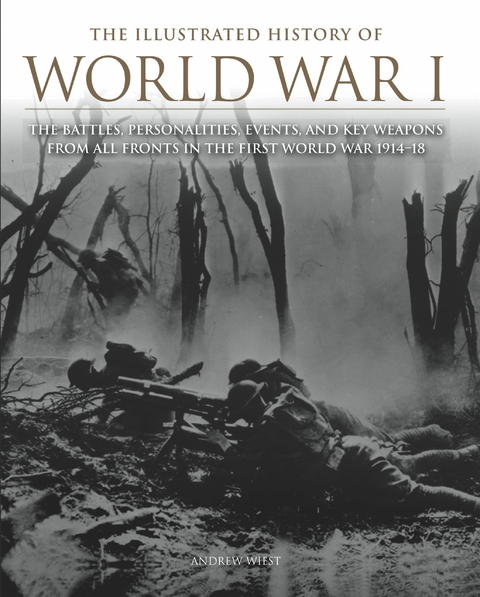
Illustrated History of World War I (eBook)
256 Seiten
Amber Books Ltd (Verlag)
978-1-78274-201-2 (ISBN)
The Illustrated History of World War I describes a conflict that began with a naval arms race in the early 1900s, and ended in 1918 with the deaths of nearly 23 million soldiers of all nations. As many more would die in the influenza pandemic that raged after the fighting had ceased. The war brought great social, political and military change. The innocence of the Victorian world was gone, replaced by an era of uncertainty.
With the aid of more than 250 black-and-white photographs and full-colour artworks, The Illustrated History of World War I recreates the battles and campaigns that raged across the surface of the globe, on land, at sea and in the air. Including full colour maps of specific actions and campaigns and feature boxes explaining important events and personalities involved in the conflict, The Illustrated History of World War I provides a graphic and compelling account of the first truly modern war.
The first truly total war, the 'war to end all wars', shocked the world with its scale and brutality. Men from both sides went to war in August 1914 expecting to be home by Christmas, but on the Western and Italian Fronts troops became locked in a grim stalemate of trench warfare. For the first time, advances in both agricultural and industrial production had made it possible to equip and sustain mass armies for years in the field. The Illustrated History of World War I describes a conflict that began with a naval arms race in the early 1900s, and ended in 1918 with the deaths of nearly 23 million soldiers of all nations. As many more would die in the influenza pandemic that raged after the fighting had ceased. The war brought great social, political and military change. The innocence of the Victorian world was gone, replaced by an era of uncertainty. With the aid of more than 250 black-and-white photographs and full-colour artworks, The Illustrated History of World War I recreates the battles and campaigns that raged across the surface of the globe, on land, at sea and in the air. Including full colour maps of specific actions and campaigns and feature boxes explaining important events and personalities involved in the conflict, The Illustrated History of World War I provides a graphic and compelling account of the first truly modern war.
CHAPTER 2
Germany Strikes West
BELGIAN SOLDIERS ADVANCE TO MEET THE INVADING GERMANS IN 1914. BELGIUM WAS AN AFTERTHOUGHT IN THE GERMAN SCHLIEFFEN PLAN, WHICH AIMED TO DEFEAT FRANCE IN JUST SIX WEEKS. AS IT UNFOLDED THE PLAN LED TO A SERIES OF BATTLES THAT WOULD DECIDE THE FATE OF THE WESTERN FRONT.
A ‘Cult of the Offensive’ gripped the military machines of Europe. In reality, the new weaponry and the great industrial might of the belligerent nations would make offensives costly and futile, but military planners would cling to their offensive beliefs like grim death.
COMPETING PLANS
The Germans had invaded France, and risked British ire by violating Belgian neutrality, hoping to defeat France in six weeks. It seems that the Kaiser had good reason to expect a quick victory; after all, Germany had defeated France in a similar space of time in 1870. Most military thinkers in every country expected the war to be swift and decisive. The industrial revolution had provided the combatants with new weaponry that would make it so. Indeed a ‘Cult of the Offensive’ gripped the military machines of Europe. In reality, the new weaponry and the great industrial might of the belligerent nations would make offensives costly and futile, but military planners would cling to their offensive beliefs like grim death.
The French Army, numbering some two million men under the command of General Joseph Joffre, was thoroughly wedded to the idea of an audacious attack aimed at achieving a Napoleonic-style decisive victory. Their offensive scheme, dubbed Plan 17, called for a mass invasion of the German-held states of Alsace-Lorraine. Joffre and his generals believed that French fighting spirit, or èlan, would make up for what Plan 17 lacked in subtlety but the plan had several obvious weaknesses, including the fact that it left much of northern France thinly defended. Such details mattered little to the French, who planned to sweep forward so fast that any German riposte would come too late to stave off their inevitable defeat.
MOLTKE
General Helmuth von Moltke, the nephew of the Field Marshal who had defeated France in the Franco-Prussian War, succeeded Schlieffen as Chief of the German General Staff in 1906. The younger Moltke saw fit to make several alterations to the Schlieffen Plan. Afraid of losing too much territory, he weakened the all-important right flank of the German advance and strengthened the defensive formations in Alsace-Lorraine. As the war began, the somewhat timid and nervous Moltke remained far behind the front lines and quickly lost touch with his advancing forces. As a result, he overestimated the success of the German advance. Adding to his difficulties was a Russian invasion on the Eastern Front and a British landing at Antwerp. The Schlieffen Plan called for German forces to ignore such distractions and to focus on the speedy defeat of France, but Moltke’s confidence wavered. Frightened of the consequences, he removed troops from the right flank of the German advance to deal with the perceived threats. The delicate balance of the Schlieffen Plan was shattered. Furthermore, Moltke’s mistakes helped lead to the critical Battle of the Marne. At this pivotal point, yet again, he lost contact with his advancing forces and sent Richard Hentsch, a mere colonel, to the front to deal with the strategic situation. His control lost, and his nerve broken, Moltke abandoned the offensive. Constant tinkering with the Schlieffen Plan and timidity had led German forces to a strategic defeat. This would help transform World War I into a gigantic stalemate. On 14 September 1914 the Kaiser relieved Moltke of his command.
GENERAL HELMUTH VON MOLTKE.
The British Expeditionary Force (BEF) numbered but 150,000 men under the command of Sir John French and they entered the French plans almost as an afterthought. The French expected their victory to be so swift that the BEF would barely have time to reach French soil before the war was over. As a result, Joffre relegated them to the northernmost portion of the line, farthest from Alsace-Lorraine and seemingly furthest from trouble. The Germans, too, paid the BEF little attention in their planning, the Kaiser even referring to the force as a ‘contemptible little army’ that would have scant impact on the outcome of the conflict. The original BEF, with customary aplomb, turned the pejorative term into a compliment and referred to themselves ever after as the ‘Old Contemptibles’.
The German plan of action was developed by Alfred von Schlieffen. He realised that the French would probably attempt to seize their lost states of Alsace-Lorraine and he aimed to use such a predictable plan of action to his advantage. The ‘Schlieffen Plan’ called for a relatively small force to hold Alsace-Lorraine. The weakness of the defenders was designed to draw the attacking French further into a trap. While the French advanced into Alsace-Lorraine, five German armies would advance through Belgium into lightly defended northern France, before wheeling on the pivot of Alsace-Lorraine, rather like a great revolving door. The armies would capture Paris and then advance upon the attacking French from behind. While the French pushed on one part of the door in Alsace-Lorraine, the other part of the door would hit them in the back. It was to be a classic battle of envelopment, rather like Hannibal at Cannae. It would result in the destruction of the entire French Army in a Kesselschlacht (cauldron battle).
THE GREAT WAR BEGAN THE WAY MOST MILITARY EXPERTS EXPECTED — AS A WAR OF RAPID MOVEMENT, AS EVIDENCED BY THESE GERMANS QUICKLY FORDING A RIVER WITH A FIELD GUN IN THE EARLY DAYS OF THE CONFLICT.
KING ALBERT
After Germany invaded the tiny nation of Belgium, King Albert assumed command of the nation’s small, but spirited army. He and his commanders hoped to make a gallant stand at the fortress city of Liege, but the speed of the German advance and the weight of German firepower forced the Belgians to retreat to and take refuge within the fortifications of the port of Antwerp within days. During the ‘Race to the Sea’ German forces once again pummelled the outmatched Belgians, forcing them to relinquish Antwerp and retreat further down the coast. Finally, after almost all of Belgium had fallen, in late October 1914 Albert’s forces held firm at the Battle of the Yser, stemming the German advance partly by flooding the low-lying countryside and making it impassible to German troops; Belgian forces, led by their king, tenaciously held on to a tiny corner of their nation for the remainder of the war. Although Albert remained tied to the British and the French, relations between the erstwhile allies were often strained. King Albert distanced himself from most allied war aims, maintaining that he and his forces fought only for the freedom and independence of Belgium. Indeed, King Albert was often quite keen to pursue the notion of a compromise peace with the Germans, and his forces did not participate in many of the great Allied offensives in the west. By 1918, though, his position had modified and Albert personally led his army forward in the final Allied offensives that won the war.
KING ALBERT OF BELGIUM.
Schlieffen realised that his plan had some weaknesses. The army on the German right flank would have to travel a tremendous distance to effect the capture of Paris and the envelopment of the French armies in the south. Success of his scheme was so important to Schlieffen that on his deathbed his final words were ‘do not weaken the right flank’. He had also realised that to make such a massive military operation possible would require miracles of logistics. To that end, he meticulously worked out the supply of the advancing German forces. Even so, his plan was so delicately balanced that any alteration of the allocation of men or supplies would threaten to ruin the entire scheme.
OVERVIEW
In 1914, following the dictates of the Schlieffen Plan, Germany attacked France, hoping to win a victory in the west in six weeks. German forces stampeded through neutral Belgium in a great wheeling motion designed to crush the French in a battle of envelopment. Initially the French played right into the German hand by attacking into Alsace-Lorraine. Such action allowed the Germans to advance in the north almost unopposed. Meanwhile, the British Expeditionary Force (BEF) landed in France and advanced to Mons, expecting to man a quiet sector of the line. Instead, they stumbled headlong into the path of the main German advance. After mounting a brave defence, the BEF retreated toward Paris. All seemed to be lost but the French reacted quickly to the disaster and rallied their troops for a successful battle on the Marne River at the very gates of Paris. The Germans were thrown back and their bid to win the war in six weeks had failed. Slowly World War I would engulf the entire length of France and would evolve into a trench war.
General Helmuth von Moltke, in command of the German armed forces numbering over three million men, put the Schlieffen Plan into operation in 1914. Even before the outbreak of war, he had altered its very nature. His revised version placed more emphasis on the defence of Alsace-Lorraine which, as a result, weakened the all-important right flank. Once the battle had begun, it became apparent that Moltke was somewhat timid and made disastrous...
| Erscheint lt. Verlag | 11.6.2014 |
|---|---|
| Reihe/Serie | Illustrated History | Illustrated History |
| Sprache | englisch |
| Themenwelt | Sachbuch/Ratgeber ► Geschichte / Politik ► Allgemeines / Lexika |
| Geschichte ► Allgemeine Geschichte ► Neuzeit (bis 1918) | |
| Geisteswissenschaften ► Geschichte ► Hilfswissenschaften | |
| Geschichte ► Teilgebiete der Geschichte ► Militärgeschichte | |
| Sozialwissenschaften ► Politik / Verwaltung | |
| Schlagworte | Dreadnought • Front • Gallipoli • Kaiser • Marne • Navy • Somme • Trench • tsar • Verdun • war • Western • Ypres |
| ISBN-10 | 1-78274-201-8 / 1782742018 |
| ISBN-13 | 978-1-78274-201-2 / 9781782742012 |
| Informationen gemäß Produktsicherheitsverordnung (GPSR) | |
| Haben Sie eine Frage zum Produkt? |
 EPUB (Adobe DRM)
Größe: 53,1 MB
Kopierschutz: Adobe-DRM
Adobe-DRM ist ein Kopierschutz, der das eBook vor Mißbrauch schützen soll. Dabei wird das eBook bereits beim Download auf Ihre persönliche Adobe-ID autorisiert. Lesen können Sie das eBook dann nur auf den Geräten, welche ebenfalls auf Ihre Adobe-ID registriert sind.
Details zum Adobe-DRM
Dateiformat: EPUB (Electronic Publication)
EPUB ist ein offener Standard für eBooks und eignet sich besonders zur Darstellung von Belletristik und Sachbüchern. Der Fließtext wird dynamisch an die Display- und Schriftgröße angepasst. Auch für mobile Lesegeräte ist EPUB daher gut geeignet.
Systemvoraussetzungen:
PC/Mac: Mit einem PC oder Mac können Sie dieses eBook lesen. Sie benötigen eine
eReader: Dieses eBook kann mit (fast) allen eBook-Readern gelesen werden. Mit dem amazon-Kindle ist es aber nicht kompatibel.
Smartphone/Tablet: Egal ob Apple oder Android, dieses eBook können Sie lesen. Sie benötigen eine
Geräteliste und zusätzliche Hinweise
Buying eBooks from abroad
For tax law reasons we can sell eBooks just within Germany and Switzerland. Regrettably we cannot fulfill eBook-orders from other countries.
EPUB (Ohne DRM)Digital Rights Management: ohne DRM
Dieses eBook enthält kein DRM oder Kopierschutz. Eine Weitergabe an Dritte ist jedoch rechtlich nicht zulässig, weil Sie beim Kauf nur die Rechte an der persönlichen Nutzung erwerben.
Dateiformat: EPUB (Electronic Publication)
EPUB ist ein offener Standard für eBooks und eignet sich besonders zur Darstellung von Belletristik und Sachbüchern. Der Fließtext wird dynamisch an die Display- und Schriftgröße angepasst. Auch für mobile Lesegeräte ist EPUB daher gut geeignet.
Systemvoraussetzungen:
PC/Mac: Mit einem PC oder Mac können Sie dieses eBook lesen. Sie benötigen dafür die kostenlose Software Adobe Digital Editions.
eReader: Dieses eBook kann mit (fast) allen eBook-Readern gelesen werden. Mit dem amazon-Kindle ist es aber nicht kompatibel.
Smartphone/Tablet: Egal ob Apple oder Android, dieses eBook können Sie lesen. Sie benötigen dafür eine kostenlose App.
Geräteliste und zusätzliche Hinweise
Buying eBooks from abroad
For tax law reasons we can sell eBooks just within Germany and Switzerland. Regrettably we cannot fulfill eBook-orders from other countries.
aus dem Bereich