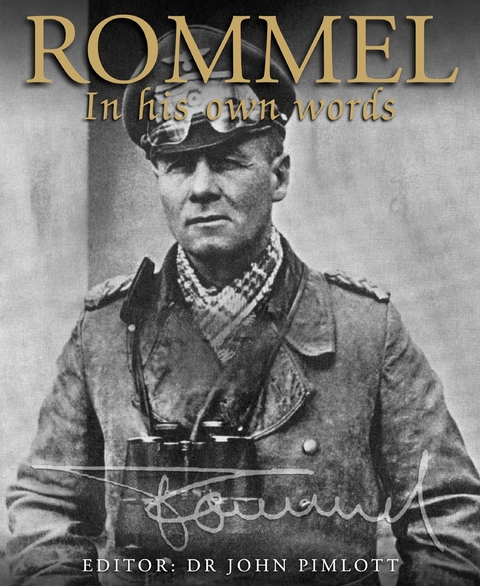
Rommel (eBook)
192 Seiten
Amber Books Ltd (Verlag)
978-1-78274-190-9 (ISBN)
'One loses all sense of time here. The battles for the last positions before Alexandria are hard. I was several days in the front line and lived in the car or a hole in the ground.'
Erwin Rommel
Combining private letters to his wife, orders, his daily accounts of battle written during World War II and his published memoirs, Rommel offers a compelling insight into the mind of one of the twentieth century's great military leaders. Alongside accounts of fighting in World War I and World War II, Rommel shares his views on the philosophy of warfare, battles, leaders and the progress of both world wars.
Dr John Pimlott's commentary puts Rommel's writing into historical context, describing the background to Rommel's ideas and how his plans were affected by circumstances beyond his control.
120 black-and-white photographs - many of them taken by Rommel himself - and battle maps illustrate the theatres in which Rommel fought. From the Alps in World War I to the invasion of France in 1940, and from the Desert War in 1943 to Normandy in 1944, Rommel - in his own words brings the concerns and crises of Rommel's wars to life.
"e;One loses all sense of time here. The battles for the last positions before Alexandria are hard. I was several days in the front line and lived in the car or a hole in the ground."e; - Erwin RommelCombining private letters to his wife, orders, his daily accounts of battle written during World War II and his published memoirs, Rommel offers a compelling insight into the mind of one of the twentieth century's great military leaders. Alongside accounts of fighting in World War I and World War II, Rommel shares his views on the philosophy of warfare, battles, leaders and the progress of both world wars. Dr John Pimlott's commentary puts Rommel's writing into historical context, describing the background to Rommel's ideas and how his plans were affected by circumstances beyond his control. 120 black-and-white photographs - many of them taken by Rommel himself - and battle maps illustrate the theatres in which Rommel fought. From the Alps in World War I to the invasion of France in 1940, and from the Desert War in 1943 to Normandy in 1944, Rommel - in his own words brings the concerns and crises of Rommel's wars to life.
Chapter I
Young Rommel
Born into a strict, typically middle-class southern German family, the young Erwin Rommel showed no early signs of military genius. A pale and sometimes sickly child, he nonetheless enjoyed physical challenges, and had youthful ambitions of becoming an aeronautical engineer. However, his future was to be in another profession…
Erwin Johannes Eugen Rommel was born on Sunday 15th November 1891 at Heidenheim, near Ulm in Württemberg. His father, after whom he was named, was a schoolmaster and a mathematician of some distinction; his mother, Helene, was the eldest daughter of Karl von Luz, President of the Government (Regierungs-Praesident) of Württemberg. Erwin was therefore assured of a comfortable upbringing; as he was later to recall: ‘my early years passed very pleasantly as I was able to romp around our yard and big garden all day long’. He had an elder sister, Helena, and two younger brothers, Karl and Gerhardt; an elder brother, Manfred, died while still an infant.
Officer Cadet Rommel photographed in 1911, an official portrait he gave to his mother at the beginning of his military career.
There was no indication in his early years that he would pursue a military career. As a child, Erwin was so pale and sickly that, according to Helene, he was known in the family as the ‘white bear’. He also displayed little intellectual capacity. In 1898 his father was appointed headmaster of the secondary school (Realgymnasium) at Aalen, but as there was no primary school in the town, Erwin had to be educated by private tuition. Although this proved sufficient to gain him a place in his father’s school in 1900, he had clearly not kept up with his contemporaries. Aware of this, he became even more pale and sickly, falling so far behind in his work that he gained a reputation for being lazy and inattentive.
But he did have potential. According to an anecdote recalled to Desmond Young when he was researching his book Rommel (Collins, London, 1950), he was so careless that it became a standing joke, leading his teacher to declare that ‘if Rommel ever shows up [with] a dictation without a mistake, we will hire a band and go off for a day in the country’. On hearing this, the youngster woke up and produced a perfect piece of work. When the day in the country did not materialise, however, he soon reverted to his former character. Erwin suddenly changed when he was in his teens, showing a flair for mathematics, taking an interest in sport and, with a friend, building a glider in the countryside near his home. Indeed, at this stage he seems to have wanted to be an engineer, with particular reference to the new and exciting field of aeronautics.
He was stopped from doing this by his father, however, who had a reputation for being strict and insistent. Instead, the young Erwin changed his mind and declared that he wanted to join the Württemberg Army. Erwin senior, who had served in the artillery as a young man, accepted this and did all he could to help his son, even though he would probably have preferred him to further his education. In March 1910, young Rommel was ordered to report to his local garrison for a medical; although he was found to be suffering from an inguinal hernia, this was rectified by a small operation and, on 19th July, he was told to report to the 124th Württemberg Infantry Regiment as a lowly Fahnenjunker (officer candidate).
After rudimentary recruit training, he was posted to the Royal Officer Cadet School in Danzig. His career had begun. Just before he joined the school, he was asked to produce a short account of his early life.
Aalen, March 1910 – I was born on 15th November 1891 at Heidenheim on the Brenz as the second son of the schoolmaster Erwin Rommel and his wife Helene, née Luz, both of the Protestant faith…
I was supposed to start primary school in the autumn when I was seven; but as my father was promoted to headmaster at Aalen that year and there is no primary school there, I had to acquire the necessary knowledge by private tuition in order to be able to get into the elementary school at Aalen. Two years later I entered the Latin School, and stayed there five years…
Kaiser Wilhelm II (smoking cigarette) and von Moltke peer suspiciously at the camera during a pre-war military ceremony. Moltke succeeded General von Schlieffen as Chief of the German General Staff, and also largely succeeded in dismantling Schlieffen’s inspired plan for the rapid defeat of France.
In the autumn vacation of 1907 1 had the misfortune to break my right ankle jumping over a stream. But the foot was well set and it has healed satisfactorily, so that despite even the most strenuous activities I have never noticed any after effects. In the autumn of 1908 1 started the fifth grade of the Royal Secondary Modern school at Gmund and a year later the sixth grade, to which I still belong…
I have occupied my spare time with homework and reading, and apart from that with physical exercises like cycling, tennis, skating, rowing, skiing, etcetera. (From David Irving, The Trail of the Fox: The Life of Field Marshal Erwin Rommel, Weidenfeld and Nicolson, London, 1977.)
Cadet Rommel did well. According to a report by the commandant of the cadet school in March 1911, he was ‘quite good’ at rifle and drill work, ‘adequate’ at gymnastics, fencing and riding, and ‘a useful soldier’. He was duly commissioned as a lieutenant in January 1912 and posted back to the 124th Infantry at Weingarten, spending the next two years learning his trade and training recruits. As a young officer, he was unusual in that he was virtually teetotal and a non-smoker, but he showed great interest in even the most mundane of military matters. He was also deeply in love with Lucie Mollin, whom he had met in Danzig where she was studying languages. They were to get married in 1916. Meanwhile, in March 1914, Rommel was attached to the 49th Field Artillery Regiment to gain experience, and he was with that unit in July, when the war clouds began to gather. He described the atmosphere of the time in his book Infanterie Greift an (Infantry Attacks), published in 1937:
Ulm, 31st July 1914
The danger of war hung ominously over the German nation. Everywhere, serious, troubled faces! Unbelievable rumours which spread with the greatest of rapidity filled the air. Since dawn all public bulletin boards had been surrounded. One extra edition of the papers followed the other.
At an early hour the 4th Battery of the 49th Field Artillery Regiment hurried through the old imperial city. Die Wacht am Rhein [‘Watch on the Rhine’] resounded in the narrow streets.
German military manoeuvres towards the end of the nineteenth century. Serried ranks of riflemen waiting to fire and advance were a far cry from the reality of trench warfare and artillery barrage characterising the war when it finally came.
I rode as an infantry lieutenant and platoon commander in the smart Fuchs Battery to which I had been assigned since March. We trotted along in the bright morning sunshine, did our normal exercises, and then returned to our quarters accompanied by an enthusiastic crowd whose numbers ran into thousands.
During the afternoon, while horses were being purchased in the barrack yard, I obtained relief from my assignment. Since the situation appeared most serious, I longed for my own regiment, the Kaiser Wilhelm I, to be back with the men whose last two years of training I had supervised in the 7th Company, 124th Infantry (6th Württemberger).
Along with Private Haenle [Rommel’s orderly], I hurriedly packed my belongings; and late in the evening we reached Weingarten, our garrison town.
On 1st August 1914, there was much activity in the regimental barracks, the big old cloister building in Weingarten. Field equipment was being tried on! I reported back to headquarters and greeted the men of the 7th Company whom I was to accompany into the field. All the young faces radiated joy and anticipation. Is there anything finer than marching against an enemy at the head of such soldiers?
At 1800hrs, regimental inspection, Colonel Haas followed his thorough inspection of the field-grey-clad regiment with a vigorous talk. Just as we fell out, the mobilisation order came. Now the decision had been made. The shout of German youths eager for battle rang through the ancient grey cloister buildings. The 2nd August, a portentous Sabbath! In the evening the proud Württemberger Regiment marched out to resounding band music and entrained for Ravensburg. (Transcript from General Field Marshal Erwin Rommel, Infantry Attacks, Greenhill Books, London, 1990.)
IMPERIAL GERMANY
Rommel grew up in an atmosphere of German nationalism and political confidence. Until 1871 Germany had consisted of a collection of loosely associated states, but in that year Wilhelm I of Prussia was elected Kaiser (Emperor) of a united Germany. This coincided with victory over the French, out of which the Germans gained control of Alsace-Lorraine and planted the seeds of future enmity with their western neighbour. But this did nothing to prevent a surge of German nationalism, based on people associating themselves with an entity greater than their local states. Thus, although the young Rommel would have felt loyalty towards Württemberg – shown by his decision to join the Württemberg Army – he would also have been aware, through his education, of its place in a powerful and...
| Erscheint lt. Verlag | 15.5.2014 |
|---|---|
| Reihe/Serie | Military Classics | Military Classics |
| Sprache | englisch |
| Themenwelt | Literatur ► Biografien / Erfahrungsberichte |
| Literatur ► Romane / Erzählungen | |
| Sachbuch/Ratgeber ► Geschichte / Politik ► Allgemeines / Lexika | |
| Geschichte ► Allgemeine Geschichte ► Neuzeit (bis 1918) | |
| Geschichte ► Allgemeine Geschichte ► 1918 bis 1945 | |
| Geisteswissenschaften ► Geschichte ► Regional- / Ländergeschichte | |
| Geschichte ► Teilgebiete der Geschichte ► Militärgeschichte | |
| Sozialwissenschaften ► Politik / Verwaltung | |
| Schlagworte | Africa • Afrika • alamein • D-Day • Division • Guderian • kasserine |
| ISBN-10 | 1-78274-190-9 / 1782741909 |
| ISBN-13 | 978-1-78274-190-9 / 9781782741909 |
| Informationen gemäß Produktsicherheitsverordnung (GPSR) | |
| Haben Sie eine Frage zum Produkt? |
 EPUB (Adobe DRM)
Größe: 10,7 MB
Kopierschutz: Adobe-DRM
Adobe-DRM ist ein Kopierschutz, der das eBook vor Mißbrauch schützen soll. Dabei wird das eBook bereits beim Download auf Ihre persönliche Adobe-ID autorisiert. Lesen können Sie das eBook dann nur auf den Geräten, welche ebenfalls auf Ihre Adobe-ID registriert sind.
Details zum Adobe-DRM
Dateiformat: EPUB (Electronic Publication)
EPUB ist ein offener Standard für eBooks und eignet sich besonders zur Darstellung von Belletristik und Sachbüchern. Der Fließtext wird dynamisch an die Display- und Schriftgröße angepasst. Auch für mobile Lesegeräte ist EPUB daher gut geeignet.
Systemvoraussetzungen:
PC/Mac: Mit einem PC oder Mac können Sie dieses eBook lesen. Sie benötigen eine
eReader: Dieses eBook kann mit (fast) allen eBook-Readern gelesen werden. Mit dem amazon-Kindle ist es aber nicht kompatibel.
Smartphone/Tablet: Egal ob Apple oder Android, dieses eBook können Sie lesen. Sie benötigen eine
Geräteliste und zusätzliche Hinweise
Buying eBooks from abroad
For tax law reasons we can sell eBooks just within Germany and Switzerland. Regrettably we cannot fulfill eBook-orders from other countries.
EPUB (Ohne DRM)Digital Rights Management: ohne DRM
Dieses eBook enthält kein DRM oder Kopierschutz. Eine Weitergabe an Dritte ist jedoch rechtlich nicht zulässig, weil Sie beim Kauf nur die Rechte an der persönlichen Nutzung erwerben.
Dateiformat: EPUB (Electronic Publication)
EPUB ist ein offener Standard für eBooks und eignet sich besonders zur Darstellung von Belletristik und Sachbüchern. Der Fließtext wird dynamisch an die Display- und Schriftgröße angepasst. Auch für mobile Lesegeräte ist EPUB daher gut geeignet.
Systemvoraussetzungen:
PC/Mac: Mit einem PC oder Mac können Sie dieses eBook lesen. Sie benötigen dafür die kostenlose Software Adobe Digital Editions.
eReader: Dieses eBook kann mit (fast) allen eBook-Readern gelesen werden. Mit dem amazon-Kindle ist es aber nicht kompatibel.
Smartphone/Tablet: Egal ob Apple oder Android, dieses eBook können Sie lesen. Sie benötigen dafür eine kostenlose App.
Geräteliste und zusätzliche Hinweise
Buying eBooks from abroad
For tax law reasons we can sell eBooks just within Germany and Switzerland. Regrettably we cannot fulfill eBook-orders from other countries.
aus dem Bereich