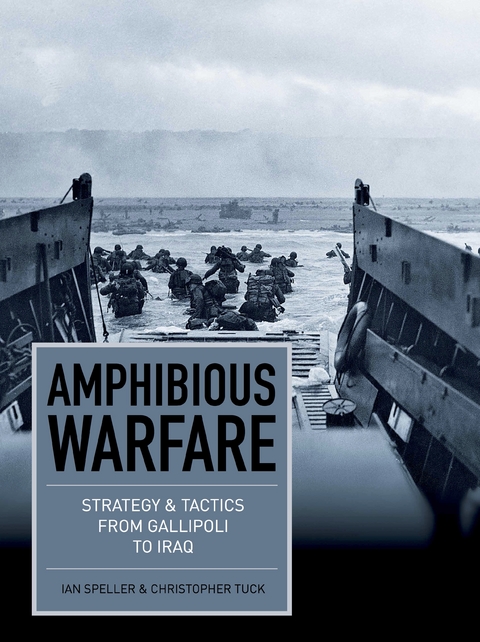
Amphibious Assault (eBook)
192 Seiten
Amber Books Ltd (Verlag)
978-1-78274-173-2 (ISBN)
Landing on a hostile beach is one of the most ancient forms and still most difficult forms of warfare. It requires unparalleled levels of planning, organisation, coordination and cooperation between the services. After the disasters of Gallipoli and Zeebrugge in the World War I, amphibious operations reached their maturity in World War II, and were essential in the defeat of Japan, while the D-Day landings signaled the beginning of the end for Hitler. Since 1945, a myriad of expeditionary naval forces have set off for a wide range of destinations, including Korea, Vietnam, the Falkland Islands, Grenada, the Balkans and Iraq in 2003. In the post-Cold War era, amphibious warfare has reached new heights of importance in its ability to intervene rapidly in crisis situations.
Rather than following a narrative history, Amphibious Warfare takes the unique approach of building up the different stages of an amphibious campaign chapter by chapter, illustrating each with case studies. From planning and preparation to reaching landing zones, from beachhead consolidation to securing a target, Amphibious Warfare offers the complete picture of the people, strategy and tactics, ships and landing craft, tanks and aircraft, as well as the assaults involved.
Illustrated with more than 150 photographs and including a colour plate section of more than 40 artworks, Amphibious Warfare is the complete guide to a form of conflict of increasing relevance to the modern world.
Landing on a hostile beach is one of the most ancient forms and still most difficult forms of warfare. It requires unparalleled levels of planning, organisation, coordination and cooperation between the services. After the disasters of Gallipoli and Zeebrugge in the World War I, amphibious operations reached their maturity in World War II, and were essential in the defeat of Japan, while the D-Day landings signaled the beginning of the end for Hitler. Since 1945, myriad expeditionary naval forces have set off for a wide range of destinations, including Korea, Vietnam, the Falkland Islands, Grenada, the Balkans and Iraq in 2003. In the post-Cold War era, amphibious warfare has reached new heights of importance in its ability to intervene rapidly in crisis situations. Rather than following a narrative history, Amphibious Warfare takes the unique approach of building up the different stages of an amphibious campaign chapter by chapter, illustrating each with case studies. From planning and preparation to reaching landing zones, from beachhead consolidation to securing a target, Amphibious Warfare offers the complete picture of the people, strategy and tactics, ships and landing craft, tanks and aircraft, as well as the assaults involved. Illustrated with more than 150 photographs and including a colour plate section of more than 40 artworks, Amphibious Warfare is the complete guide to a form of conflict of increasing relevance to the modern world.
A light tank is unloaded from a transport ship into a landing craft prior to the US landing at Guadalcanal in the Solomon Islands on 7 August 1942. Operation Watchtower, the assault on Guadalcanal, was the first of many successful American amphibious operations during the Pacific War. The initial landing on 7 August was unopposed. However, fierce fighting ensued inland and the island was not finally secured until February 1943.
INTRODUCTION
THE
STRATEGIC
CONTEXT
The ability to deploy a military force across the seas to a chosen point has often been decisive in determining success in war.
An amphibious operation involves the projection of a military force from the sea onto a hostile, or a potentially hostile, shore. It is usually suggested that there are four general types of amphibious operations — assault, raid, withdrawal and demonstration. Recently, some commentators have argued that there is a fifth type, described as ‘amphibious support to other operations’. Amphibious operations share many characteristics with other maritime activities, including the administrative disembarkation of forces on a friendly shore and simple ferry activities between ports; indeed, specialist amphibious shipping is frequently employed on tasks like these. However, the need to land military forces on a hostile shore is a defining characteristic and sets amphibious warfare apart.
This drawing offers an imaginative interpretation of a Danish (Viking) attack on the English coast. The sacking of the monastery of Lindisfarne in Northumbria in 793 AD marked the beginning of Viking attacks on the British Isles and these were to continue until the 11th century. The Vikings also attacked the coast of mainland Europe, establishing settlements in places such as Normandy in France.
The ability to conduct successful amphibious operations has been a vital factor in warfare since ancient times. Over two-thirds of the earth’s surface is ocean, and a maritime force’s ability to exploit its access to land has been of profound strategic significance. With strength at sea, a maritime power can strike an opponent’s coast at whatever time and place they choose. When this factor is linked to the ability to land a balanced military force, the results have often been devastating.
Amphibious forces offer secure, independent, forward-deployed operating bases. They can be configured to conduct a range of operations, from humanitarian support following a natural disaster, to high-intensity war fighting against sophisticated opposition. The strategic reach and mobility provided by maritime assets means that amphibious forces can deploy or withdraw, and concentrate or disperse, at will, without the need to negotiate over-flight or basing facilities. They therefore have political independence and military flexibility. Amphibious forces can exploit the element of surprise, hitting the enemy when they least expect it, and where they are least prepared. They can sail early in times of crisis, either in a blaze of publicity to demonstrate resolve and capability, or covertly when a more diplomatic approach is required. Once in theatre, an amphibious force can be held in international waters, offering presence without occupation, and leverage without embroilment. If embarked in appropriate shipping, an amphibious force can be maintained at sea almost indefinitely or, if necessary, can be sustained ashore in protracted conflict. In sum, the independence, mobility, flexibility and sustainability of a balanced amphibious task force, particularly when supported by suitable naval vessels and furnished with air support, make it an extremely capable instrument.
By nature, amphibious operations are challenging. Conducted at the juncture between the military and naval spheres of competence, they have the potential to demonstrate the worst characteristics of both and the best characteristics of neither. Amphibious forces face hazards posed by the force of nature as well as man-made defences. To rapidly build up combat power on the shore before enemy forces counter-attack has always proved to be a difficult task. The simple logistical problem of embarking and disembarking troops, vehicles and equipment without conventional port facilities complicates the planning and conduct of operations. However, despite all of these problems, landing a balanced military force on an enemy shore has been one of the key means of achieving success in conflict throughout history.
AMPHIBIOUS WARFARE IN HISTORY
Amphibious forces have been used to good effect for as long as mankind has ventured onto the sea. Historical evidence shows that as early as 1200 BC the Egyptian Empire was subjected to attacks by seaborne raiders from the Mediterranean islands and the coastline of southern Europe. The Egyptians repulsed most of the raids by these so-called ‘Sea Peoples’, but some of the invaders established themselves along the coast, such as the Philistines in Palestine. Centuries later, the Greeks made full use of amphibious forces. The defeat of the Athenian expedition to Sicily between 413 and 415 BC stands as a key turning-point in the Peloponnesian War. Later still, the British Isles suffered their first major amphibious invasion in 55 BC when Julius Caesar brought his legions across the Channel. The Romans landed on a beach near present-day Dover, where they faced fierce opposition by the Celtic forces waiting for them on the shore. In an early example of naval fire support, the Roman ships were brought in close so that their catapults could fire down on the defenders.
The Roman invasion was the first of many to hit the British Isles. In the centuries that followed, succeeding waves of Angles, Saxons,Vikings and Normans all sought to conquer Britain from the sea. The Norman invasion of 1066 involved an estimated 20,000 infantry and 12,000 cavalry. The English King Harold’s defeat at the Battle of Hastings came only weeks after his army had marched north to successfully repulse a Viking invasion at the Battle of Stamford Bridge. However, proficiency in expeditionary operations was not restricted to the European continent. During the 15th century, the Chinese admiral Zheng He led a series of expeditions throughout the Indian Ocean. By the time of his final expedition, which took place in 1433, his combined land and naval force had extracted tribute from most of the nations that were located along the shore of the Indian Ocean.
Historically weak on the land but strong at sea, England (and, from 1707, Britain) made good use of amphibious forces in a series of wars against both Spain and France. Francis Drake’s raid on Spanish possession in the Caribbean between 1585 and 1586 was a prelude to a series of successful amphibious operations that included the capture of Gibraltar in 1704, the seizure of Louisbourg in 1758 and of Quebec in 1759, the model landing at Aboukir Bay in 1801 and the capture of Washington, D.C. in 1814. However, the difficulty of conducting amphibious operations in the age of sail was demonstrated by an equally long list of failures, including Drake’s final expedition to the Caribbean in 1595 and the disastrous expedition to Cartagena in 1741 after which, of the 10,000 men who embarked for the operation, only 2600 could be accounted for. British victories against the Spanish Armada in 1588 and at Trafalgar in 1805 thwarted Spanish and French attempts to gain sufficient control of the sea to launch amphibious invasions of the British Isles.
The Norman conquest of 1066 was the last occasion when England was successfully invaded from the sea. The transport of a balanced military force from across the English Channel was a considerable logistical feat and was the only way in which William of Normandy could militarily support his claim to the English throne.
One of the key problems for amphibious forces was that the land and sea elements of the force had to provide mutual support. This was often difficult, as the naval and land force commanders had little understanding of, or sympathy for, the troubles of their sister service. The army’s need to maintain contact with the fleet in order to guarantee re-supply and re-embarkation — as well as the difficulty in landing horses for the cavalry and guns for the artillery — often meant that amphibious forces could not gain full advantage from the strategic mobility of their naval transports. The landing of British troops at Aboukir Bay in 1801, despite heavy opposition on the beaches, showed that opposed landings were possible, but, even so, they remained difficult and dangerous.
By the end of the 19th century, these problems were exacerbated by the advent of long-range coastal defence guns, sea mines and torpedo boats. The arrival of submarines in the early part of the 20th century meant that operations close to enemy bases would be much more dangerous than had been the case. At the same time, improvements in land communications and the growth of large, professional armies threatened to erode the strategic advantages of amphibious forces. Armies could now utilize railways and modern roads to rapidly move forces to meet the threat of invasion and therefore small amphibious forces could not rely on meeting weak and poorly coordinated defenders.
The creation of local defence organizations and militias further complicated the matter; the German Chancellor Otto von Bismarck reputedly stated that if the British landed an army on the Prussian coast he would call out the local police force and have it arrested. Improvements in defensive firepower — with the introduction of the machine-gun, the magazine...
| Erscheint lt. Verlag | 10.6.2014 |
|---|---|
| Reihe/Serie | Strategy and Tactics | Strategy and Tactics |
| Sprache | englisch |
| Themenwelt | Sachbuch/Ratgeber ► Geschichte / Politik ► Allgemeines / Lexika |
| Geschichte ► Teilgebiete der Geschichte ► Militärgeschichte | |
| Sozialwissenschaften ► Politik / Verwaltung | |
| Schlagworte | Amphibious • Assault • craft • dday • Landing • Marine • Normandy |
| ISBN-10 | 1-78274-173-9 / 1782741739 |
| ISBN-13 | 978-1-78274-173-2 / 9781782741732 |
| Informationen gemäß Produktsicherheitsverordnung (GPSR) | |
| Haben Sie eine Frage zum Produkt? |
 EPUB (Ohne DRM)
Digital Rights Management: ohne DRM
Dieses eBook enthält kein DRM oder Kopierschutz. Eine Weitergabe an Dritte ist jedoch rechtlich nicht zulässig, weil Sie beim Kauf nur die Rechte an der persönlichen Nutzung erwerben.
Dateiformat: EPUB (Electronic Publication)
EPUB ist ein offener Standard für eBooks und eignet sich besonders zur Darstellung von Belletristik und Sachbüchern. Der Fließtext wird dynamisch an die Display- und Schriftgröße angepasst. Auch für mobile Lesegeräte ist EPUB daher gut geeignet.
Systemvoraussetzungen:
PC/Mac: Mit einem PC oder Mac können Sie dieses eBook lesen. Sie benötigen dafür die kostenlose Software Adobe Digital Editions.
eReader: Dieses eBook kann mit (fast) allen eBook-Readern gelesen werden. Mit dem amazon-Kindle ist es aber nicht kompatibel.
Smartphone/Tablet: Egal ob Apple oder Android, dieses eBook können Sie lesen. Sie benötigen dafür eine kostenlose App.
Geräteliste und zusätzliche Hinweise
Buying eBooks from abroad
For tax law reasons we can sell eBooks just within Germany and Switzerland. Regrettably we cannot fulfill eBook-orders from other countries.
aus dem Bereich