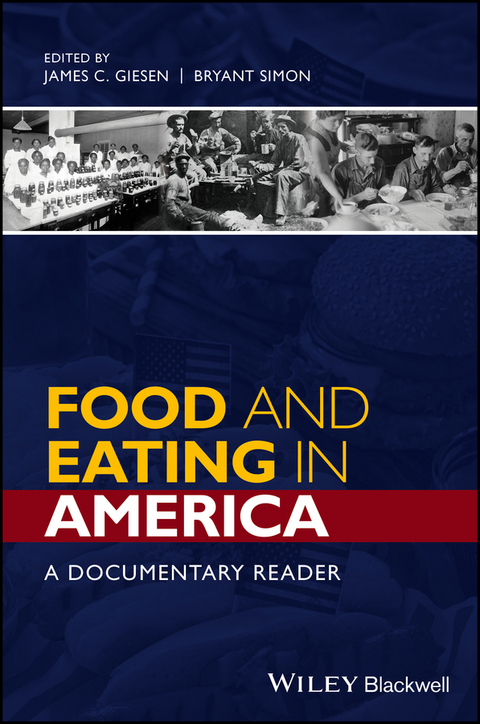
Food and Eating in America (eBook)
John Wiley & Sons (Verlag)
978-1-118-93640-5 (ISBN)
Guides students through a rich menu of American history through food and eating
This book features a wide and diverse range of primary sources covering the cultivation, preparation, marketing, and consumption of food from the time before Europeans arrived in North America to the present-day United States. It is organized around what the authors label the 'Four P's'-production, politics, price, and preference-in order to show readers that food represents something more than nutrition and the daily meals that keep us alive. The documents in this book demonstrate that food we eat is a 'highly condensed social fact' that both reflects and is shaped by politics, economics, culture, religion, region, race, class, and gender.
Food and Eating in America covers more than 500 years of American food and eating history with sections on: An Appetizer: What Food and Eating Tell Us About America; Hunting, Harvesting, Starving, and the Occasional Feast: Food in Early America; Fields and Foods in the Nineteenth Century; Feeding a Modern World: Revolutions in Farming, Food, and Famine; and Counterculture Cuisines and Culinary Tourism.
- Presents primary sources from a wide variety of perspectives-Native Americans, explorers, public officials, generals, soldiers, slaves, slaveholders, clergy, businessmen, workers, immigrants, activists, African Americans, Hispanics, Asian Americans, artists, writers, investigative reporters, judges, the owners of food trucks, and prison inmates
- Illustrates the importance of eating and food through speeches, letters, diaries, memoirs, newspaper and magazine articles, illustrations, photographs, song lyrics, advertisements, legislative statutes, court rulings, interviews, manifestoes, government reports, and recipes
- Offers a new way of exploring how people lived in the past by looking closely and imaginatively at food
Food and Eating in America: A Documentary Reader is an ideal book for students of United States history, food, and the social sciences. It will also appeal to foodies and those with a curiosity for documentary-style books of all kinds.
Guides students through a rich menu of American history through food and eating This book features a wide and diverse range of primary sources covering the cultivation, preparation, marketing, and consumption of food from the time before Europeans arrived in North America to the present-day United States. It is organized around what the authors label the Four P s production, politics, price, and preference in order to show readers that food represents something more than nutrition and the daily meals that keep us alive. The documents in this book demonstrate that food we eat is a highly condensed social fact that both reflects and is shaped by politics, economics, culture, religion, region, race, class, and gender. Food and Eating in America covers more than 500 years of American food and eating history with sections on: An Appetizer: What Food and Eating Tell Us About America; Hunting, Harvesting, Starving, and the Occasional Feast: Food in Early America; Fields and Foods in the Nineteenth Century; Feeding a Modern World: Revolutions in Farming, Food, and Famine; and Counterculture Cuisines and Culinary Tourism. Presents primary sources from a wide variety of perspectives Native Americans, explorers, public officials, generals, soldiers, slaves, slaveholders, clergy, businessmen, workers, immigrants, activists, African Americans, Hispanics, Asian Americans, artists, writers, investigative reporters, judges, the owners of food trucks, and prison inmates Illustrates the importance of eating and food through speeches, letters, diaries, memoirs, newspaper and magazine articles, illustrations, photographs, song lyrics, advertisements, legislative statutes, court rulings, interviews, manifestoes, government reports, and recipes Offers a new way of exploring how people lived in the past by looking closely and imaginatively at food Food and Eating in America: A Documentary Reader is an ideal book for students of United States history, food, and the social sciences. It will also appeal to foodies and those with a curiosity for documentary-style books of all kinds.
Part I
An Appetizer: What Food and Eating Tell Us About America
No matter who you are or what you do or where you live, food stands at the center of life. Obviously, you cannot survive long without food, and neither can the people around you. Communities and nation states can’t build forts or ships or railroads or bridges or airports or nuclear reactors if people don’t have enough to eat. Wars can’t be fought, and can’t be won, without food, food for soldiers in the trenches and food for production workers and their families behind the lines. No matter what their faith, nationality, or background, people celebrate holidays and milestones with food. Think of the first, or the most recent, Thanksgiving. It is an American national holiday built around food, the bounty and promise of the United States, and the symbolism of a shared meal. When families and friends come together for births, marriages, confirmations, bar mitzvahs, and deaths, they typically eat. Religious celebrations like Ramadan and Yom Kippur involve fasting, followed by prayers that bless the wine and bread, then, and only then, lavishly scripted meals. In the United States, the second biggest day for eating (after Thanksgiving) is Super Bowl Sunday. Indeed, much of contemporary social life revolves around food, the focus of going out, and getting together. We post photos of our burritos and take selfies with our desserts. Eateries dot the landscapes of cities and suburbs, highways, and back roads from Maine to California. Cooking shows take up the endless time slots on cable television channels and recipes fill up pages of websites, newspapers, and magazines. Food apps glow on our phone screens.
As food stands at the center of daily life, it not only sustains life, it also kills. It can be contaminated or tainted. Run‐off from the farms that produce our food contaminates our rivers and streams. Food waste—parts of the plants and animals that we don’t cook or the scraps from our plates—clogs the nation’s waterways and overflows its landfills. For farmers and workers, producing and processing food can be deadly as well, due to the often dangerous working conditions on farms and in processing plants. Not having enough food and the illnesses that result from having too little to eat still kill millions each year—more than 21,000 per day to be precise—in the world, while in the United States, having too much of foods laden with fat, salt, and sugar threatens the health of countless people.
Despite food’s central role in the daily life and rituals of people now and in the past, studying food has for a long time remained at the margins of history writing. To be sure, scholars have researched famines, talked about feeding troops during wars, and remarked on changing diets and agricultural practices. But, foodways, meals, and the act of eating itself rarely made it into college textbooks or classroom lectures prior to the twenty‐first century.
In recent years food’s place on the margins of history has changed. Relying on new evidence and looking at old sources in news ways, historians of food and eating have written stacks of imaginative, wide‐ranging, and influential histories of things like sugar, cod, and the hamburger. They have looked at the social, cultural, and architectural significance of fast‐food joints and high‐end French restaurants, and the inner‐workings of animal factories in the fields and the gory efficiency of slaughterhouses in the cities. They have paid close attention to changes in understanding of biology, horticulture, nutrition, and ecology. They have discussed gender, dieting, and eating disorders, the appeal of Chinese food to Jews and Gentiles, and the growth of culinary tourism and foodie culture. They have talked about Native American cooking and the foodways immigrants from Europe, Asia, and Africa brought with them to the United States and took to other places in the diaspora. They have analyzed global protests against McDonald’s and boycotts against local butchers in ethnic enclaves. They have traced the early stirrings of vegetarianism and the first whiffs of the countercultural cuisines of the 1960s. They have recounted strikes at processing plants and the organizing campaigns of cooks and waitresses. Collectively they have begun to imagine, conceive, and write about food, as the anthropologist Arjun Appadurai suggested (in an article in American Ethnologist in August, 1981) that they do, as a “highly condensed social fact.”
This idea of food as a highly condensed social fact is the organizing framework for this book. What exactly does this concept mean? Essentially, it suggests that food represents more than just something to eat, calories to burn, or carbohydrates churning in our stomachs. Each meal, dish, and ingredient represents a crucial intersection of vital social forces that involve what we’re going call the Four Ps: production, politics, price, and preference. The idea of food as a dense social fact means that every time we eat something we place ourselves within a complex mix of these four broad forces.
Think for a few minutes about what goes into a rather typical meal. Let’s take as an example a Sunday dinner of roast chicken, mashed potatoes, and green beans. Perhaps the most obvious way to start thinking about this food is to ask how it arrived at our table. Each and every spice, ingredient, and item on the menu has a story, a process that brought it from the fields to our table, a process that throughout the majority of American history and for most Americans has meant many stops along the way. That process involves production, starting with who mined the salt, raised the chicken, picked the vegetables, and dug the potatoes. Who killed the chicken? Where did they do this killing? Where were the animals, for the meat and the milk, raised? What did they eat during their lives? What sorts of fertilizers or chemicals were sprayed on the beans or inserted into the soil? What role did the soil itself—or the rain, wind, and sunshine—play in the food’s production? What networks were used to get these products to the stores and shops? In what form did they arrive? How did the feed get to farmers? Did it come from a local supplier or a big agribusiness? What role did science, research, and technology play in the process and in the development of new breeds of chickens, new potato plants, and new flavors? Who controls the parts of that process, from the growing to the science to the transportation?
As the documents that follow demonstrate, the answers to these questions changed over time. Before the American Revolution most Americans ate chicken rarely if at all, and the availability of green beans depended on the season and the location. Meals like this were unthinkable to most slaves, even into the mid‐nineteenth century. As we’ll read, potatoes had their own cultural place for Americans and the little tuber itself played a role in who became accepted as “American” and when.
Food involves domestic production as well. Who made the food for the Sunday dinner? A mother? A father? The whole family? A domestic worker? How was this work divided along gender lines? Did they make it from scratch? Where did they obtain and accumulate their culinary knowledge? How were the foods prepared and cooked? What devices or appliances were used to make the foods? Was it cooked on an open fire, or a gas or electric oven, or in a microwave? Were the potatoes produced with a hand masher or a Cuisinart or did they come as a powder in a box? Did some or all of the food come from the store? Was it prepared ahead of time? Who served it? Was the table set? Did everyone sit down to eat together? Did the house they live in have a separate space for eating? What did that space look like and where was it in relation to the kitchen? Did the family or group eat at a table or in front of a newspaper, a radio, a television, or iPhone screens?
This brings us to our second “P.” Our food choices always involve politics. This might seem surprising. No one, of course, voted on that chicken dinner. It wasn’t legislated somewhere that the family get together to eat Sunday supper together. But the dinner itself is the result of a political history that involves slavery, industrialism, imperialism, and nationalism. Those big historical processes often determined who ate what, where they ate, and how they ate. Each of these processes is rooted in politics. Throughout much of early American history, dinner was determined as much by natural constraints as by any other force—it was who had control over grazing land, the crop land, the wild animals, the seas and waterways. This control was just as political as a modern U.S. Department of Agriculture agent inspecting chicken carcasses at a packinghouse. Were the potatoes Yukon® Golds or the more generic “golden potato”? Why does that difference matter?
These are more than agricultural questions; they are political ones. As you’ll see in the documents that fill this book, as the act of eating moves farther from the place of production, food becomes even more about politics. Think for a moment about where the green beans came from and how were they made it to the table. Did the farmer get a guaranteed price to grow them, or state‐sponsored crop insurance? Were they produced by an American company on U.S. soil, or in another nation? Politicians have passed laws to encourage immigration so that landowners had access to cheaper labor, which in turn made the price of...
| Erscheint lt. Verlag | 26.2.2018 |
|---|---|
| Reihe/Serie | Uncovering the Past: Documentary Readers in American History |
| Uncovering the Past: Documentary Readers in American History | Uncovering the Past: Documentary Readers in American History |
| Sprache | englisch |
| Themenwelt | Geisteswissenschaften ► Geschichte ► Regional- / Ländergeschichte |
| Geschichte ► Teilgebiete der Geschichte ► Kulturgeschichte | |
| Sozialwissenschaften | |
| Schlagworte | a history of eating • America foods • american food • American food culture • American History • American perspectives • American perspectives on food • American Social & Cultural History • documentaries • documentary on food • early American food • early American fool • eating in America • fields and foods in the nineteenth century • food and American society • food and class • food and economics • Food and history • Food and Race • Food and Religion • Food and Society • Food culture • food in America • food in early America • Food Studies • Food Writing & Reference • Geschichte • History • Hospitality • Hotelgewerbe, Gastronomie u. Touristik • Lebensmittel-Literatur u. -Nachschlagewerke • <p>food history • modern food • Regional American History • Regionalgeschichte Amerikas • revolutions in farming</p> • Sozial- u. Kulturgeschichte Amerikas • the foods we eat • USA /Geschichte • what food and eating tells us about America • Wirtschaft |
| ISBN-10 | 1-118-93640-X / 111893640X |
| ISBN-13 | 978-1-118-93640-5 / 9781118936405 |
| Informationen gemäß Produktsicherheitsverordnung (GPSR) | |
| Haben Sie eine Frage zum Produkt? |
 EPUB (Adobe DRM)
Kopierschutz: Adobe-DRM
Adobe-DRM ist ein Kopierschutz, der das eBook vor Mißbrauch schützen soll. Dabei wird das eBook bereits beim Download auf Ihre persönliche Adobe-ID autorisiert. Lesen können Sie das eBook dann nur auf den Geräten, welche ebenfalls auf Ihre Adobe-ID registriert sind.
Details zum Adobe-DRM
Dateiformat: EPUB (Electronic Publication)
EPUB ist ein offener Standard für eBooks und eignet sich besonders zur Darstellung von Belletristik und Sachbüchern. Der Fließtext wird dynamisch an die Display- und Schriftgröße angepasst. Auch für mobile Lesegeräte ist EPUB daher gut geeignet.
Systemvoraussetzungen:
PC/Mac: Mit einem PC oder Mac können Sie dieses eBook lesen. Sie benötigen eine
eReader: Dieses eBook kann mit (fast) allen eBook-Readern gelesen werden. Mit dem amazon-Kindle ist es aber nicht kompatibel.
Smartphone/Tablet: Egal ob Apple oder Android, dieses eBook können Sie lesen. Sie benötigen eine
Geräteliste und zusätzliche Hinweise
Buying eBooks from abroad
For tax law reasons we can sell eBooks just within Germany and Switzerland. Regrettably we cannot fulfill eBook-orders from other countries.
aus dem Bereich