Social Movements, Memory and Media (eBook)
XIII, 339 Seiten
Springer International Publishing (Verlag)
978-3-319-68551-9 (ISBN)
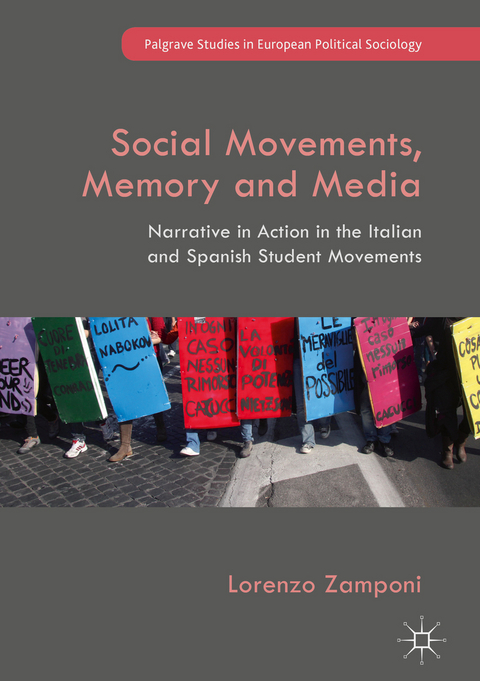
This book analyses the relationship between social movements and collective memories: how do social movements participate in the building of public memory? And how does public memory, and in particular the media's representation of a contentious past, influence strategic choices in contemporary movements? To answer these questions the book draws its focus on the evolution of the representation of specific events in the Italian and Spanish student movements of the 1960s and 1970s. Furthermore, through qualitative interviews to contemporary student activists in both countries, it investigates the role of past waves of contention in shaping the present through the publicly discussed image of the past.
Lorenzo Zamponi is a Research Fellow in sociology and political science at the Scuola Normale Superiore, in the Istituto di Scienze Umane e Sociali (Institute of Humanities and Social Sciences) in Italy, where he is part of the COSMOS (Centre on Social Movement Studies) research team. He holds a Ph.D. in Political and Social Sciences from the European University Institute. His research interests include memory, contentious politics and media analysis.
Lorenzo Zamponi is a Research Fellow in sociology and political science at the Scuola Normale Superiore, in the Istituto di Scienze Umane e Sociali (Institute of Humanities and Social Sciences) in Italy, where he is part of the COSMOS (Centre on Social Movement Studies) research team. He holds a Ph.D. in Political and Social Sciences from the European University Institute. His research interests include memory, contentious politics and media analysis.
Acknowledgements 7
Contents 9
List of Figures 11
List of Tables 12
Part I: Introduction, Background and Methods 13
1: Introduction 14
References 22
Bibliography 22
2: Memory and Movements: A Long Research Path 23
1 Conceptualising Memory in Social Science 23
2 Memory and Legacies in Social Movement Studies 28
3 The Media as the Arena of Public Memory 33
4 Memory and Movements: A Research Agenda 35
Memory in Discourse 35
Memory in Action 37
References 38
Bibliography 38
3: The Student Movements in Italy and Spain and How to Study Their Memories 46
1 Research Design and Case Studies 46
Contentious Past 49
Present 50
2 Media Content Analysis 52
3 Interviews with Contemporary Activists 54
Memory in Located Memory Texts 55
4 An Experience of Engaged Research 58
References 61
Bibliography 61
Part II: Memory in Discourse: Representations of the 1960s and 1970s in the Media Forum 65
4: Contentious Memories of the Italian Student Movement: The ‘Long 1968’ in the Field of Public Memory 66
1 The Student Movement, 1968, 1977 66
2 Historiography 67
3 Public Memory 69
Cinema, TV, and the Press 69
Memoirs and Narrative 72
4 Tracing the Paths of Two Events in 40 Years of Public Memory 75
Sources 75
Events 76
Some Peculiar Cultural Artefacts as Memory Carriers 78
5 The ‘Battle of Valle Giulia’ 85
6 The ‘Chase of Lama’ 95
7 Concluding Remarks 103
Possessive Memory and Contentious Politics 103
The Decreasing Malleability of Mnemonic Material 104
The Two 1968s: 1968-Counterculture Versus the 1968-Struggle 105
Valle Giulia as the Canon of Social Conflict (the Role of Cultural Artefacts) 106
Repositories of Memory 107
References 122
Bibliography 122
5: Contentious Memories of the Spanish Student Movement: Representations of the Spanish 1968 in the Public Memory of the Transition 126
1 The Spanish 1968 Between Student Mobilisation and Anti-Francoism 127
2 The Debate on Memory and the Spanish Transition 128
3 Sources: The Spanish Press and the Transition to Democracy 129
4 La Capuchinada: 1968 Before 1968 130
5 ‘En extrañas circunstancias’: The Memory and Oblivion of Enrique Ruano’s Death 151
6 Concluding Remarks 169
Political Context, Social Mobilisation, and Different Narratives 169
Actors: Appropriation and Possessive Memory 170
Democratisation, Controversial Victims, and the Sixty-Eight-isation of Spanish Memory 170
References 180
Bibliography 180
Part III: Memory in Action: Mnemonic Practices, Collective Identities and Strategic Choices in Contemporary Student Movements 183
6: Syntax: The Forms of Memory 184
1 Memories, Legacies, Continuities, and Rituals: Keeping Together Macro, Meso, and Micro Levels 184
2 Syntax: The Forms of Memory 186
Origin Stories and Foundation Myths 187
Organisational or Material Structures Remaining from the Past 190
Protest Traditions and Political Connotations of the Local Field of Action 194
Comparisons Between Waves of Mobilisation 197
‘Classical’ Repertoires and the Textbook of Student Mobilisation 198
3 Concluding Remarks 201
References 203
Bibliography 203
Interviews 204
7: Semantics: The Competing Narratives of Student Movement Memories 205
1 Introduction 205
Competing Memories 208
Resisting Memories 211
2 What Past Do Activist Refer To? 213
Italy 214
Spain 222
3 Analogies and Differences 227
4 ‘We Start from Scratch Every Time’: The Eternal Turnover of the Student Movement 230
5 ‘What Came Before Us, We Lived It, as an Organisation’: Movement Areas as Mnemonic Communities 234
6 ‘I Learned It from the Newspapers’: A Complex Repertoire, Plural Repositories, and Movement Culture Permeability 241
7 Concluding Remarks 243
References 245
Bibliography 245
Interviews 247
8: Pragmatics: Memory, Identity, and Strategy 249
1 The Return of the ‘Already Seen’: Comparisons from Outside and Movement Reactions 253
2 Imagined Continuities: Comparisons from Inside and Movement Appropriation of Memory 259
3 Cultural Traumas 263
4 Knowing the Textbook and Learning from It 266
5 No Trespassing: Historical Taboos, Inherited Proscriptions, and Metonymies 267
6 Born This Way: The Groups’ Given Identities and the Curse of History 269
7 Memory Work and Memory at Work: Dealing with Inherited Identities in the Context of Mobilisation 273
8 Limited Apostasy: Downplaying Identity 274
9 Unity and Innovation in the Emergence of Mobilisation 278
10 Sweet Weight: The Limits of Apostasy and the Choice of Compliance 281
11 The Lighter the Better: The Strategic Exploitation of the Others’ Inherited Constraints 284
12 ‘There and Back Again’: Mobilisation as the Context of Change 287
13 Concluding Remarks 290
References 292
Bibliography 292
Interviews 293
9: Conclusions 295
1 Collective Memory and Social Movements 295
2 Memory: A Complex Repertoire and Plural Repositories 296
3 Movements: An Embedded History in Identity, Strategy, and Continuity 300
4 Proposals for a Contextual Analysis of Mnemonic Processes 306
5 Open Questions 318
References 319
Bibliography 319
Bibliography 323
Interviews 337
Index 339
| Erscheint lt. Verlag | 26.2.2018 |
|---|---|
| Reihe/Serie | Palgrave Studies in European Political Sociology | Palgrave Studies in European Political Sociology |
| Zusatzinfo | XIII, 339 p. 3 illus. |
| Verlagsort | Cham |
| Sprache | englisch |
| Themenwelt | Sozialwissenschaften ► Politik / Verwaltung |
| Sozialwissenschaften ► Soziologie ► Spezielle Soziologien | |
| Schlagworte | activism • Collective memory • implicit memory • media representations • Public memory • social contention • Social Movements • Student movements • terrorism |
| ISBN-10 | 3-319-68551-1 / 3319685511 |
| ISBN-13 | 978-3-319-68551-9 / 9783319685519 |
| Informationen gemäß Produktsicherheitsverordnung (GPSR) | |
| Haben Sie eine Frage zum Produkt? |
 PDF (Wasserzeichen)
DRM: Digitales Wasserzeichen
Dieses eBook enthält ein digitales Wasserzeichen und ist damit für Sie personalisiert. Bei einer missbräuchlichen Weitergabe des eBooks an Dritte ist eine Rückverfolgung an die Quelle möglich.
Dateiformat: PDF (Portable Document Format)
Mit einem festen Seitenlayout eignet sich die PDF besonders für Fachbücher mit Spalten, Tabellen und Abbildungen. Eine PDF kann auf fast allen Geräten angezeigt werden, ist aber für kleine Displays (Smartphone, eReader) nur eingeschränkt geeignet.
Systemvoraussetzungen:
PC/Mac: Mit einem PC oder Mac können Sie dieses eBook lesen. Sie benötigen dafür einen PDF-Viewer - z.B. den Adobe Reader oder Adobe Digital Editions.
eReader: Dieses eBook kann mit (fast) allen eBook-Readern gelesen werden. Mit dem amazon-Kindle ist es aber nicht kompatibel.
Smartphone/Tablet: Egal ob Apple oder Android, dieses eBook können Sie lesen. Sie benötigen dafür einen PDF-Viewer - z.B. die kostenlose Adobe Digital Editions-App.
Buying eBooks from abroad
For tax law reasons we can sell eBooks just within Germany and Switzerland. Regrettably we cannot fulfill eBook-orders from other countries.
aus dem Bereich