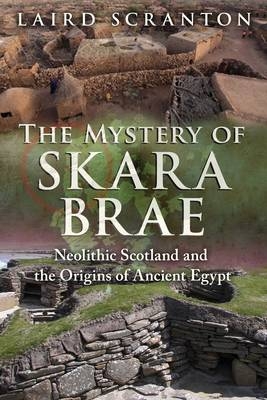
Mystery of Skara Brae (eBook)
208 Seiten
Inner Traditions/Bear & Company (Verlag)
978-1-62055-574-3 (ISBN)
An investigation of the origins of the Neolithic farming village on Orkney Island*; Reveals the striking similarities between Skara Brae and the traditions of pre-dynastic ancient Egypt as preserved by the Dogon people of Mali*; Explains how megalithic stone sites near Skara Brae conform to Dogon cosmology*; Examines the similarities between Skara Brae and Gobekli Tepe and how Skara Brae may have been a secondary center of learning for the ancient worldIn 3200 BC, Orkney Island off the coast of Northern Scotland was home to a small farming village called Skara Brae. For reasons unknown, after nearly six centuries of continuous habitation, the village was abandoned around 2600 BC and its stone structures covered over--perhaps deliberately, like the structures at Gobekli Tepe. Although now well-excavated, very little is known about the peaceful people who lived at Skara Brae or their origins. Who were they and where did they go?Drawing on his in-depth knowledge of the connections between the cosmology and linguistics of Egyptian, Dogon, Chinese, and Vedic traditions, Laird Scranton reveals the striking similarities between Skara Brae and the Dogon of Mali, who still practice the same cosmology and traditions they once shared with pre-dynastic Egypt. He shows how the earliest Skara Brae houses match the typical Dogon stone house as well as Schwaller de Lubicz's intrepretation of the Egyptian Temple of Man at Luxor. He explains how megalithic stone sites near Skara Brae conform to Dogon cosmology, each representing sequential stages of creation as described by Dogon priests, and he details how the houses at Skara Brae also represent a concept of creation. Citing a linguistic phenomenon known as ';ultraconserved words,' the author compares words of the Faroese language at Skara Brae, a language with no known origin, with important cosmological words from Dogon and ancient Egyptian traditions, finding obvious connections and similarities. Scranton shows how the cultivated field alongside the village of Skara Brae corresponds to the ';heavenly field' symbolism pervasive throughout many ancient cultures, such as the Field of Reeds of the ancient Egyptians and the Elysian Fields of ancient Greece. He demonstrates how Greek and Egyptian geographic descriptions of these fields are a consistent match with Orkney Island. Examining the similarities between Skara Brae and Gobekli Tepe, Scranton reveals that Skara Brae may have been a secondary center of initiation and civilizing knowledge, a long-lost Egyptian mystery school set up millennia after Gobekli Tepe was ritually buried, and given the timing of the site, is possibly the source of the first pharaohs and priests of ancient Egypt.
| Erscheint lt. Verlag | 15.11.2016 |
|---|---|
| Sprache | englisch |
| Themenwelt | Sachbuch/Ratgeber ► Gesundheit / Leben / Psychologie ► Esoterik / Spiritualität |
| Geschichte ► Allgemeine Geschichte ► Vor- und Frühgeschichte | |
| Geschichte ► Allgemeine Geschichte ► Altertum / Antike | |
| Sozialwissenschaften ► Soziologie | |
| ISBN-10 | 1-62055-574-3 / 1620555743 |
| ISBN-13 | 978-1-62055-574-3 / 9781620555743 |
| Informationen gemäß Produktsicherheitsverordnung (GPSR) | |
| Haben Sie eine Frage zum Produkt? |
 EPUB (Adobe DRM)
Kopierschutz: Adobe-DRM
Adobe-DRM ist ein Kopierschutz, der das eBook vor Mißbrauch schützen soll. Dabei wird das eBook bereits beim Download auf Ihre persönliche Adobe-ID autorisiert. Lesen können Sie das eBook dann nur auf den Geräten, welche ebenfalls auf Ihre Adobe-ID registriert sind.
Details zum Adobe-DRM
Dateiformat: EPUB (Electronic Publication)
EPUB ist ein offener Standard für eBooks und eignet sich besonders zur Darstellung von Belletristik und Sachbüchern. Der Fließtext wird dynamisch an die Display- und Schriftgröße angepasst. Auch für mobile Lesegeräte ist EPUB daher gut geeignet.
Systemvoraussetzungen:
PC/Mac: Mit einem PC oder Mac können Sie dieses eBook lesen. Sie benötigen eine
eReader: Dieses eBook kann mit (fast) allen eBook-Readern gelesen werden. Mit dem amazon-Kindle ist es aber nicht kompatibel.
Smartphone/Tablet: Egal ob Apple oder Android, dieses eBook können Sie lesen. Sie benötigen eine
Geräteliste und zusätzliche Hinweise
Buying eBooks from abroad
For tax law reasons we can sell eBooks just within Germany and Switzerland. Regrettably we cannot fulfill eBook-orders from other countries.
aus dem Bereich