


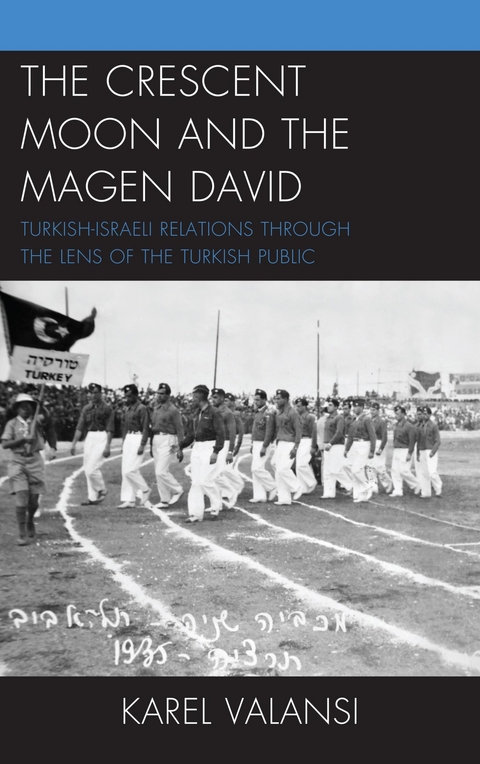
Crescent Moon and the Magen David (eBook)
196 Seiten
Hamilton Books (Verlag)
9780761870098 (ISBN)
Karel Valansi, born in Istanbul, completed her BA in Koç University. She wrote her MA thesis on Turkish-Israeli relations in Kadir Has University. She continues her Ph.D. studies in International Relations at the same university. In addition to her academic track, she has been writing for Şalom newspaper as foreign news editor and columnist. She also contributes to many newspapers and journals. She appears for commentary on various TV and radio programs. She specializes in Turkish-Israeli relations, Arab-Israeli conflict, and Turkish Jewish history. She contributed to Atilla Dorsay’s book about the disappearance of the old Istanbul symbolized with Emek movie theater; “Emek Yoksa Ben De Yokum!” (Kırmızı Kedi, 2014), to “Meçhul Yahudiler Ansiklopedisi” edited by Rıfat N. Bali (Libra, 2016) on the history of ordinary Turkish Jews, and to “Türkiye’de Yahudi Olmak, Bir Deneyim Sözlüğü” edited by Raşel Meseri and Aylin Kuryel (Iletişim, 2017) on the Jewish experience in Turkey. She is the winner of the 10thAltındağ Short Story Contest in March 2017.
1 IntroductionTurkish Public Reaction Methodology Literature Review Turkish Press Two Critical Clarifications PalestineZionism Pre-First World War Palestine Demography of Palestine Historical Homeland vs. Nature of Population: The Yishuv First Aliyah and the Jewish Settlement The Establishment of Agricultural Settlements Ottoman Reaction to the Jewish Immigration to Palestine Struggle to Survive The Arab People of Palestine Second Aliyah and the First Jewish Defense Organizations Theodor Herzl and The Zionist Congress The Rise of Pan-Arabism The First World War and the Dissolution of the Ottoman Empire The Outbreak of the First World War The Role of the Palestinian Jews in the First World War The Balfour Declaration vs. Hussein-McMahon Correspondence Conflict Between the Arab and Jewish Population of Palestine The Third and Fourth Wave of Aliyah and 1920 Riots The Establishment of Haganah and the division among ZionistsThe Fifth Wave of Aliyah and 1929 RiotsThe Arab Revolt of 1936, the Introduction of The Mandate of Palestine During the Second World War HaShoah (Holocaust) The UN Partition Plan and the Creation of the State of Israel Palestine Issue in the Turkish Press During 1930s and 1940s The Jewish Population of the Ottoman Empire The Millet System of the Ottomans A Revolutionary Change in Education; Alliance Israelite Schools Nationalist Movements in the Ottoman Empire The Treaty of Lausanne Turkish Republic, a New Beginning Full of Hope The First Decade of the Republic The Ideal of Turkism From Nationalism to Racism Creating a Turkish-Muslim Middle Class Restoring the Effendi Class Turkish Language as a Unifying Element The Language of the Minorities Unification of the Education ‘Citizen, Speak Turkish!’ Campaign Steps for Dismantling the Community Structure Two Positive Steps on Turkification Process; the Law A Milestone in the History of the Jews of Turkey; Rise of Fascism, Nazi IdeologyTurkey during 1930s, under the Shadow of Nazism Press Freedom in Turkey During the First Four German Academics, 1933 The Settlement Law of 2510 and the Exodus of the Jews of Thrace Turkey’s Foreign Policy during the Second World War Jewish Immigration to Palestine Discriminatory Policies Concerning the Minorities The Conscription of the Twenty Classes Yirmi Kur’a İhritiyat) 1941-1942 The Capital Tax 1942-1944 Republican Party and Minority Report Survival Tactics: Kayadez Aliyah of 1948 The Idealist Pioneers The UN Partition Plan, 1947 Urfa Massacre, 1947 The Creation of the State of Israel and Turkey’s Position Aliyah Boosted with the Establishment of the State of Israel in 1948 Reactions to the Immigration Turkish Jews in Israel The Recognition of Israel – 28 March 1949 An Historical Date: The Opening of the Israeli Consulate in Istanbul Turkish Foreign Policy During the Cold War Turkish Aliyah Expanded Cultural and Economic Relations Life in Turkey for the Ones Who Stayed 6Conclusion Bibliography
| Sprache | englisch |
|---|---|
| Themenwelt | Geisteswissenschaften ► Geschichte ► Regional- / Ländergeschichte |
| Geschichte ► Teilgebiete der Geschichte ► Religionsgeschichte | |
| Geisteswissenschaften ► Religion / Theologie ► Judentum | |
| Sozialwissenschaften ► Politik / Verwaltung ► Europäische / Internationale Politik | |
| Sozialwissenschaften ► Politik / Verwaltung ► Staat / Verwaltung | |
| Sozialwissenschaften ► Soziologie | |
| Schlagworte | foreign policy • Migration • Minorities • Sephardim • Turkish Jews |
| ISBN-13 | 9780761870098 / 9780761870098 |
| Informationen gemäß Produktsicherheitsverordnung (GPSR) | |
| Haben Sie eine Frage zum Produkt? |
 EPUB (Adobe DRM)
Kopierschutz: Adobe-DRM
Adobe-DRM ist ein Kopierschutz, der das eBook vor Mißbrauch schützen soll. Dabei wird das eBook bereits beim Download auf Ihre persönliche Adobe-ID autorisiert. Lesen können Sie das eBook dann nur auf den Geräten, welche ebenfalls auf Ihre Adobe-ID registriert sind.
Details zum Adobe-DRM
Dateiformat: EPUB (Electronic Publication)
EPUB ist ein offener Standard für eBooks und eignet sich besonders zur Darstellung von Belletristik und Sachbüchern. Der Fließtext wird dynamisch an die Display- und Schriftgröße angepasst. Auch für mobile Lesegeräte ist EPUB daher gut geeignet.
Systemvoraussetzungen:
PC/Mac: Mit einem PC oder Mac können Sie dieses eBook lesen. Sie benötigen eine
eReader: Dieses eBook kann mit (fast) allen eBook-Readern gelesen werden. Mit dem amazon-Kindle ist es aber nicht kompatibel.
Smartphone/Tablet: Egal ob Apple oder Android, dieses eBook können Sie lesen. Sie benötigen eine
Geräteliste und zusätzliche Hinweise
Buying eBooks from abroad
For tax law reasons we can sell eBooks just within Germany and Switzerland. Regrettably we cannot fulfill eBook-orders from other countries.


