


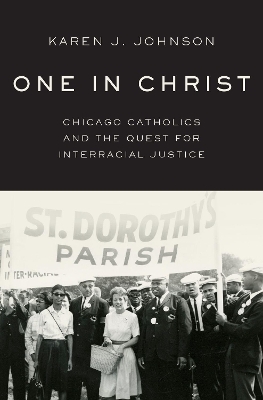
One in Christ
Chicago Catholics and the Quest for Interracial Justice
Seiten
2018
Oxford University Press Inc (Verlag)
978-0-19-061897-1 (ISBN)
Oxford University Press Inc (Verlag)
978-0-19-061897-1 (ISBN)
When Martin Luther King, Jr. marched in Chicago in 1966, he joined black and white lay Catholics who had worked together for civil rights for more than forty years. One in Christ traces the development of Catholic interracial activism from the ground up, demonstrating that accounting for religion is crucial to understanding race and civil rights in the North.
Today, the images of Catholic priests and nuns marching in 1960s civil rights protests are iconic. Their cassocks and habits clothed the movement in sacred garments. But by the time of those protests Catholic Civil Rights activism already had a long history, one in which the religious leadership of the Church played, at best, a supporting role. Instead, it was laypeople, first African Americans and then, as they found white partners, black and white Catholics working together, who shaped the movement regular people who, in self-consciously Catholic ways, devoted their time, energy, and prayers to what they called "interracial justice," a vision of economic, social, religious, and civil equality.
Karen J. Johnson tells the story of Catholic interracial activism from the bottom up through the lives of a group of women and men in Chicago who struggled with one another, their Church, and their city to try to live their Catholic faith in a new, and what they thought was more complete and true, way. Black activists found a handful of white laypeople, some of whom later became priests, who believed in their vision of a universal church in the segregated city. Together, they began to fight for interracial justice, all while knitted together in sometimes-contentious friendship as members of the Mystical Body of Christ. In the end, not only had Catholic activists lived out their faith as active participants in the long civil rights movement and learned how to cooperate, and indeed love, across racial lines, but they had changed the practice of Catholicism. They broke down the hierarchy that placed priests above the laity and crossed the parish boundaries that defined urban Catholicism.
Chicago was a vital laboratory in what became a national story. One in Christ traces the development of Catholic interracial activism, revealing the ways religion and race combined both to enforce racial hierarchies and to tear them down, and demonstrating that we cannot understand race and civil rights in the North without accounting for religion.
Today, the images of Catholic priests and nuns marching in 1960s civil rights protests are iconic. Their cassocks and habits clothed the movement in sacred garments. But by the time of those protests Catholic Civil Rights activism already had a long history, one in which the religious leadership of the Church played, at best, a supporting role. Instead, it was laypeople, first African Americans and then, as they found white partners, black and white Catholics working together, who shaped the movement regular people who, in self-consciously Catholic ways, devoted their time, energy, and prayers to what they called "interracial justice," a vision of economic, social, religious, and civil equality.
Karen J. Johnson tells the story of Catholic interracial activism from the bottom up through the lives of a group of women and men in Chicago who struggled with one another, their Church, and their city to try to live their Catholic faith in a new, and what they thought was more complete and true, way. Black activists found a handful of white laypeople, some of whom later became priests, who believed in their vision of a universal church in the segregated city. Together, they began to fight for interracial justice, all while knitted together in sometimes-contentious friendship as members of the Mystical Body of Christ. In the end, not only had Catholic activists lived out their faith as active participants in the long civil rights movement and learned how to cooperate, and indeed love, across racial lines, but they had changed the practice of Catholicism. They broke down the hierarchy that placed priests above the laity and crossed the parish boundaries that defined urban Catholicism.
Chicago was a vital laboratory in what became a national story. One in Christ traces the development of Catholic interracial activism, revealing the ways religion and race combined both to enforce racial hierarchies and to tear them down, and demonstrating that we cannot understand race and civil rights in the North without accounting for religion.
Karen Johnson is Associate Professor of History at Wheaton College in Illinois. She studies the intersection of religion and race in American history, teaches classes on the civil rights movement, race, and urban and suburban history, and works with future history teachers.
Introduction
Chapter 1: Black Bodies, White Church
Chapter 2: Catholic Action vs. Black Protest
Chapter 3: White Partners
Chapter 4: Communism and Interracial Justice
Chapter 5: Radical Love
Chapter 6: Respectability
Chapter 7: Who Is My Neighbor?
Chapter 8:The National Movement
Chapter 9 Conclusion: Chicago Freedom Summer, 1966
| Erscheinungsdatum | 16.07.2018 |
|---|---|
| Verlagsort | New York |
| Sprache | englisch |
| Maße | 236 x 160 mm |
| Gewicht | 612 g |
| Themenwelt | Geisteswissenschaften ► Geschichte ► Regional- / Ländergeschichte |
| Religion / Theologie ► Christentum ► Kirchengeschichte | |
| Sozialwissenschaften ► Politik / Verwaltung | |
| ISBN-10 | 0-19-061897-3 / 0190618973 |
| ISBN-13 | 978-0-19-061897-1 / 9780190618971 |
| Zustand | Neuware |
| Informationen gemäß Produktsicherheitsverordnung (GPSR) | |
| Haben Sie eine Frage zum Produkt? |
Mehr entdecken
aus dem Bereich


aus dem Bereich
eine andere Geschichte der Papststadt
Buch | Softcover (2024)
C.H.Beck (Verlag)
CHF 25,20
die Macht des Dunklen in unserer Zeit und wie wir ihr entgegentreten
Buch | Hardcover (2025)
Verlag Herder
CHF 27,90


