


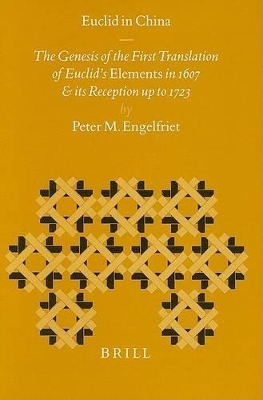
Euclid in China
The Genesis of the First Chinese Translation of Euclid's Elements Books I-VI (Jihe yuanben; Beijing, 1607) and its Reception up to 1723
Seiten
1998
Brill (Verlag)
978-90-04-10944-5 (ISBN)
Brill (Verlag)
978-90-04-10944-5 (ISBN)
The subject of this volume is the first translation (1607) into Chinese of Euclid's Elements (± 300 BC) and its reception in seventeenth century China. The book covers mathematical and linguistic matters and deals extensively with the cultural and intellectual context.
As part of the Jesuits' programme of introduction to European culture, in 1607 the Elements of Euclid (± 300 BC) were translated for the first time into Chinese.
The translation of this epoch-making ancient Greek textbook on deductive geometry meant a confrontation of contemporary Chinese and European cultures.
Part I of Peter Engelfriet's work deals mainly with the European and Chinese backgrounds, part II with linguistic and textual matters. In part III the manner in which learned Chinese tried to integrate this new knowledge into their own, Chinese, mathematical and cultural traditions comes to the fore.
This fascinating work explores in depth and at various levels the circumstances and mechanisms that shaped the transmission of a key work of science from one language and cultural context onto another. Consequently it offers often surprising insights into the ways of intercultural exchange and misunderstandings.
As part of the Jesuits' programme of introduction to European culture, in 1607 the Elements of Euclid (± 300 BC) were translated for the first time into Chinese.
The translation of this epoch-making ancient Greek textbook on deductive geometry meant a confrontation of contemporary Chinese and European cultures.
Part I of Peter Engelfriet's work deals mainly with the European and Chinese backgrounds, part II with linguistic and textual matters. In part III the manner in which learned Chinese tried to integrate this new knowledge into their own, Chinese, mathematical and cultural traditions comes to the fore.
This fascinating work explores in depth and at various levels the circumstances and mechanisms that shaped the transmission of a key work of science from one language and cultural context onto another. Consequently it offers often surprising insights into the ways of intercultural exchange and misunderstandings.
Peter M. Engelfriet, Ph.D. (1996), in Sinology, University of Leiden, is Research Fellow of the Royal Dutch Academy of Arts and Sciences at the Sinological Institute of Leiden University.
| Reihe/Serie | Sinica Leidensia ; 40 |
|---|---|
| Verlagsort | Leiden |
| Sprache | chinesisch; englisch; Greek, Ancient (to 1453) |
| Maße | 155 x 235 mm |
| Gewicht | 1025 g |
| Einbandart | Leinen |
| Themenwelt | Geisteswissenschaften ► Sprach- / Literaturwissenschaft ► Anglistik / Amerikanistik |
| Geisteswissenschaften ► Sprach- / Literaturwissenschaft ► Literaturwissenschaft | |
| Geisteswissenschaften ► Sprach- / Literaturwissenschaft ► Sprachwissenschaft | |
| Mathematik / Informatik ► Mathematik ► Geometrie / Topologie | |
| Sozialwissenschaften | |
| ISBN-10 | 90-04-10944-7 / 9004109447 |
| ISBN-13 | 978-90-04-10944-5 / 9789004109445 |
| Zustand | Neuware |
| Informationen gemäß Produktsicherheitsverordnung (GPSR) | |
| Haben Sie eine Frage zum Produkt? |
Mehr entdecken
aus dem Bereich


aus dem Bereich
Affektordnungen des Sozialen in der Gegenwartsliteratur
Buch | Softcover (2025)
De Gruyter (Verlag)
CHF 62,90


