


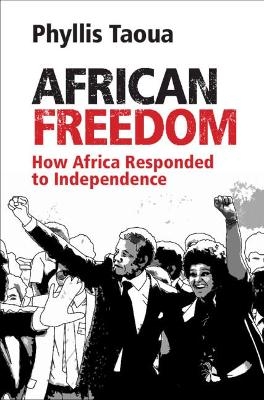
African Freedom
How Africa Responded to Independence
Seiten
2018
Cambridge University Press (Verlag)
978-1-108-42741-8 (ISBN)
Cambridge University Press (Verlag)
978-1-108-42741-8 (ISBN)
African Freedom explains how freedom emerged as an ideal during the national liberation movements and continues to inspire struggles to achieve meaningful freedom for the majority. The author takes a pan-African, interdisciplinary approach as she traces the evolution of this conversation among writers, filmmakers and activists since the 1960s.
The push for independence in African nations was ultimately an incomplete process, with the people often left to wrestle with a partial, imperfect legacy. Rather than settle for liberation in name alone, the people engaged in an ongoing struggle for meaningful freedom. Phyllis Taoua shows how the idea of freedom in Africa today evolved from this complex history. With a pan-African, interdisciplinary approach, she synthesizes the most significant issues into a clear, compelling narrative. Tracing the evolution of a conversation about freedom since the 1960s, she defines three types and shows how they are interdependent. Taoua investigates their importance in key areas of narrative interest: the intimate self, gender identity, the nation, global capital, and the spiritual realm. Allowing us to hear the voices of African artists and activists, this compelling study makes sense of their struggle and the broad importance of the idea of freedom in contemporary African culture.
The push for independence in African nations was ultimately an incomplete process, with the people often left to wrestle with a partial, imperfect legacy. Rather than settle for liberation in name alone, the people engaged in an ongoing struggle for meaningful freedom. Phyllis Taoua shows how the idea of freedom in Africa today evolved from this complex history. With a pan-African, interdisciplinary approach, she synthesizes the most significant issues into a clear, compelling narrative. Tracing the evolution of a conversation about freedom since the 1960s, she defines three types and shows how they are interdependent. Taoua investigates their importance in key areas of narrative interest: the intimate self, gender identity, the nation, global capital, and the spiritual realm. Allowing us to hear the voices of African artists and activists, this compelling study makes sense of their struggle and the broad importance of the idea of freedom in contemporary African culture.
Phyllis Taoua is Professor at the University of Arizona in Francophone Studies where she teaches courses on Africa and the French-speaking world. She is affiliated with Africana Studies, World Literature and the Human Rights program.
Introduction. The meaning of freedom in Africa; 1. The self: unfettering identity after independence; 2. Gender: women's engagement with freedom; 3. The nation: from liberation to meaningful freedom; 4. Global Africa: pillaging with less impunity in the era of neoliberal capital; 5. The spiritual realm: Okonkwo's unraveling and other responses; Conclusion.
| Erscheinungsdatum | 25.09.2018 |
|---|---|
| Zusatzinfo | Worked examples or Exercises; 9 Halftones, black and white |
| Verlagsort | Cambridge |
| Sprache | englisch |
| Maße | 158 x 235 mm |
| Gewicht | 650 g |
| Themenwelt | Geisteswissenschaften ► Geschichte ► Regional- / Ländergeschichte |
| Sozialwissenschaften ► Politik / Verwaltung | |
| ISBN-10 | 1-108-42741-3 / 1108427413 |
| ISBN-13 | 978-1-108-42741-8 / 9781108427418 |
| Zustand | Neuware |
| Informationen gemäß Produktsicherheitsverordnung (GPSR) | |
| Haben Sie eine Frage zum Produkt? |
Mehr entdecken
aus dem Bereich


aus dem Bereich
die Geschichte meiner Urgroßmutter
Buch | Hardcover (2025)
C.H.Beck (Verlag)
CHF 32,15
Träume und Macht : eine Biografie
Buch | Hardcover (2025)
C.H.Beck (Verlag)
CHF 61,60


