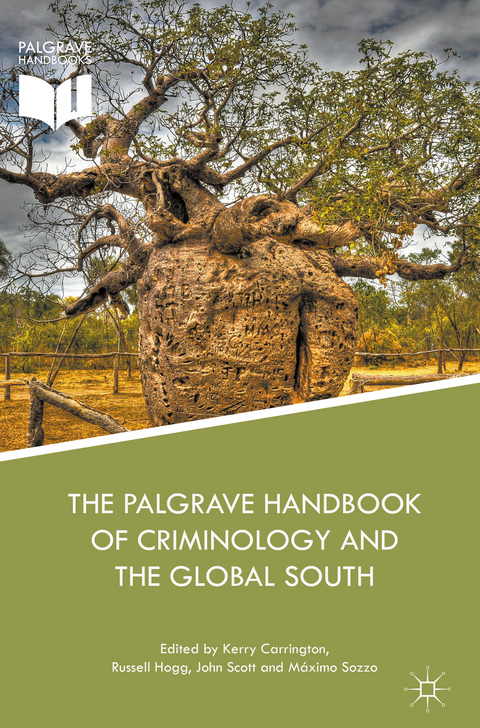
The Palgrave Handbook of Criminology and the Global South (eBook)
1068 Seiten
Springer International Publishing (Verlag)
978-3-319-65021-0 (ISBN)
Kerry Carrington is Professor and Head of School of Justice, Faculty of Law, Queensland University of Technology, Australia.Russell Hogg is Adjunct Professor School of Justice, Faculty of Law, Queensland University of Technology, Australia.John Scott is Professor School of Justice, Faculty of Law, Queensland University of Technology, Australia.Máximo Sozzo is Professor in the Faculty of Law and Social Sciences, National University of Litorel, Santa Fe, Argentina, and Adjunct Professor School of Justice, Faculty of Law, Queensland University of Technology, Australia.
Chapter 1. Criminology, Southern Theory and Cognitive Justice; Kerry Carrington, Russell Hogg, John Scott and Máximo Sozzo.- Chapter 2. Indigenous Challenges for Southern Criminology; Cuneen.- Chapter 3. Confronting the North’s South; Elliot Currie.- Chapter 4. The Asian Criminological Paradigm and How it Links Global North and South; Jianhong Liu.- Chapter 5. Southern Criminology in the Post-colony; Mark Brown.- Chapter 6. The Rural Dimensions of a Southern Criminology; Joe Donnermeyer.- Chapter 7. Queer Criminology and the Global South: Setting Queer and Southern Criminologies into Dialogue; Matthew Ball and Angela Dwyer.- Chapter 8. Southern Death Investigation; Rebecca Scott Bray, Belinda Carpenter and Michael Barnes.- Chapter 9. Research Excellence and Anglophone Dominance; Patricia Faraldo-Cabana.- Chapter 10. Southern Criminology, Zonal Banning and the Language of Urban Crime Prevention; Ian Warren and Darren Palmer.- Crime, Criminalization and Policing in the Global Peripheries.- Chapter 11. Crime and Development in the Global South; Jarrett Blaustein, Nathan W Pino and Graham Ellison.- Chapter 12. Crime and the Cyber Periphery; Murray Lee.- Chapter 13. The Digital and Legal Divide; Monique Mann and Ian Warren.- Chapter 14. Marginalized Voices; Cassandra Cross.- Chapter 15. The Global Context of Transnational Environmental Crime in Asia; Rob White.- Chapter 16. Climate Apartheid and Environmental Refugees; Avi Brisman, Nigel South and Reece Walters.- Chapter 17. Green Criminology as Decolonial tool; David Rodríguez Goyes.- Chapter 18. Human Trafficking on the Global Periphery; Larissa Sandy.- Chapter 19. Trading Corruption North/South; Mark Findlay.- Chapter 20. Capturing Crime in the Antipodes; Bridget Harris + Jenny Wise.- Chapter 21. Visual Criminology and the Southern Crime Scene; Rebecca Scott Bray.- Chapter 22. Staying Safe in Colombia and Mexico; Helen Berents and Charlotte ten Have.- Chapter 23. A Southern Perspective on Extrajudicial Police Killings in Bangladesh; Md. Kamal Uddin.- Chapter 24. Developing a Global South Perspective of Street Children’s Involvement in Organized Crime; Sally Atkinson-Sheppard.- Chapter 25. Public Spitting in ‘Developing’ Nations of the Global South; Ross Coomber, Leah Moyle and Adele Pavlidis.- Chapter 26. Trends and Patterns of Police-related Deaths in Brazil; Vânia Ceccato, Silas Melo, Tulia Kahn.- Chapter 27. Violent Crimes Committed by Juveniles in México; Elena Azaola.- Chapter 28. Expectations and Encounters; Tariro Mutongwizo.- Chapter 29. Understanding Crime and Justice in Torres Strait Islander Communities; James Morton and John Scott.- Chapter 30. Crime, Criminality and North-to-South Criminological Complexities; Danielle Watson and Dylan Kerrigan.- Chapter 31. Crimes of the Powerful in the Global South; Kristian Lasslett and Thomas MacManus.- Southern Penalities.- Chapter 32. Beyond the Neoliberal Penality Thesis?; Maximo Sozzo.- Chapter 33. Transformations of the Crime Control Field in Colombia; Libardo José Ariza and Manuel Iturralde.- Chapter 34. Punishment at the Margins; David Fonseca.- Chapter 35. One of the Smallest Prison Populations in the World under Threat; John Pratt and Timi Melei.- Chapter 36. Rethinking Penal Modernism from the Global South; Russell Hogg and David Brown.- Chapter 37. ‘Profiles’ of Deportability; Cristina Fernández Bessa and José A Brandariz García.- Chapter 38. The Rise of Crimmigration in Australia; Khanh Hoang.- Gender, Culture and Crime on the Global Periphery.- Chapter 39. Globalizing Feminist Criminology; Rosemary Barberet and Kerry Carrington.- Chapter 40. Criminology and the Violence(s) of Northern Theorizing; Sandra Walklate and Kate Fitz-gibbon.- Chapter 41. Globalization and Theorizing Intimate Partner Violence from the Global South; Stephanie Spaid Miedema and Emma Fulu.- Chapter 42. Male Violence against Women in the Global South; Walter S. DeKeseredy and Amanda Hall-Sanchez.- Chapter 43. A Critical Understanding of Resistance to Criminalization of Female Genital Mutilation in Kenya; Emmanuel K Bunei and Joseph K Rono.- Chapter 44. Feminicide; Julia E Monárrez Fragoso.- Chapter 45. Patriarchy, Gender Inequality and Criminal Victimization of Women in Turkey; Halil Ibrahim Bahar.- Chapter 46. Constructions of Honor-based Violence David Tokiharu Mayeda, Raagini Vijaykumar and Meda Chesney-Lind.- Transitional Justice and Justice Innovations.- Chapter 47. Criminology, Peacebuilding and Transitional Justice; John Braithwaite.- Chapter 48. Building Social Democracy through Transitional Justice; Diego Zysman Quirós.- Chapter 49. Trauma on Trial; Julia Viebach.- Chapter 50. Critical Reflections on the Operation of Aboriginal Night Patrols; John Scott, Elaine Barclay, Margaret Sims, Trudy Cooper and Terry Love
| Erscheint lt. Verlag | 12.1.2018 |
|---|---|
| Zusatzinfo | XXIV, 1068 p. 23 illus. |
| Verlagsort | Cham |
| Sprache | englisch |
| Themenwelt | Recht / Steuern ► Strafrecht |
| Sozialwissenschaften ► Politik / Verwaltung | |
| Schlagworte | African Americans • Asian Criminology • death investigation • derivative discourse • homicide rates • India • Indigenous • indigenous epistemology • inquests • Justice • LGBTQ politics • Neo-liberalism • Post-Colonialism • Queer Criminology • racial disparities • rural criminology • Southern Criminology • Trafficking • Transitional Justice • Violence |
| ISBN-10 | 3-319-65021-1 / 3319650211 |
| ISBN-13 | 978-3-319-65021-0 / 9783319650210 |
| Informationen gemäß Produktsicherheitsverordnung (GPSR) | |
| Haben Sie eine Frage zum Produkt? |
 PDF (Wasserzeichen)
DRM: Digitales Wasserzeichen
Dieses eBook enthält ein digitales Wasserzeichen und ist damit für Sie personalisiert. Bei einer missbräuchlichen Weitergabe des eBooks an Dritte ist eine Rückverfolgung an die Quelle möglich.
Dateiformat: PDF (Portable Document Format)
Mit einem festen Seitenlayout eignet sich die PDF besonders für Fachbücher mit Spalten, Tabellen und Abbildungen. Eine PDF kann auf fast allen Geräten angezeigt werden, ist aber für kleine Displays (Smartphone, eReader) nur eingeschränkt geeignet.
Systemvoraussetzungen:
PC/Mac: Mit einem PC oder Mac können Sie dieses eBook lesen. Sie benötigen dafür einen PDF-Viewer - z.B. den Adobe Reader oder Adobe Digital Editions.
eReader: Dieses eBook kann mit (fast) allen eBook-Readern gelesen werden. Mit dem amazon-Kindle ist es aber nicht kompatibel.
Smartphone/Tablet: Egal ob Apple oder Android, dieses eBook können Sie lesen. Sie benötigen dafür einen PDF-Viewer - z.B. die kostenlose Adobe Digital Editions-App.
Buying eBooks from abroad
For tax law reasons we can sell eBooks just within Germany and Switzerland. Regrettably we cannot fulfill eBook-orders from other countries.
aus dem Bereich