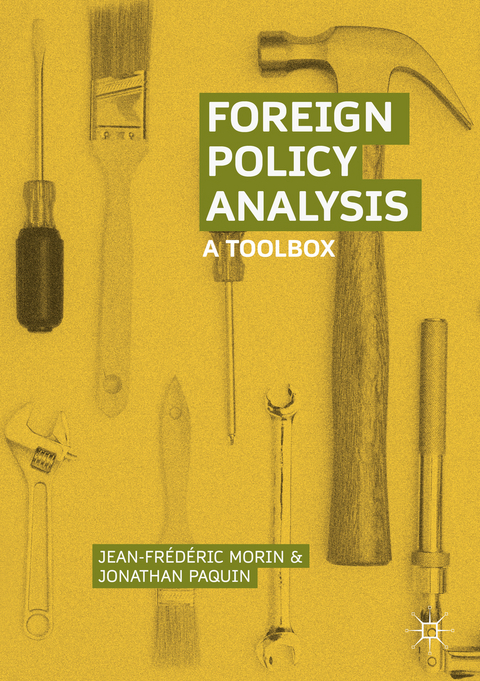
Foreign Policy Analysis (eBook)
XIII, 359 Seiten
Springer International Publishing (Verlag)
978-3-319-61003-0 (ISBN)
Jean-Frédéric Morin is Associate Professor at Laval University, Canada, where he holds the Canada Research Chair in International Political Economy.Jonathan Paquin is Professor of Political Science at Laval University, Canada.
1.What is Foreign Policy Analysis?What is a Policy? When a Policy Becomes ForeignAn Array of Explanations The Levels of Analysis and the Evolution in FPAA Toolbox for Studying FPA 2. How to Identify and Assess a Foreign Policy?The Goals of Foreign Policy--The Goals Communicated --Doctrine--National Interest--Deducing the Goals Pursued Mobilized Resources--Resources--The Power Paradox--Mobilization and ExploitationInstruments of Foreign Policy--Socialization--Coercion--Interventions--Event-Based DatabasesThe Process of Foreign Policy--Segmentation in Six Phases--A Linear, Cyclical or Chaotic ProcessThe Outcome of Foreign Policy--Measuring Effectiveness--Feedback Effects--Historical Institutionalism--Explaining EffectivenessFrom the Puzzle to the Theoretical Explanations--Theoretical Models3. Do Decision-Makers Matter?Emotions--From Psychobiography to Statistics--The Middle Way: Affective Dimensions--Typologies Combining the Affective DimensionsCognition--Cognitive Consistency--Operational Codes--Heuristic Shortcuts--Cognitive Mapping--Cognitive Complexity--Schema TheoryPerceptions--Misperception--Attribution Bias--Probabilities4. What is the Influence of the Bureaucracy?Management Styles--Defining Management Styles--The Most Appropriate Management StyleGroup Dynamics--Groupthink--Defining the PhenomenonThe Organizational Model--Organizational Strategies--The Effects of Standard Operating ProceduresThe Bureaucratic Model--One Game, Several Players--The Interactions between the Players--The Position of the Ministry of Foreign Affairs--The Bureaucratic Model and Its Critics5. To What Extent is Foreign Policy Shaped by Institutions?Parliamentary and Electoral System--Presidential and Parliamentary Regimes--Parliamentarians and their Preferences--Political Cohabitation and CoalitionsThe Strong State and the Weak State--Determining the Relative Power of the State--The Power of the State and Its Foreign PolicyThe Democratic Peace Proposition--Observing the Democratic Peace--Defining the Variables of the Democratic Peace--The Peaceful Nature of Democracies--Explaining the Democratic Peace Through Norms--The Exchange of Information and CredibilityEconomic Liberalism--From Democracy to Free Trade--From Free Trade to Peace and Vice Versa--Critics of the Liberal Peace6. How Influential Are the Social Actors?Public Opinion--The Almond-Lippmann Consensus and Its Critics--The Structure of Public Opinion--The Influence of Public Opinion--Audience CostsThe Influence of Leaders on Public Opinion--The Rally Around the Flag--The Temptation of War as a Rallying LeverThe Media--The Media's Influence--How Leaders Influence the Media?--The CNN EffectThe Interest Groups--How Interest Groups Influence Foreign Policy?--Methodological Pitfalls--Case Studies and GeneralizationsThe Experts--Think Tanks--Epistemic Communities--The Experts' Predictions7. How Does Rationality Apply to FPA and What Are Its Limitations?Rational Choice--From Micro-Economics to Foreign Policy--The Substitutability of Foreign Policies--Rational DeterrenceModelling Rationality--Game Theory--Cybernetic Theory--The Two-Level GameRationality and Cognition--Prospect Theories--Poliheuristic Theory8. What Part Does Culture Play in FPA?Norms--Norm Compliance--Norm DiffusionNational Identities--The Self and the Other--Evolving Identities--Foreign Policy as Identity Affiliation--Social Identity TheoryNational Roles--Role Conception--Roles as Foreign Policy GuidesGender--Women, Femininity and Feminism--The Nation and the State in the Feminist Grammar--Foreign States and NationsOrganizational and Strategic Cultures--The Stability of Organizational Cultures--Interactions between Organizational Cultures--Strategic Culture--Strategic Cultures and PracticesDiscourse--Discourse as a Field of Interaction--The Methods of Discourse Analysis9. Does the International Structure Explain Foreign Policy?Structural Theories--The Structural Shift in International Relations--Limits and CriticismCan Structural Theories Inform Foreign Policy?--Structural Assumptions and State UnitsReconciling Agent and Structure--From Structure to Agent--From Agent to Structure10. What are the Current Challenges to FPA?Challenge 1: Beyond EclecticismChallenge 2: Beyond the American FrameworkChallenge 3: Beyond the State-Centric PrismChallenge 4: Beyond the Ivory Tower
| Erscheint lt. Verlag | 3.1.2018 |
|---|---|
| Verlagsort | Cham |
| Sprache | englisch |
| Themenwelt | Sachbuch/Ratgeber ► Geschichte / Politik ► Politik / Gesellschaft |
| Sozialwissenschaften ► Politik / Verwaltung | |
| Sozialwissenschaften ► Soziologie | |
| Schlagworte | Bureaucratic Politics • Cognitive Mapping • Cybernetics • discursive institutionalism • Foreign policy analysis • Groupthink • IR theory • poliheuristic analysis • Strategic culture • two-level game analysis |
| ISBN-10 | 3-319-61003-1 / 3319610031 |
| ISBN-13 | 978-3-319-61003-0 / 9783319610030 |
| Informationen gemäß Produktsicherheitsverordnung (GPSR) | |
| Haben Sie eine Frage zum Produkt? |
 PDF (Wasserzeichen)
DRM: Digitales Wasserzeichen
Dieses eBook enthält ein digitales Wasserzeichen und ist damit für Sie personalisiert. Bei einer missbräuchlichen Weitergabe des eBooks an Dritte ist eine Rückverfolgung an die Quelle möglich.
Dateiformat: PDF (Portable Document Format)
Mit einem festen Seitenlayout eignet sich die PDF besonders für Fachbücher mit Spalten, Tabellen und Abbildungen. Eine PDF kann auf fast allen Geräten angezeigt werden, ist aber für kleine Displays (Smartphone, eReader) nur eingeschränkt geeignet.
Systemvoraussetzungen:
PC/Mac: Mit einem PC oder Mac können Sie dieses eBook lesen. Sie benötigen dafür einen PDF-Viewer - z.B. den Adobe Reader oder Adobe Digital Editions.
eReader: Dieses eBook kann mit (fast) allen eBook-Readern gelesen werden. Mit dem amazon-Kindle ist es aber nicht kompatibel.
Smartphone/Tablet: Egal ob Apple oder Android, dieses eBook können Sie lesen. Sie benötigen dafür einen PDF-Viewer - z.B. die kostenlose Adobe Digital Editions-App.
Buying eBooks from abroad
For tax law reasons we can sell eBooks just within Germany and Switzerland. Regrettably we cannot fulfill eBook-orders from other countries.
aus dem Bereich